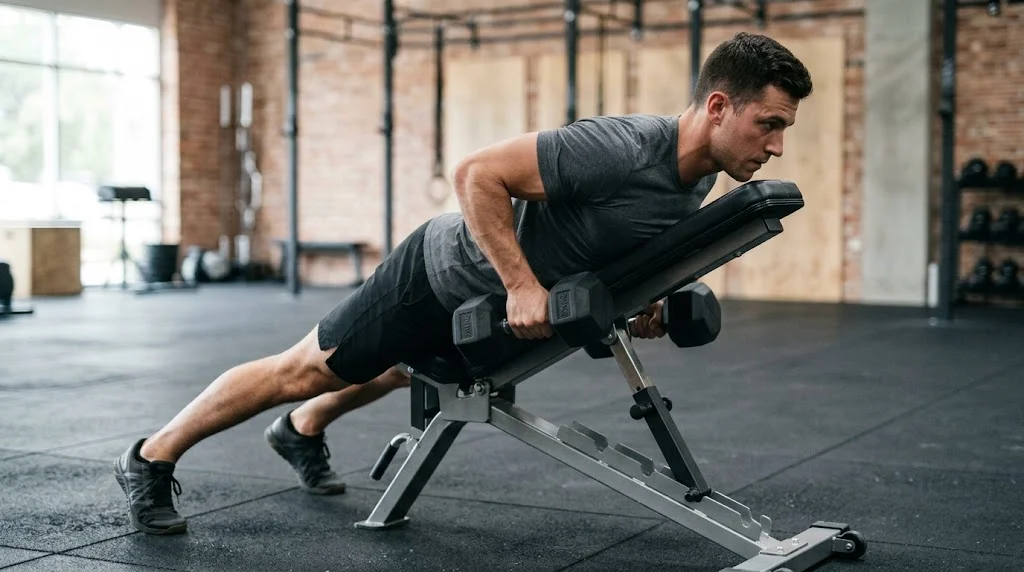
The chest-supported dumbbell row is a horizontal pulling exercise performed lying face-down on an incline bench. By bracing the torso against the pad, it removes lower-back strain and momentum, forcing themid-back musclesto do the work in strict isolation. This makes it one of the best movements for building back thickness and improving posture without taxing the spinal erectors.
What Muscles Does the Chest-Supported Dumbbell Row Work?
- Primary: Latissimus dorsi, rhomboids, middle trapezius
- Secondary: Posterior deltoid, biceps brachii, lower trapezius
- Tertiary: Teres major, brachialis, forearm flexors
How Do You Set Up for the Chest-Supported Dumbbell Row?
Set an adjustableincline benchto roughly a 30-45 degree incline and lie face-down with your chest and stomach supported against the pad, feet planted firmly on the floor or footrests. Hold a dumbbell in each hand with a neutral grip (palms facing each other), letting your arms hang straight down with a slight stretch in the lats. Keep your head in a neutral position and your shoulders relaxed before initiating the pull.
How Do You Perform the Chest-Supported Dumbbell Row?
- Brace your core and keep your chest pinned to the pad so the torso stays completely stable throughout
- Initiate by retracting the shoulder blades, drawing them together before the arms begin to move
- Row the dumbbells up by driving your elbows back and toward your hips in a controlled arc
- Pull until the dumbbells reach your ribcage, achieving a full contraction in the mid-back
- Squeeze the shoulder blades together at the top for a brief pause where the back is fully contracted
- Lower with control back to a full stretch, resisting gravity rather than dropping the weights
- Repeat for the desired reps, keeping the chest glued to the pad the entire set
What Are the Key Form Cues?
- Retract before you pull: Set the shoulder blades back first so the back leads and the arms follow
- Keep the chest pinned: Do not push off the pad with your chest - staying braced is what makes the movement strict
- Drive the elbows back: Think about pulling your elbows toward your hips rather than curling with the hands
- Maintain a neutral neck: Avoid craning your head up; keep it in line with your spine
- Control the stretch: Lower fully and feel the lats lengthen before each rep
What Are the Most Common Mistakes?
- Lifting the chest off the pad: Pushing off reintroduces momentum and defeats the strict purpose of the exercise.
- Using too much weight: Overloading leads to partial reps and shoulder-led heaving instead of back contraction.
- Shrugging the shoulders: Letting the traps dominate by shrugging upward reduces lat and rhomboid engagement.
- Cutting the range short: Failing to reach a full stretch at the bottom limits muscle development.
- Flaring the elbows too wide: Excessive flare shifts load to the rear delts and away from the lats and mid-back.
What Are the Best Chest-Supported Dumbbell Row Variations?
- Chest-supported barbell row: Bilateral version using a barbell for heavier loading
- Chest-supported T-bar row: Machine or landmine variation with a fixed path
- Single-arm chest-supported row: Unilateral version correcting imbalances
- Wide-grip chest-supported row: Wider elbow path emphasizing the upper back and rear delts
- Seal row: Flat-bench variation with the body fully horizontal
How Do You Progress the Chest-Supported Dumbbell Row?
- Increase weight gradually: Add 2.5-5 pounds per dumbbell once you complete all reps with strict form
- Increase reps: Build to 12-15 controlled reps before adding load
- Add a pause: Hold the peak contraction for 1-2 seconds to intensify mid-back recruitment
- Slow the tempo: Lengthen the lowering phase to increase time under tension
How Should You Program the Chest-Supported Dumbbell Row?
Include the chest-supported dumbbell row in your back or pull-day training 1-2 times per week, typically after a primary vertical pull. It works best for 8-12 reps with moderate to heavy weight and a deliberate, controlled tempo. Rest 60-120 seconds between sets. Because it removes lower-back fatigue, it is an ideal accessory for adding back volume on days when the spinal erectors are already taxed by deadlifts or bent-over rows.