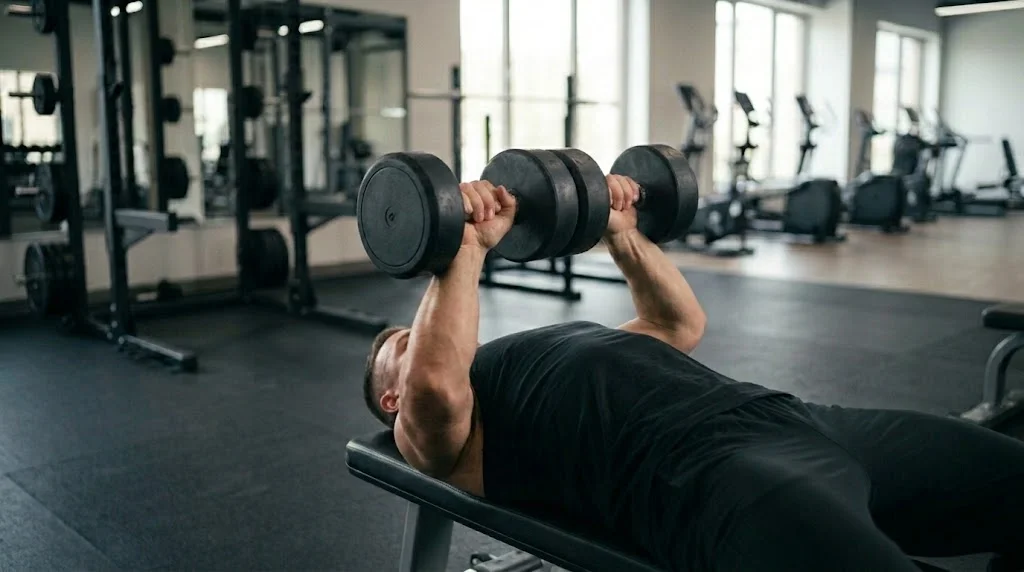
The push-up is a classic bodyweight pressing exercise that trains thechest, shoulders, andtricepswhile also demanding stability from the core and entire body. Performed in a plank-like position, it mirrors the mechanics of a bench press but uses your own bodyweight as resistance. It requires no equipment, making it one of the most accessible and scalable upper-body exercises available.
What Muscles Does the Push-Up Work?
- Primary: Pectoralis major
- Secondary: Anterior deltoid, triceps brachii
- Tertiary: Serratus anterior, core (rectus abdominis, obliques), glutes
How Do You Set Up for the Push-Up?
Begin in a high plank with your hands placed slightly wider than shoulder-width and fingers pointing forward. Set your feet together or hip-width apart, and form a straight line from your head through your hips to your heels. Brace your core, squeeze your glutes, and retract your shoulder blades slightly to create a stable, rigid body position.
How Do You Perform the Push-Up?
- Brace your core and set your body in a straight line from head to heels
- Lower your body under control by bending your elbows, keeping them at roughly a 45-degree angle to your torso
- Descend until your chest is just above the floor, maintaining the rigid plank position
- Press through your palms to push your body back up to the starting position
- Fully extend the arms at the top without letting your hips sag or pike
- Repeat for the desired reps, keeping the body tight and the movement smooth throughout
What Are the Key Form Cues?
- Keep a straight line from head to heels: Brace the core and squeeze the glutes to avoid sagging hips
- Position elbows at 45 degrees: Avoid flaring them straight out to the sides to protect the shoulders
- Move through a full range: Lower until the chest nearly touches the floor for full chest engagement
- Drive through the whole hand: Spread the fingers and push evenly to stabilize the wrists
- Keep the neck neutral: Look slightly ahead of your hands rather than dropping or craning the head
What Are the Most Common Mistakes?
- Sagging or piking the hips: Losing the straight body line reduces tension and stresses the lower back.
- Flaring the elbows wide: A T-shape arm position strains the shoulders - keep elbows moderately tucked.
- Partial range of motion: Not lowering far enough reduces chest activation and progress.
- Letting the head drop forward: This breaks alignment and shifts strain to the neck.
- Holding the breath: Failing to breathe limits core bracing and endurance.
What Are the Best Push-Up Variations?
- Knee push-up: Reduces load for beginners while learning the pattern
- Incline push-up: Hands improved on a surface to make the movement easier
- Decline push-up: Feet improved to increase difficulty and upper-chest emphasis
- Diamond push-up: Hands close together to emphasize the triceps
- Wide push-up: A wider hand placement to bias the chest
How Do You Progress the Push-Up?
- Build reps gradually: Increase total reps and sets as strength improves
- Adjust use: Move from knee to incline to standard to decline to add difficulty
- Slow the tempo: Lower over 3-4 seconds to increase time under tension
- Add a pause: Hold at the bottom to build strength out of the hardest position
How Should You Program the Push-Up?
Push-ups can be trained frequently - 2-4 times per week - because bodyweight loading is generally easy to recover from. Beginners can start with knee or incline variations and progress toward full reps, aiming for sets of 8-15 with good form before increasing difficulty. They work well both as a primary movement for at-home training and as accessory or high-rep finisher work in a gym program.