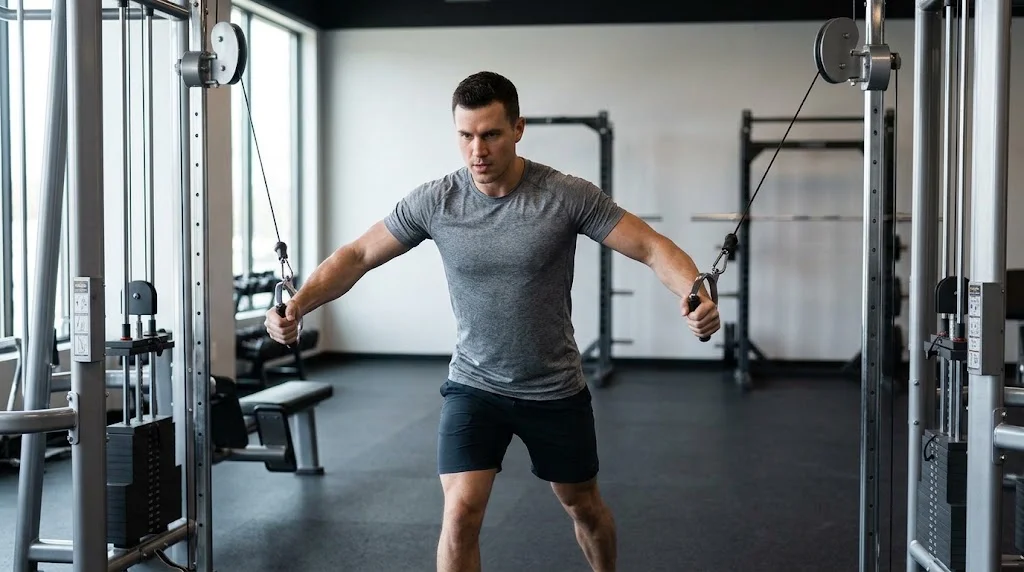
The kneeling cable chest fly on Bosu is a chest isolation movement performed kneeling on a Bosu dome between two cable pulleys, training the pecs under constant tension. Compared with thestanding cable chest fly, kneeling removes the legs from the base, so every pull of the cable tries to rock you sideways or backwards and the abs and hips have to hold the torso still. The dome adds a wobble that forces lighter loads and a slower arc. Program it as a late accessory on a chest day, after your pressing is done.
What Muscles Does the Kneeling Cable Chest Fly on Bosu Work?
- Primary: Pectoralis major (sternal and clavicular heads)
- Secondary: Anterior deltoid (front shoulder), biceps brachii (short head)
- Tertiary: Rectus abdominis, obliques, gluteus medius, serratus anterior
How Do You Set Up for the Kneeling Cable Chest Fly on Bosu?
Set both pulleys to about hip height when you stand, which is shoulder height once you kneel, and clip on single handles. Place the Bosu dome side up in the centre of the station. Kneel on the dome with your knees hip-width apart, shins draped over the back edge, hips stacked over your knees. Grasp one handle at a time, palms forward, and let your arms open until your chest stretches.
How Do You Perform the Kneeling Cable Chest Fly on Bosu?
- Set your elbows at a soft bend and hold them there, hands level with your shoulders and slightly behind your torso line.
- Squeeze your glutes so your hips stop drifting on the dome before the handles move.
- Sweep the handles forward in a wide arc, driving from the upper arm rather than the hand.
- Bring your hands together in front of your sternum until they touch or cross slightly; the pec contraction is your end point.
- Hold the squeeze for one count while the cables pull you backwards and your trunk refuses to move.
- Open your arms slowly along the same arc back to the stretched position, re-centre your knees on the dome, and start the next rep.
What Are the Key Form Cues?
- Hug a tree: picture wrapping your arms around a trunk so the arc stays wide and the elbows never collapse inward as the handles meet.
- Knees glued to the dome: press your shins and knees into the rubber through the whole rep so the base cannot roll.
- Ribs stay down as the arms open; the stretch belongs in your chest, not your lower back.
- Wrists stay in line with your forearms at the midline, no curling the handles toward you.
- Return only as far as the stretch, never past the point where your shoulder rolls forward.
What Are the Most Common Mistakes?
- Loading the stack like a standing fly: the weight drags the handles back faster than your trunk can hold, so the rep turns into a rock and a swing; use a load you can pause at the midline.
- Kneeling too far forward on the dome: your shins lift and every rep wobbles; shift back until your shins rest on the rubber.
- Letting the elbows straighten: a locked arm shifts the strain from the pec onto the biceps tendon at the front of the shoulder; keep the bend fixed.
- Leaning into the cables: a forward torso turns the fly into a press and hides the trunk work the Bosu is there for; stay upright.
- Shrugging as the handles meet: the upper traps take over at the midline; pull your shoulder blades down before you squeeze.
What Are the Best Kneeling Cable Chest Fly on Bosu Variations?
- Kneeling cable chest fly on the floor: same pulley height without the dome, for learning the arc first.
- Kneeling cable chest fly on Bosu with a pause: three-second midline holds that make the trunk work the main challenge.
- Kneeling low-to-high cable fly on Bosu: pulleys set low so the arc rises toward the upper chest.
- Single-arm kneeling cable fly on Bosu: one handle at a time, so the obliques fight rotation every rep.
- Kneeling resistance band chest fly on Bosu: bands anchored at shoulder height for a home setup.
How Do You Progress the Kneeling Cable Chest Fly on Bosu?
- Add one plate on each stack once every set ends with your knees still on the dome and a full midline pause.
- Work from 12 reps up to 15 per set before the next weight jump.
- Add a fourth set when three no longer leave the chest fatigued.
- Slow the opening phase to a four-count and hold the stretch for a beat before sweeping forward.
How Should You Program the Kneeling Cable Chest Fly on Bosu?
Place the kneeling cable chest fly on Bosu at the end of a chest or upper-body session, after flat and incline pressing, once or twice a week. Work 3 to 4 sets of 12 to 15 reps with 45 to 75 seconds of rest, keeping the load light enough that the midline pause never disappears. It pairs well with a heavy dumbbell press earlier and a plank finisher after it.