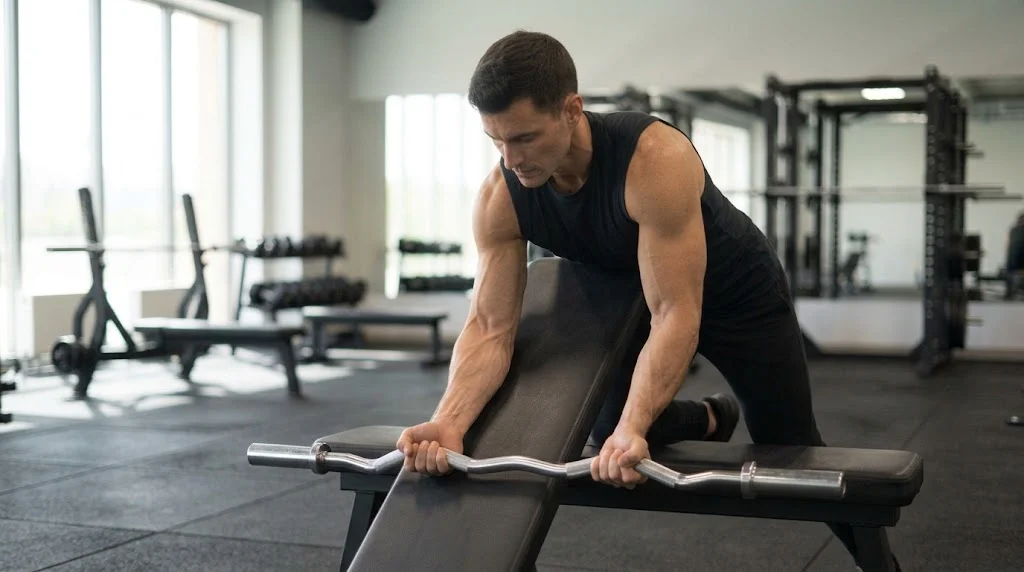
The lying biceps curl low with resistance bands is an isolation curl performed on your back with a band anchored under your feet, curling the handles toward the shoulders against rising band tension. Lying flat turns the floor into a preacher pad: the upper arms cannot drift forward and the torso cannot lean back, so thebicepswork without the shoulder swing that creeps into standing curls. Because the band starts at the feet, resistance climbs as the elbow closes and peaks where the biceps are shortest. Lifters program it as a late arm accessory at home.
What Muscles Does the Lying Biceps Curl Low with Resistance Bands Work?
- Primary: Biceps brachii (long and short head)
- Secondary: Brachialis, brachioradialis
- Tertiary: Forearm flexors, anterior deltoid holding the upper arm on the floor
How Do You Set Up for the Lying Biceps Curl Low with Resistance Bands?
Lie on your back on the floor with your legs straight and loop the middle of the band under the arches of both feet. Hold a handle or a loop end in each hand with palms facing up. Rest your upper arms flat on the floor beside your ribs, elbows straight, so the band runs taut along your legs. Tuck your chin, press your lower back down and take up the slack before rep one.
How Do You Perform the Lying Biceps Curl Low with Resistance Bands?
- Pin your upper arms to the floor and point your toes slightly so the band cannot slip off the feet.
- Curl the handles toward your shoulders by bending the elbows, keeping the palms up and the wrists straight.
- Stop when the forearms are vertical or the handles reach the front of the shoulders; the band is at its tightest here.
- Squeeze the biceps for one count without lifting the elbows off the floor.
- Lower the handles under control over a two or three count, straightening the elbows against the band's pull.
- Finish with straight arms on the floor, band still taut, then start the next rep from the same position.
What Are the Key Form Cues?
- Elbows glued to the floor: if they lift, the shoulder joins the curl; press the back of the arm down through the whole rep.
- Curl the little fingers toward the ceiling: a slight outward turn of the wrist at the top loads the short head harder.
- Keep the feet still; a foot sliding forward slackens the band mid-rep.
- Feel the band pull hardest at the top, and hold that inch before lowering.
- Let the elbows straighten fully on the way down; the band still holds tension there.
What Are the Most Common Mistakes?
- Choosing a band so heavy that the hips lift: bridging to finish the rep shortens the band and steals the top of the curl, so drop to a lighter band or grip the band lower.
- Lifting the elbows off the floor: the front delt takes over and the biceps unload, so keep the upper arms down.
- Letting the wrists curl back toward the forearms: the forearm flexors take the load, so keep the wrists flat in line with the forearm.
- Bending the knees: knee flexion slackens the band and removes tension at the bottom, so keep the legs straight.
- Rushing the lowering phase: a band snaps the arms straight if you let it, so control the descent for at least two counts.
What Are the Best Lying Biceps Curl Low with Resistance Bands Variations?
- Lying biceps curl with a lighter band: less stretch per inch, the easier version for learning the pattern.
- Lying biceps curl with the band doubled: doubling the loop increases the pull at every angle.
- Lying hammer curl with the band: palms facing in shifts the work to the brachialis.
- One arm biceps side curl with resistance band: a single-arm band curl that lets each arm work alone.
- Lying cable curl: the same supine curl on a low pulley for a steady load instead of a rising one.
How Do You Progress the Lying Biceps Curl Low with Resistance Bands?
- Move up one band thickness once you finish every set at the top of the rep range with your elbows still on the floor.
- Build from 12 to 20 reps per set before changing bands.
- Add a set at a time up to 4 sets, or a second arm session per week.
- Pause two counts at the top and lower for a three count to make a lighter band work harder.
How Should You Program the Lying Biceps Curl Low with Resistance Bands?
Place the lying biceps curl low with resistance bands at the end of an upper-body or arm session, after your rows and any heavier curls. Train it 2 to 3 times per week for 3 to 4 sets of 12 to 20 reps, resting 45 to 60 seconds between sets. Pair it with a band triceps extension so both sides of the arm finish the session together.