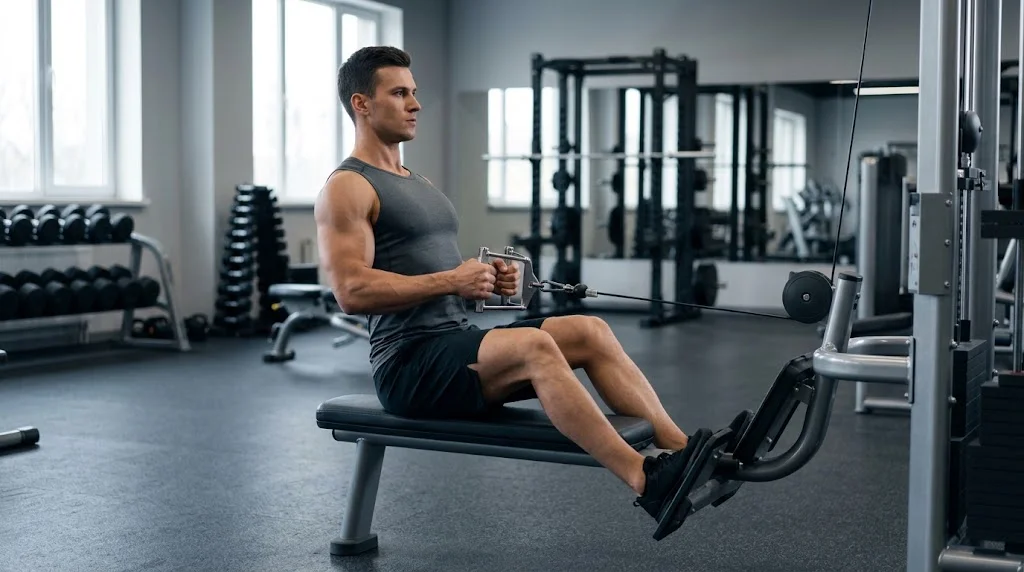
The pull to stand rope climb is a scaled rope climb performed from a seated start, pulling hand over hand until you stand and lowering back to the floor to train the lats and grip. Your feet stay on the ground the whole time, so you choose how much bodyweight the arms carry by how far you sit back. That makes it the first rope drill worth doing: it teaches the hand over hand rhythm and the foot placement without ever leaving the floor. Coaches use it to scale rope climbs for anyone who cannot yet hang.
What Muscles Does the Pull to Stand Rope Climb Work?
- Primary: Latissimus dorsi (lats), teres major
- Secondary: Biceps brachii, posterior deltoid, gluteus maximus
- Tertiary: Forearm flexors (grip), rectus abdominis, quadriceps
How Do You Set Up for the Pull to Stand Rope Climb?
Sit on the floor facing a rope anchored overhead, close enough that the low end of the rope is within reach of your extended arms. Set your feet flat about hip-width apart with the heels planted and the knees bent. Take the rope with one hand above the other, palms facing in. Lean back until your arms are straight and the rope is tight, with your shoulders pulled down and your abs braced.
How Do You Perform the Pull to Stand Rope Climb?
- Lean back into straight arms with the heels planted and the rope taut across your torso line.
- Pull with the lower hand and drive that elbow down past your ribs to bring your chest toward the rope.
- Move the free hand above the other and grip before the pulling arm loses any of the height won.
- Keep pulling hand over hand until your hips are over your feet and you are standing tall.
- Reverse the ladder by lowering hand under hand, letting the hips travel back and down under control.
- Sit back to the floor with the arms straight and the rope tight, ready to pull again.
What Are the Key Form Cues?
- Drive the elbow past the ribs: a low, close pulling elbow moves you further up the rope than a high bent arm.
- Push the heels into the floor: the legs support what the arms cannot, and how hard you push sets the load.
- Keep the rope on the centreline of your chest so you do not twist off to one side.
- Close the reaching hand fully before the other lets go of any tension.
- Lead the stand with the hips, not the chin.
What Are the Most Common Mistakes?
- Sitting so far back that the arms cannot start the pull: the rep becomes a leg press with a rope, so sit closer until the arms lead.
- Standing up with the legs and letting the hands ride along: nothing is trained, so keep the arms pulling the whole way.
- Dropping back to the floor instead of lowering: the descent is half of the work, so control every hand switch on the way down.
- Reaching with an open hand mid-pull: the finger flexors and elbow tendons take a jolt when the load lands, so grip before you pull.
- Pulling with a rounded back and the ribs collapsed: the lumbar spine flexes as the arms load, so keep the chest tall and the abs braced.
What Are the Best Pull to Stand Rope Climb Variations?
- Standing rope pull: begin standing and only lean back, the easiest entry point.
- Seated rope pull with the legs straight: heels out in front raise the share of weight on the arms.
- Single-arm pull to stand: alternate one working hand to expose the weaker side.
- Rope climb with a leg wrap: leave the floor once the pull to stand is easy, the true progression.
- Ring row: rings replace the rope for the same horizontal pull without the grip demand.
How Do You Progress the Pull to Stand Rope Climb?
- Sit further from the anchor a few inches at a time so the arms take more bodyweight.
- Build from 5 pull to stand reps per set to 10 before moving your seat back.
- Add sets from 3 to 5 per session as the grip holds up.
- Slow the descent to a three count per hand switch, then pause halfway down.
How Should You Program the Pull to Stand Rope Climb?
Place the pull to stand rope climb early in a pulling session, after a light row and before heavierbackwork, two or three times a week. Work 3 to 5 sets of 5 to 10 reps with 60 to 90 seconds of rest, ending the set once the hands stop closing fully. Pair it with hanging work such as bar hangs so the grip catches up with the pull.