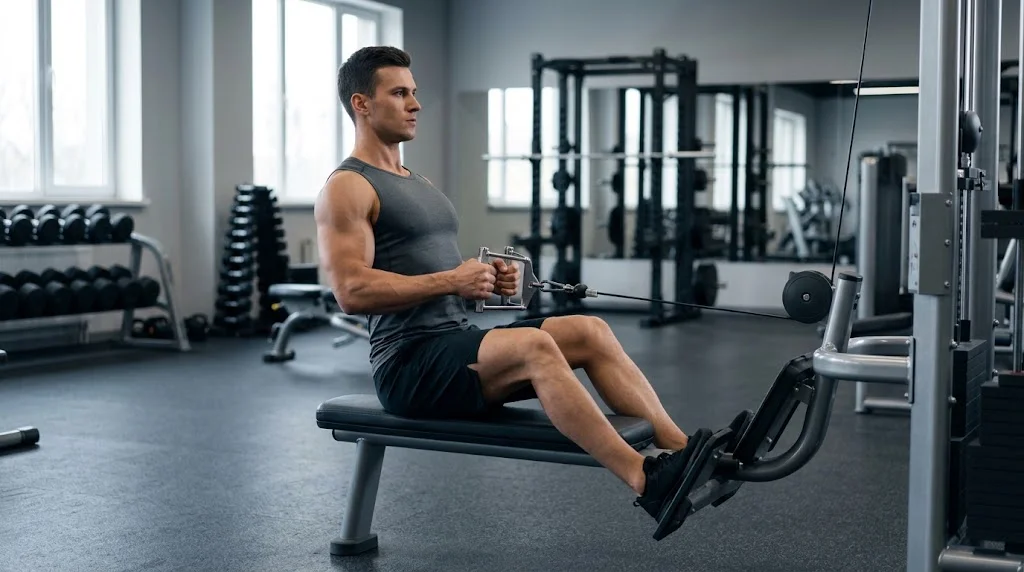
The seated cable crossover lat pulldown is a vertical pull performed seated between two high pulleys with the cables crossed overhead, pulling both handles down to the sides. Because each hand holds the far pulley, the line of pull runs down and across, so the lats work through adduction as well as extension and each arm can travel its own path. A fixed bar cannot do that. Seating fixes the hips so the load cannot be swung. Program it as abackaccessory.
What Muscles Does the Seated Cable Crossover Lat Pulldown Work?
- Primary: Latissimus dorsi
- Secondary: Teres major, lower trapezius, rhomboids, biceps brachii
- Tertiary: Posterior deltoid, pectoralis major (sternal fibres), forearm flexors (grip)
How Do You Set Up for the Seated Cable Crossover Lat Pulldown?
Set both pulleys above head height and clip a D-handle to each. Place a bench or seat midway between the stacks and sit facing forward, feet flat, hips back against the pad if there is one. Reach up and across to take the left handle in your right hand and the right handle in your left, so the cables cross above your head. Sit tall with the plates lifted.
How Do You Perform the Seated Cable Crossover Lat Pulldown?
- Sit tall with both arms extended overhead, cables crossed and the shoulders reaching up.
- Pull the shoulder blades down and start the handles moving before the elbows bend.
- Drive both elbows down and out along the crossed cable lines until the hands pass your shoulders.
- Finish with the hands beside your ribs, elbows behind the torso and the chest lifted.
- Let the handles travel back up slowly along the same crossed paths until the arms are long.
- Reach up fully at the top, plates hovering, torso vertical, before the next rep.
What Are the Key Form Cues?
- Blades first, elbows second: depress the shoulder blades to start each rep so the lats take the load before the arms.
- Follow the cable, not the floor: pull each handle down and slightly outward along its own crossed line.
- Keep the chest tall and the ribs stacked; if the torso leans back, the cable is winning.
- Squeeze both armpits closed at the bottom, thinking of the elbows meeting behind your back.
- Let both shoulders rise fully overhead at the top so the lats reach full length.
What Are the Most Common Mistakes?
- Setting the stacks heavier than the seat can hold: the torso rocks back to start each rep, so cut the load until you stay vertical.
- Bending the elbows before the shoulder blades move: the biceps take the first third of the pull and the lats get the leftovers.
- Pulling the handles straight down: the crossed line is the reason for the setup, so let the hands finish wide beside the ribs.
- Sitting too far from one stack: the cables load unevenly and the near arm cuts its range, so line your seat up midway.
- Letting the arms fold back up fast: the overhead stretch is where the lat lengthens, so return on a three-count.
What Are the Best Seated Cable Crossover Lat Pulldown Variations?
- Seated lat pulldown with a bar: one fixed handle makes the path simpler and the loading heavier.
- Kneeling cable pulldown with rope: kneeling removes the seat, so the trunk holds position.
- Single-arm crossover pulldown: one cable at a time lets the weaker lat set the load.
- Neutral grip crossover pulldown: turning the palms in drops the elbows tighter to the ribs.
- Straight-arm crossover pulldown: locking the elbows takes the biceps out entirely.
How Do You Progress the Seated Cable Crossover Lat Pulldown?
- Add one plate per side once both arms finish beside the ribs on every rep.
- Work 8 to 12 reps here, adding a rep per session before you change pins.
- Build from 3 sets to 4 when the last set still reaches full overhead stretch.
- Pause one second at the bottom, or lower on a three-count to load the stretch.
How Should You Program the Seated Cable Crossover Lat Pulldown?
Use the seated cable crossover lat pulldown as your main vertical pull on a back day, or as the second pull after chin-ups. Two sessions a week works. Perform 3 to 4 sets of 8 to 12 reps with 60 to 90 seconds of rest. Because the crossed line adds adduction, pair it with a horizontal row rather than another pulldown so the mid-back gets its own work.