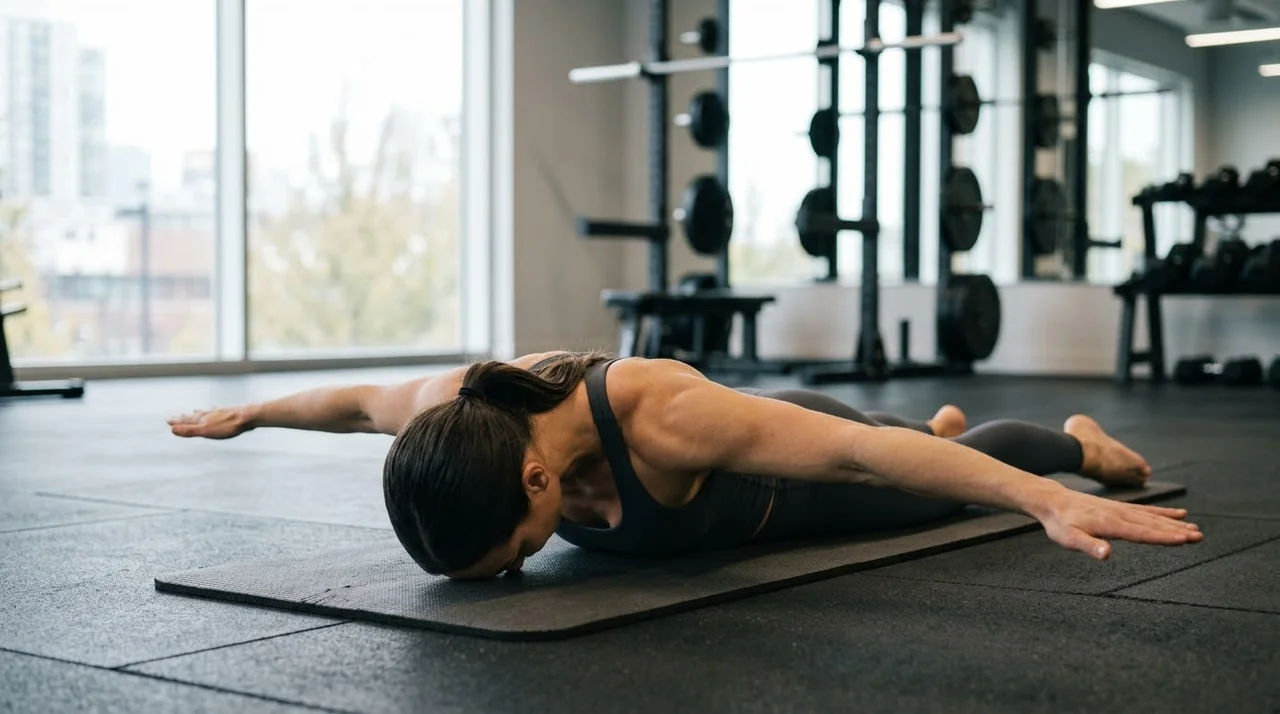
The reverse snow angel is a bodyweight shoulder mobility drill performed face down on the floor, sweeping straight arms from overhead to the hips to train the upper back and rear delts. Where theprone Y raise holdkeeps the arms at one angle, this drill takes the shoulder through its whole arc while the arms stay off the floor, so the rear delts and scapular muscles work at every position along the way. Lying face down blocks any cheat from the legs or a swing. Coaches use it in shoulder warm-ups and as late upper back accessory work.
What Muscles Does the Reverse Snow Angel Work?
- Primary: Posterior deltoid, lower and middle trapezius
- Secondary: Rhomboids, infraspinatus, teres minor
- Tertiary: Erector spinae, gluteus maximus, latissimus dorsi
How Do You Set Up for the Reverse Snow Angel?
Lie face down on a mat with your legs straight and together, toes pointed and forehead resting lightly on the floor. Squeeze your glutes so the pelvis presses flat and the lower back stays long. Reach both arms straight overhead, palms down and thumbs turned up. Pull your shoulder blades down toward your back pockets, then lift both hands a few inches clear of the floor.
How Do You Perform the Reverse Snow Angel?
- Lift the arms clear of the floor overhead, elbows locked and thumbs pointing at the ceiling.
- Sweep both arms out to the sides in a wide arc, keeping the same height above the floor throughout.
- Continue the arc down to your hips until the hands arrive beside your thighs, palms facing in.
- Squeeze the shoulder blades together for a one-second hold with the hands still off the floor.
- Reverse the sweep slowly back out to the sides and overhead on the same path.
- Finish with the arms overhead and still lifted, ready for the next rep without resting the hands down.
What Are the Key Form Cues?
- Keep the hands at one height: the arms travel in a flat arc, so the hands never dip to the floor at the halfway point.
- Thumbs up on the way out: external rotation keeps the rear delt loaded rather than the front of the shoulder.
- Keep the forehead in contact with the mat so the neck does not lead the movement.
- Press the hip bones into the floor and hold the glutes tight the whole set.
- Move slowly enough that you can feel the mid-back, not the arms, dragging the sweep.
What Are the Most Common Mistakes?
- Rushing the sweep: momentum carries the arms past the positions that are hard, so slow the arc to about three seconds each way.
- Letting the hands touch down near the hips: the shoulder unloads at the end of the range where the lower traps work most, so keep an inch of air under the palms.
- Lifting the chest and arching the lower back: hyperextending the lumbar spine to raise the arms shifts the effort to the erectors, so keep the ribs on the mat.
- Bending the elbows as the arms come down: a bent arm shortens the lever and hides a mobility limit, so hold the elbows straight and reduce the range instead.
- Craning the head up to watch the hands: the neck extends under load and the upper traps take over, so keep the forehead down.
What Are the Best Reverse Snow Angel Variations?
- Partial reverse snow angel: sweep only from overhead to shoulder height, a regression for tight shoulders.
- Reverse snow angel with a pause: hold three seconds at the hips each rep for more time under tension.
- Bench reverse snow angel: lying on a flat bench lets the hands travel below body level for extra range.
- Single-arm reverse snow angel: one arm sweeps while the other stays overhead, exposing side differences.
- Plate reverse snow angel: a light plate in each hand adds resistance across the whole arc.
How Do You Progress the Reverse Snow Angel?
- Stay bodyweight until 15 clean reps, then hold a 2.5 to 5 pound plate in each hand.
- Build from 8 reps per set to 15 with the hands never touching down.
- Add a set at a time up to four, or a second shoulder day per week.
- Slow each sweep to a three-second count out and three back before adding weight.
How Should You Program the Reverse Snow Angel?
Use the reverse snow angel in a shoulder or upper body warm-up, or as accessory work at the end of a pull session after your rows. Train it two to three times per week for 2 to 3 sets of 8 to 15 reps with 45 to 60 seconds of rest. Pair it with a face pull or a prone Y raise hold so the rear delts get both moving and static work.