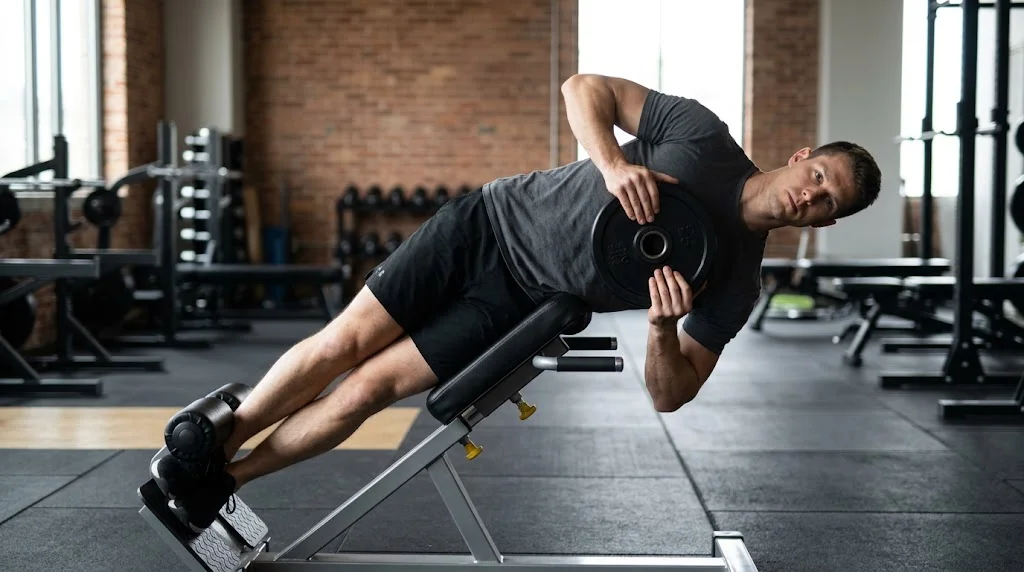
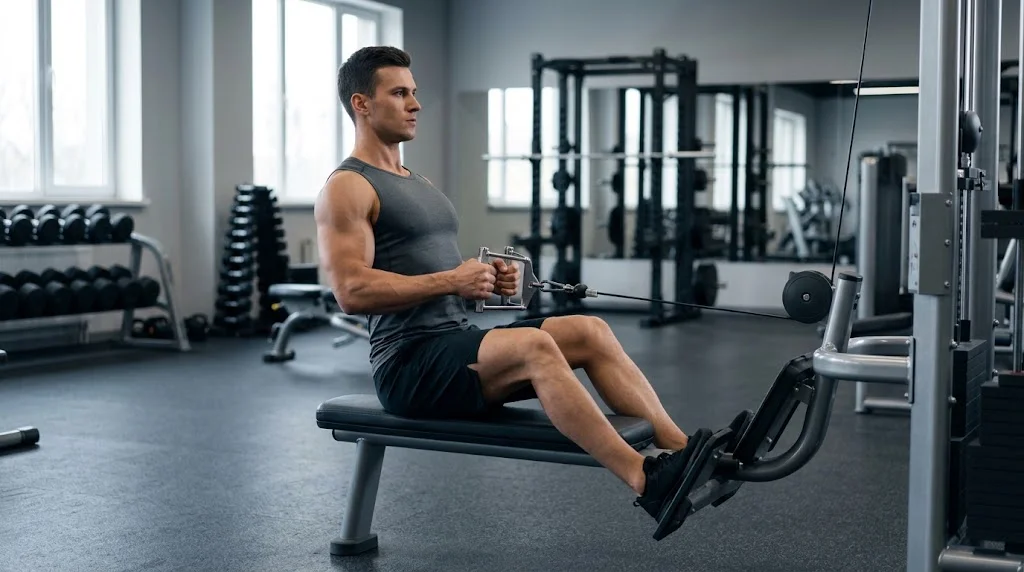
The plate row is a bent-over pulling exercise performed holding a single weightplateby its edges with both hands, drawing it to the ribs to train the mid back. Because a plate is wide and flat, your hands sit further apart than on a barbell and the load hangs a hand's width forward of a bar path, so the rhomboids and rear delts take more of the pull and the lats less. The pinch grip on the rim also caps the weight. Use it as a mid-session back accessory.
What Muscles Does the Plate Row Work?
- Primary: rhomboids, middle trapezius, latissimus dorsi
- Secondary: posterior deltoid, biceps brachii, brachioradialis
- Tertiary: erector spinae, hamstrings, forearm flexors
How Do You Set Up for the Plate Row?
Stand with your feet hip width apart and take a plate by the rim with both hands, thumbs on top and fingers underneath, hands about shoulder width on the edges. Soften your knees, push your hips back, and hinge until your torso is around forty five degrees to the floor with a flat back. Let the plate hang below your chest, pull your shoulder blades down, and squeeze the rim hard.
How Do You Perform the Plate Row?
- Set the hinge at forty five degrees with the plate hanging under your chest and the back flat.
- Pull your shoulder blades together first, before the elbows bend at all.
- Row the plate to your lower ribs, keeping the elbows tracking close to your sides.
- Squeeze the mid back for a count with the plate touching or nearly touching your torso.
- Lower the plate under control until the arms hang straight and the blades spread again.
- Reset the hinge and the grip at the bottom without standing up between reps.
What Are the Key Form Cues?
- Pinch the rim, do not hook it: a hard grip on the edges keeps the plate level and stops it tipping mid-rep.
- Lead with the blades, not the hands: start each rep by drawing the shoulder blades toward your spine so the mid back fires first.
- Keep the plate close to your body, since its width already pulls the load forward.
- Hold the torso angle still for the whole set, so the hips never help the row.
- Feel the stretch across the upper back at the bottom before you pull again.
What Are the Most Common Mistakes?
- Loading a plate heavier than your pinch grip: the fingers slip, the plate tips, and the rep turns into a heave, so size the weight to the grip.
- Standing up as you row: the torso rises to meet the plate and the hips do the work, so lock the hinge angle and keep it.
- Rounding the low back in the hinge: the lumbar spine flexes with the plate hanging away from your hips, so hinge less and keep the chest wedged.
- Flaring the elbows wide: the pull becomes a shoulder-height row and the rear delts take it alone, so keep the elbows near the ribs.
- Cutting the bottom short: stopping with the arms half bent skips the stretch, so let the plate hang fully each rep.
What Are the Best Plate Row Variations?
- Plate row with a shrug grip: hold the plate at the top edge only, shortening the range for lighter work.
- Chest-supported plate row: lie on an incline bench so the low back is out of it.
- Single-arm plate row: one hand on the rim, so the torso resists rotation.
- Underhand plate row: palms up under the plate, shifting more work to the lower lats.
- Barbell row: the same hinge and pull with a bar, for loading beyond what a grip on a rim allows.
How Do You Progress the Plate Row?
- Move up one plate size, usually 10 pounds, once every set finishes at the same torso angle.
- Build from 8 up to 15 reps per set before you change plates.
- Add a set, to 4, before adding weight again.
- Hold the squeeze for two counts, or take three counts to lower, when the next plate is too big a jump.
How Should You Program the Plate Row?
Program it in the middle of a pulling or upper body session, after chin-ups or a heavy barbell row rather than before them. Twice a week suits it. Do 3 to 4 sets of 8 to 15 reps with 60 to 90 seconds of rest, keeping the hinge for the whole set. Pair it with a straight-arm pulldown so thebackgets both a bent-elbow and a straight-arm pull.