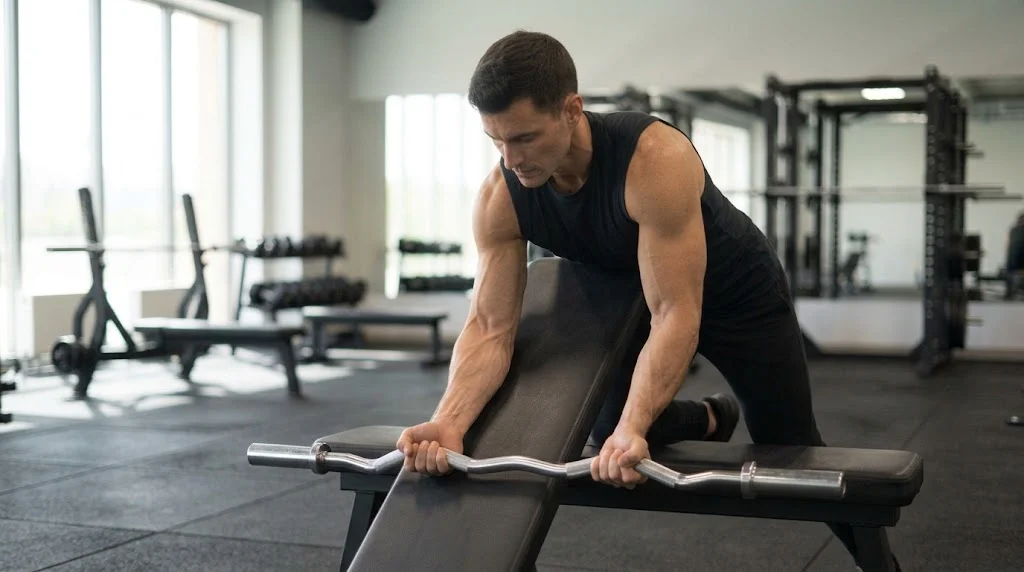
The seated cable curl is a biceps isolation exercise performed on a bench facing a low pulley, curling a bar or handle with the torso fixed and tension on at the bottom. Sitting takes the cheat away: you cannot rock the hips or lean back to start the rep, so the elbow does the work. A dumbbell hangs slack at the bottom, while the wire keeps pulling along its line, so the stretched position stays loaded and the biceps get no rest. Lifters use it as a late arm accessory.
What Muscles Does the Seated Cable Curl Work?
- Primary: Biceps brachii
- Secondary: Brachialis, brachioradialis
- Tertiary: Forearm flexors, anterior deltoid, upper trapezius
How Do You Set Up for the Seated Cable Curl?
Set the pulley at the lowest setting and clip on a straight bar or an E-Z bar. Place a bench a couple of feet from the tower, facing it, and sit with the feet flat. Take the bar underhand at shoulder width, then set the upper arms against your sides with the elbows just in front of the ribs. Sit tall, brace the abs and let the arms straighten until the cable goes tight.
How Do You Perform the Seated Cable Curl?
- Pin the elbows to your sides with the arms straight and the cable already loaded.
- Curl the bar up by bending only the elbows, keeping the upper arms still.
- Bring the bar to chest height where the forearms pass vertical and the biceps are fully shortened.
- Squeeze for a count at the top with the wrists straight and the shoulders down.
- Lower for three counts until the arms are straight and you feel the pull at the bottom.
- Hold the straight-arm position for a beat against the cable, then start the next rep.
What Are the Key Form Cues?
- Feel the bottom, not the top: the stretched position is where the cable earns its place, so pause a beat with the arms straight every rep.
- Keep the elbows in front of the ribs: fix them there and the shoulders cannot help by swinging the upper arm.
- Sit tall against the pull rather than letting the torso drift toward the tower.
- Keep the wrists flat in line with the forearms through the whole curl.
- Keep the shoulders pulled down so the traps stay out of the rep.
What Are the Most Common Mistakes?
- Setting the pin too heavy: the torso leans back to start each rep, so drop the load until you can curl sitting tall.
- Letting the elbows drift back or up: once the upper arm moves, the front delt takes over and the biceps range shortens.
- Dropping the bar back down: the eccentric is where the cable holds tension, so lower it under control.
- Curling the wrists: bending the wrist at the top loads the forearm flexors and irritates the tendons at the elbow, so keep them flat.
- Stopping short of straight arms: cutting the bottom removes the stretched position that the seated cable setup exists to load.
What Are the Best Seated Cable Curl Variations?
- Standing cable curl: the same pulley on your feet, easier to load but easier to cheat.
- Seated cable curl with a rope: the neutral grip brings the brachialis in and eases the wrists.
- Cable Single Arm Biceps Hammer Curl: one arm at a time on a low pulley, with the free hand steadying you.
- Seated incline cable curl: sitting on an incline bench puts the arms behind the torso for a deeper stretch.
- Seated dumbbell curl: dumbbells replace the cable, so the load drops away at the bottom.
How Do You Progress the Seated Cable Curl?
- Add one plate on the stack once you complete every set at 15 reps sitting tall.
- Work from 10 reps up to 15 at a setting before moving the pin.
- Add a set at a time to a ceiling of 4 across the week.
- Lower for four counts, or hold the straight-arm position for two, when the next plate is too big a jump.
How Should You Program the Seated Cable Curl?
Curl it late in the session, after rows, pulldowns or pressing, as a finisher for thebiceps. Train it 2 to 3 times per week for 3 to 4 sets of 10 to 15 reps, resting 45 to 60 seconds between sets. Pair it with a triceps pushdown on the same pulley so both sides of the arm get constant tension in one block.