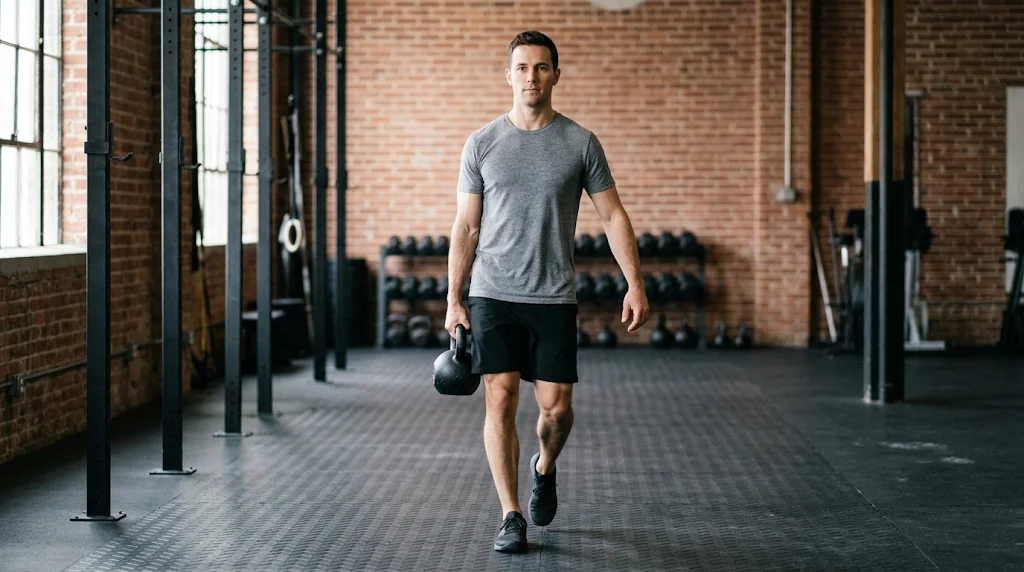
The kettlebell suitcase carry is a loaded walk with onekettlebellheld in one hand, arm hanging straight at your side like a suitcase. Also called the suitcase walk, one-arm carry or single-arm farmer's carry, it differs from the bilateral farmer's walk because the load sits on one side only, so the obliques and deep trunk stabilisers must stop you bending toward the bell. That makes it a plank you perform while walking, with grip work on top. Lifters program it as a core accessory or finisher, timed per side.
What Muscles Does the Kettlebell Suitcase Carry Work?
- Primary: Obliques (opposite side), quadratus lumborum, rectus abdominis
- Secondary: Forearm flexors (grip), gluteus medius (side glute)
- Tertiary: Lower trapezius, transverse abdominis, calves
How Do You Set Up for the Kettlebell Suitcase Carry?
Stand tall beside the kettlebell with your feet hip width apart and the handle next to the outside of one foot. Hinge at the hips with a flat back, grip the handle and stand up so the bell hangs at arm's length beside your thigh. Pull the loaded shoulder blade down so both shoulders sit level, set the ribs down, and let the free arm relax or hold it slightly out for balance.
How Do You Perform the Kettlebell Suitcase Carry?
- Brace your trunk as if someone were about to poke you in the side, ribs stacked over the pelvis.
- Step off with normal, controlled strides, keeping the bell still beside your thigh.
- Keep the torso vertical and both shoulders at the same height for every step of the set.
- Walk for the prescribed time, breathing behind the brace rather than holding the air.
- Stop and set the bell down with a hip hinge and a flat back, not by bending sideways.
- Switch hands and repeat for the same time on the other side, then rest.
What Are the Key Form Cues?
- Grow tall on the loaded side: think of pushing the top of your head up so the side holding the bell stays long.
- Pocket the shoulder blade: keep the loaded shoulder pulled down toward the opposite back pocket for the whole walk.
- Feel the obliques on the free side working to hold you upright; that is where the effort should sit.
- Keep the ribs down over the belt so the lower back stays neutral as you step.
- Squeeze the handle hard enough that the bell hangs dead still against your thigh.
What Are the Most Common Mistakes?
- Leaning toward the kettlebell: the obliques stop resisting and the spine side-bends under load, so drop to a bell you can carry perfectly upright.
- Overcorrecting away from the bell: leaning the other way turns the carry into a static side bend, so aim for a plumb-line torso, not a tilt.
- Shrugging the loaded shoulder: the upper trap and neck take the weight, so keep that shoulder blade pulled down and level with the other.
- Letting the bell swing or bang the leg: momentum replaces the brace and rushes the steps, so slow down and grip harder.
- Flaring the ribs and arching the lower back: the lumbar spine takes the load the trunk should hold, so keep the ribs stacked over the pelvis.
What Are the Best Kettlebell Suitcase Carry Variations?
- Dumbbell suitcase carry: a dumbbell replaces the kettlebell with the same pattern.
- Suitcase march in place: high-knee steps in place, the regression for learning the brace.
- Offset farmer's walk: a heavier bell in one hand and a lighter one in the other, easing the one-sided demand.
- Single arm kettlebell front rack carry: the bell moves to the shoulder, shifting the demand toward the upper back and anti-rotation.
- Bottoms-up suitcase carry: the bell held upside down at the side, adding a grip and wrist control challenge.
How Do You Progress the Kettlebell Suitcase Carry?
- Move up one kettlebell size, 4 kg, once every set holds a vertical torso for the full time.
- Add 10 seconds per side, from 30 up to 60 seconds, before each jump in load.
- Add a round per week, from 2 up to 4 per side.
- Slow your steps down so each foot spends longer on one leg under the load.
How Should You Program the Kettlebell Suitcase Carry?
Place the suitcase carry at the end of a lower-body or full-body session, after the main lifts have finished with the trunk, two to three times a week. Work 3 to 4 rounds of 30 to 40 seconds per side, starting around 16 kg, with 45 to 60 seconds of rest after both sides. Pair it with an anti-extension drill such as the dead bug for complete core work.
Frequently Asked Questions
What is the difference between a suitcase carry and a farmer's walk?
Thefarmer's walkloads both hands, so it mostly trains grip and traps. The suitcase carry loads one side only, which forces the trunk to resist bending sideways, so it is primarily a core exercise.
Should you use a kettlebell or a dumbbell?
Either works. A kettlebell handle sits closer to the line of your body and is easier to hold still, while a dumbbell is the same drill when that is what the gym has.
How do you know the weight is right?
You can hold a perfectly vertical torso with level shoulders for the full duration on both sides. If you start leaning toward the bell or shrugging, the load is too heavy.