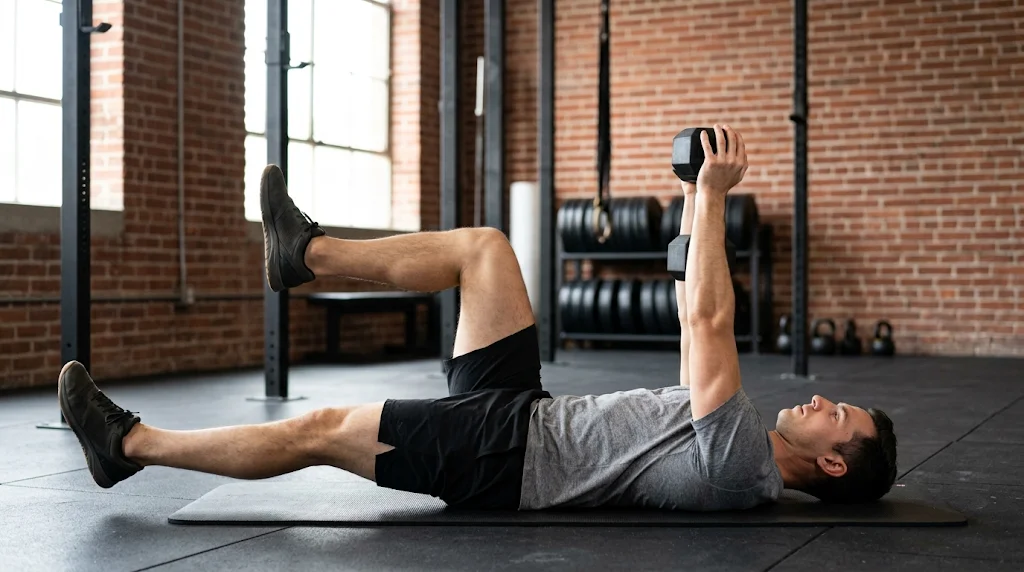
The weighted dead bug is a floor anti-extension drill performed on your back with onedumbbellheld in both hands, arms straight above the chest and still for the whole set. Unlike the classic dead bug, where the opposite arm and leg move together, only the legs move here: each one reaches out low over the floor in turn from a tabletop position. The fixed, loaded arms lock the upper body, so the deep abs must work harder to keep the lower back pressed into the floor. It fits as a warm-up primer or a core accessory.
What Muscles Does the Weighted Dead Bug Work?
- Primary: Rectus abdominis, transverse abdominis
- Secondary: Internal and external obliques
- Tertiary: Hip flexors, serratus anterior, anterior deltoids
How Do You Set Up for the Weighted Dead Bug?
Lie on your back on a mat and hold one dumbbell, 5 to 10 kg, upright in a goblet grip, both palms cupping the top end. Press the arms straight up so the dumbbell hangs vertically above your chest. Lift your legs into tabletop with hips and knees bent to 90 degrees, shins parallel to the floor. Flatten your lower back into the mat with no gap, and rest your head on the floor.
How Do You Perform the Weighted Dead Bug?
- Lock the dumbbell above your chest with straight arms and the lower back flat on the mat.
- Exhale and extend one leg forward slowly, over about two seconds, while the other leg stays in tabletop.
- Stop with the heel just above the floor, or sooner if the lower back starts to lift, since that point is your range.
- Hold for a brief pause at full reach with the dumbbell still and the lower back pressed down.
- Return the leg to tabletop over about two seconds without letting the other leg move.
- Switch sides and repeat, counting one rep for each leg extension until both sides reach the target.
What Are the Key Form Cues?
- Glue your lower back down: feel the mat under your lower back for the whole reach and return.
- Dumbbell stays over the chest: treat the weight as fixed in space so only the legs change position.
- Breathe out slowly as the leg reaches, so the ribs stay down at the longest point of the lever.
- Reach through the heel of the moving leg as if sliding it along a line just above the floor.
- Keep the neck and jaw loose with the back of the head resting on the mat.
What Are the Most Common Mistakes?
- Reaching too far or too heavy: the lower back arches off the floor and the lumbar spine takes the load, so shorten the reach or drop the dumbbell.
- Letting the dumbbell drift toward the face or behind the head: the lever changes and the lats pull the ribs up, so keep it stacked over the chest.
- Holding the breath: the ribs flare and the brace stiffens instead of holding, so exhale on every reach.
- Rushing the reps: momentum swings the leg out and back, so hold the two-second tempo in both directions.
- Resting the extended leg on the floor: tension leaves the abs at the hardest point, so keep the heel hovering.
What Are the Best Weighted Dead Bug Variations?
- Bodyweight dead bug, legs only: the dumbbell is removed and the reach shortened, the regression for learning the flat back.
- Straight-leg weighted dead bug: the moving leg stays straight, lengthening the lever for a harder version.
- Classic dead bug: opposite arm and leg lower together, adding a coordination and anti-rotation demand.
- Kettlebell weighted dead bug: a kettlebell held by the horns replaces the dumbbell with the same pattern.
- Weighted dead bug with a pause: a three-second hold at full reach on every rep, raising the time under tension.
How Do You Progress the Weighted Dead Bug?
- Move up one dumbbell increment, about 2 kg, once all sets stay flat at full reach.
- Work from 8 reps per side up to 12 before each jump in load.
- Add a set per week, from 2 up to 4.
- Straighten the moving leg or slow the tempo to three seconds each way.
How Should You Program the Weighted Dead Bug?
Use the weighted dead bug as a warm-up primer before squats or deadlifts, or late in a session as a core accessory, two to four times a week. Work 2 to 3 sets of 8 to 12 reps per side with 30 to 45 seconds of rest. Pair it with an anti-lateral-flexion drill such as the kettlebell suitcase carry to cover both directions of trunk stability.
Frequently Asked Questions
Why do only the legs move?
Keeping the arms fixed with a load raises the demand on trunk stiffness and makes the drill easier to perform strictly. It is a deliberate variant of the classic dead bug, not a shortcut.
What should you do if your lower back lifts?
Shorten the leg reach until you can keep full contact with the floor, then lengthen it gradually over the following sessions.
Is the weighted dead bug hard on the neck?
Spinal and neck load are low because the head stays relaxed on the mat, which makes it a good choice when neck tension limits crunch-type exercises.