TL;DR: No study I could find puts dumbbells and kettlebells head to head, so "which builds strength faster" has no measured answer. The trials that exist show a light kettlebell raising squat strength and jump height about as well as jump squats, and losing to heavier barbell lifting. What does differ is the ladder. At Rogue, none of the 8 kettlebell steps between 8 and 32 kg falls inside ACSM's 2 to 10 percent window, against 7 of 13 for hex dumbbells. Buy dumbbells first. Add one 12 to 16 kg bell second.
What Does "Faster" Even Mean Here?
Faster at what? A bigger squat, a higher jump, more muscle, a harder conditioning session? Each of those has a different best tool, and the internet answer to "dumbbell vs kettlebell" usually skips that question.
A note on how this was made. I haven't trained anyone with either one and I'm not going to pretend otherwise. I searched for trials, opened the ones I could read, opened Rogue's kettlebell and dumbbell pages on October 23, 2026, and ran the numbers in a short script. Where a figure comes from a summary of a paper rather than the paper itself, I say so. Anything called "model" is arithmetic from published formulas, not a measurement of a person.
The first finding is a gap. Across several searches I found no randomized trial that assigns people to dumbbells or kettlebells with matched load and volume. That isn't proof none exists, and I'd welcome a link. But the claim you see everywhere, that one of them builds full-body strength faster, has nothing measured behind it that I could open.
What the Trials Actually Compare
Here are the five studies I used, and what each one can and can't tell you.
| Study | What was compared | Result | The catch |
|---|---|---|---|
| Lake and Lauder, 2012 | Kettlebell swings against jump squats, 6 weeks, twice a week | Half squat 1RM up 9.8 percent, jump height up 19.8 percent, no significant difference between groups | Young men only; one summary lists 24 participants, the abstract record says 21 |
| Otto and colleagues, 2012 (viaIDEA's summary) | One 16 kg bell (swings, goblet squats) against pulls, cleans and back squats, 6 weeks | Back squat up 4 percent with the bell, 14 with lifting; power clean 4.2 against 9 | The lifting group used heavier loads, which the authors flag |
| Pakoz and colleagues, 2026 | Two-hand kettlebell swing against two-hand dumbbell swing, shoulder EMG | Largely comparable activation | 20 young men, cross-sectional, activation not strength |
| ACE study, University of Wisconsin-La Crosse | 20 minutes of snatches, 15 seconds on and 15 off | 13.6 kcal a minute measured, about 20.2 with a lactate add-on | 10 experienced users, no comparison group |
| BMC trial, 2024 | 12 weeks of kettlebell training against bodyweight training, obese young men | Both groups improved on body fat and VO2max against no training | Compared with bodyweight, not dumbbells; the paper contradicts itself on which group lost more fat |
Look at the right-hand column. Every study answers a neighboring question. That's the honest state of the evidence, and it's why a headline winner would be invented.
Strength: A Light Bell Does Something, Heavy Iron Does More
Lake and Lauder's result is the one kettlebell fans quote, and it holds up on its own terms. A single 12 or 16 kg bell, chosen by body mass, swung for 12 rounds of 30 seconds on and 30 off, lifted half-squat strength as well as loaded jump squats did. It's a fair demonstration that a swing is a real hip-hinge workout.
Then comes Otto's trial, and the picture sharpens. Thirty men with a year of lifting behind them either swung and goblet-squatted a 16 kg bell or did pulls, cleans and back squats with matched volume. Back squat rose 4 percent in the bell group and 14 percent in the lifting group. The authors point out that the lifting group trained with heavier loads, and I'd stress it too: that is a comparison of load as much as of tool.
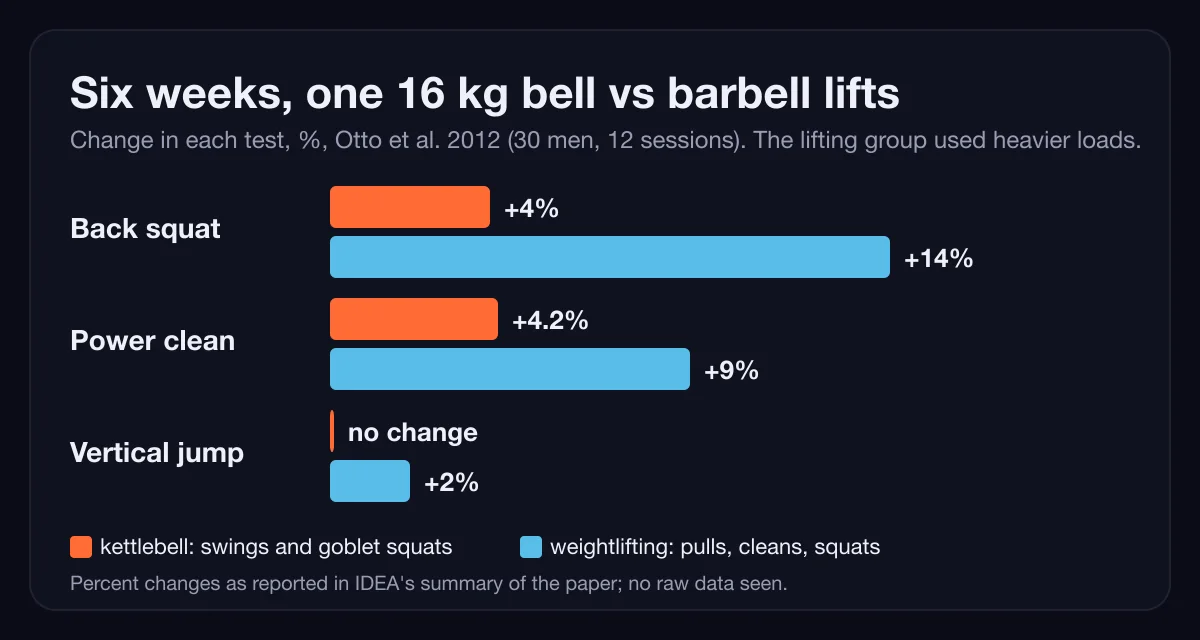 Original chart: percent change in each test, Otto and colleagues 2012, as reported in IDEA's summary.
That takes us to the part the trials don't measure, and the part I'd actually decide on.
The Ladder Matters More Than the Shape
Ourprogressive overload guidecovers ACSM's rule of thumb: raise the load 2 to 10 percent once you beat your target reps on two sessions in a row. A 10 percent step on a 16 kg bell is 1.6 kg. What does Rogue sell?
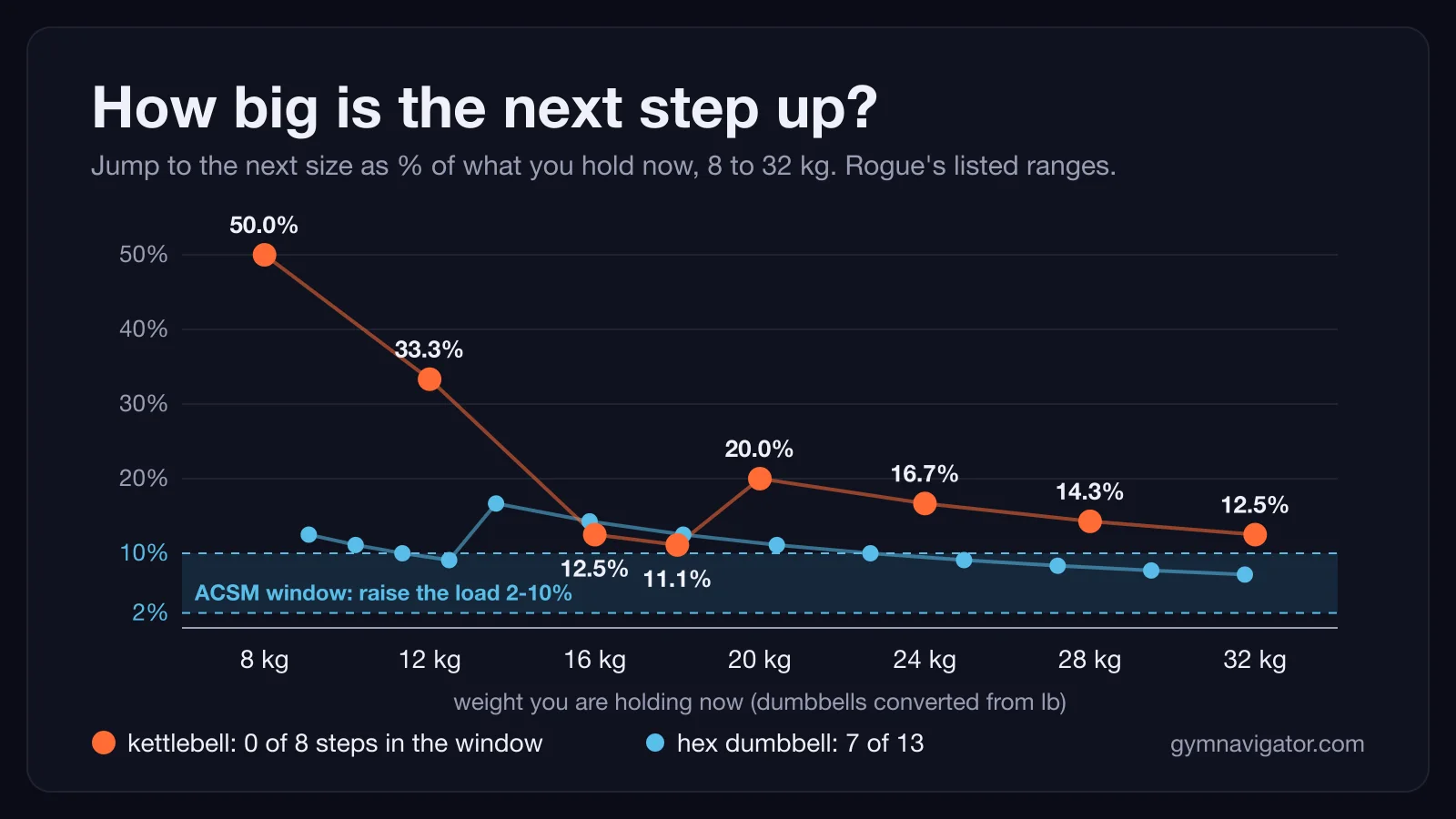 Original chart: the jump to the next size, as a percentage of the weight in your hand. Rogue's listed ranges, read October 23, 2026.
Between 8 and 32 kg, Rogue lists kettlebells at 8, 12, 16, 18, 20, 24, 28 and 32 kg. The next step from each of those eight is 50, 33.3, 12.5, 11.1, 20, 16.7, 14.3 and 12.5 percent. None is 10 percent or less. The median is 15.5.
Rogue's rubber hex dumbbells go up by 2.5 lb to 30 lb and by 5 lb above that. Between 8 and 32 kg that's 13 steps, and 7 of them sit at 10 percent or less. The median is 10.0. Same window, same retailer, different ladder.
How much does a coarse step cost you in reps? I used two published one-rep-max formulas, Epley and Brzycki, to model a lifter who just hit 12 clean reps and then moves up.
| Jump after 12 reps | Size of step | Reps to failure at the new weight (model) |
|---|---|---|
| Kettlebell 12 to 16 kg | 33.3% | 1.5 to 3.7 |
| Kettlebell 24 to 32 kg | 33.3% | 1.5 to 3.7 |
| Kettlebell 16 to 18 kg | 12.5% | 7.3 to 8.9 |
| Dumbbell 30 to 35 lb | 16.7% | 6.0 to 7.8 |
| Dumbbell 50 to 55 lb | 10.0% | 8.2 to 9.5 |
The formulas were built for estimating a maximum and they drift past about 10 reps, so read each row as a band. The pattern is still clear. A 33 percent step turns a set of 12 into a set of two to four, which is a different exercise.
A kettlebell isn't a better dumbbell. It's a dumbbell with a coarser ladder and one movement worth learning.
That's my opinion, and you can argue with it. Swing fans will say the swing needs speed, not a fine ladder, and they have a point: you can overload a swing by adding reps or snap rather than kilos. But the same coarse ladder applies to the presses and squats most people also do with a bell.
Calories: What the 20-a-Minute Figure Hides
If you've read that kettlebells burn "20 calories a minute," it came from the ACE study in the table. Ten experienced users did 20 minutes of snatches, 15 seconds on and 15 off. The measured aerobic cost was 272 calories, or 13.6 a minute. The extra 6.6 a minute was added from blood lactate, and ACE's write-up doesn't explain how that was converted.
It says nothing about dumbbells, because dumbbells weren't in it. A separate matched-effort study of swings against treadmill running, summarized by IDEA, found the treadmill used more oxygen and burned more calories. Nobody should buy either tool for the calorie figure.
What Does It Cost?
I read Rogue's two pages on October 23, 2026. Its 16 kg kettlebell was $80, or $5.00 per kg. The 35 lb hex dumbbell is sold only in a $135 pair, so one is $67.50, or $4.25 per kg.
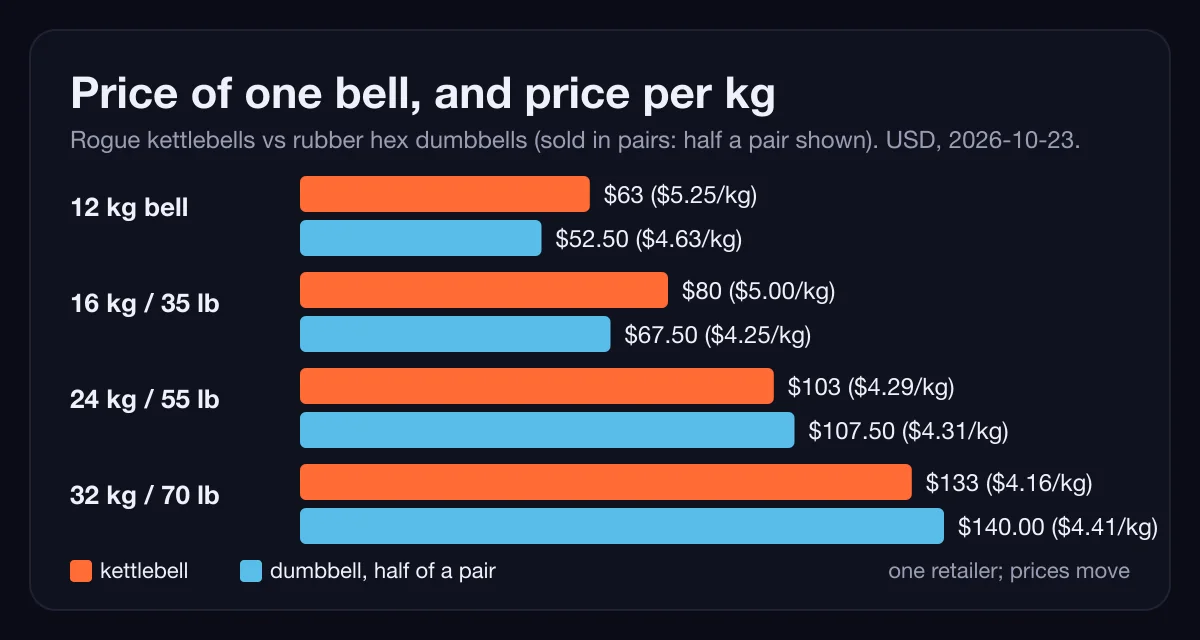 Original chart: Rogue's list prices for one bell, October 23, 2026. Dumbbells shown as half of a pair.
Below 24 kg the dumbbell is cheaper per kilogram. At 24 kg it's a tie, $4.29 against $4.31. At 32 kg the kettlebell is ahead, $4.16 against $4.41. One retailer, shipping not included, prices move.
Storage is a separate bill, and ourdumbbell and kettlebell storage guideputs numbers on it.
Is the Swing Safe for Your Back?
Ask a clinician if you've had back pain. That's the sensible sentence, and there's a reason for it. IDEA's summary of McGill and Marshall's 2012 biomechanics study, which had seven men swing a 16 kg bell, notes a large shear-to-compression ratio on the lumbar spine during swings. That doesn't make the swing dangerous. It makes the hip hinge the skill to learn first.
My view: learn the hinge with a goblet squat or a dumbbell deadlift at a light weight before you add speed. It's cheap insurance.
Which Should You Buy First?
Buy dumbbells first. Two reasons come straight from the numbers above: the ladder is finer, so the progression rules in ourbeginner full-body programwork as written, and the price per kilogram is lower up to about 24 kg. The third is a judgment call. A pair covers presses, rows and split squats that a single bell handles awkwardly.
Then add one 12 to 16 kg kettlebell. Both training trials used bells in that range, and it gives you the swing, the goblet squat and the carry. If space is the problem, a set of adjustable dumbbells may beat both; ouradjustable dumbbell comparisoncovers that.
Choose a kettlebell first only if the swing is why you're buying. Otherwise start with the ladder.