TL;DR: There are four workable ways to add weight. Linear adds a fixed jump every session and stalls early. Double progression adds reps first and lasts longer. Reps in reserve (RIR) adds load by feel, and percentage plans add it by formula. ACSM's rule of thumb sits under all four: raise the load 2 to 10 percent once you beat your target by one or two reps on two sessions in a row.
What Does Progressive Overload Actually Mean?
The American College of Sports Medicine defines progressive overload as the gradual increase of stress placed upon the body during exercise training. That's it. No trick.
The ACSM position stand onprogression models in resistance traininglists five ways to apply it. You can raise the load, add repetitions at the current load, change the tempo, change the rest periods, or add total volume gradually, and it gives 2.5 to 5 percent as an example of "gradually". This guide deals with the first two, because they're the ones a gym log can actually record, plus the rules for deciding when to use them.
A note on how this was made. I'm not a coach and I haven't run any of these methods on anyone. I read the full text of the ACSM position stand, opened the trials and the programs' own rules pages, and ran the numbers in a small script. Anything labeled "model" below is arithmetic from published formulas, not a measurement of a person. If you have a medical condition or an injury, ask a clinician before you change your training.
Method 1: Linear Progression
The rule is the shortest one in strength training. Finish every set of every rep, and next session the bar gets heavier by a fixed amount.
StrongLifts is the best-known version, and itssupport page on progressionstates the rules plainly (I checked it on October 23, 2026). The default increment is 5 lb per workout, which is 2.27 kg and in practice 2.5 kg on a metric plate set. If you miss reps, the same weight repeats. After three failed sessions in a row on an exercise, the weight drops by 10 percent.
Now the arithmetic. Start a lifter at 40 kg, add 2.5 kg every session, train three times a week, and the bar reads 70 kg after 4 weeks, 100 kg after 8 and 130 kg after 12. After a year it reads 430 kg.
That last number is absurd, and the absurdity is the point. Nobody keeps this up. A linear rule doesn't predict progress. It simply keeps adding until the first failure and then hands you the 10 percent deload as its only answer. From 100 kg that's 90 kg, and at 2.5 kg a session it takes four sessions to climb back.
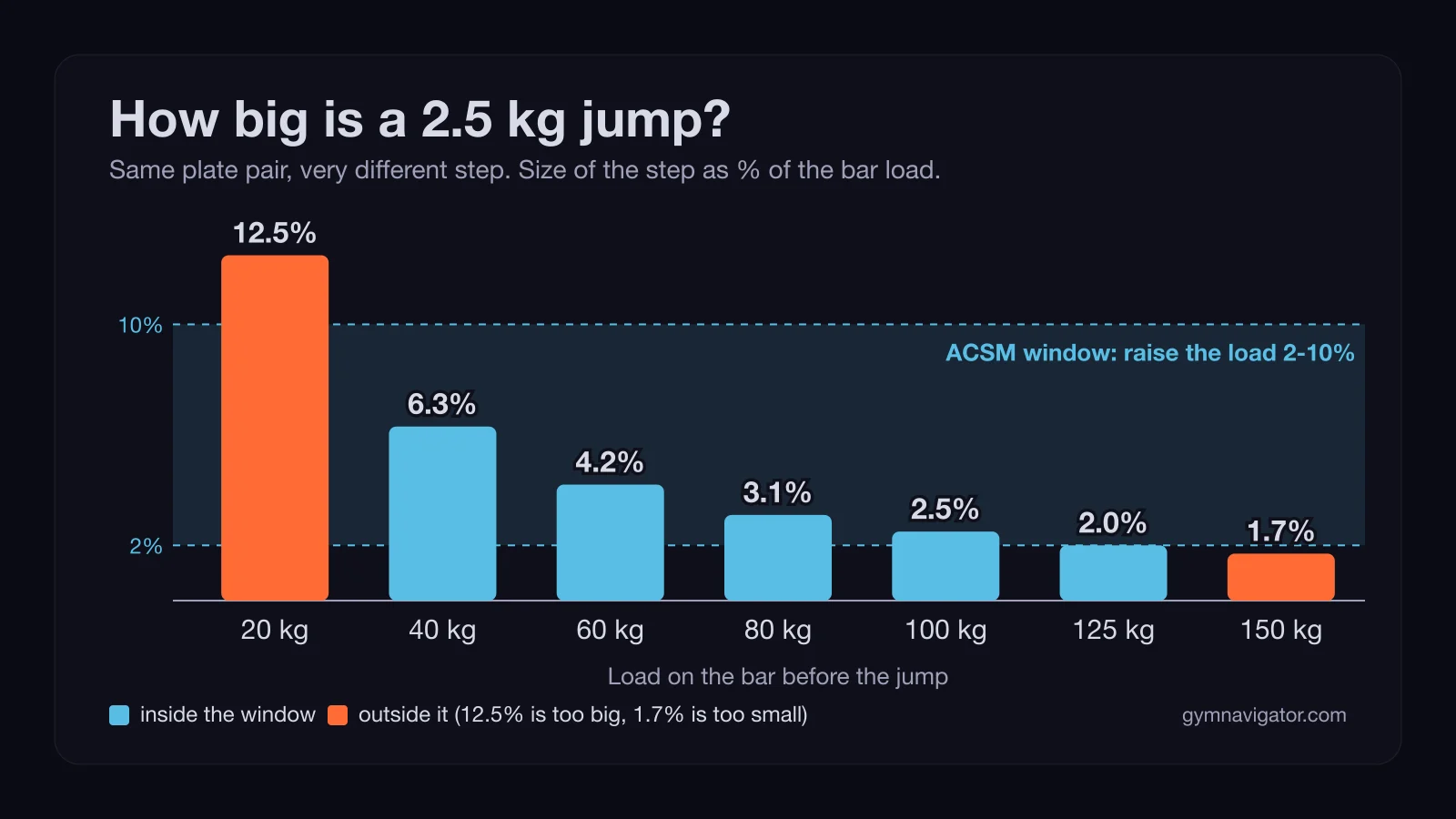 Original chart: a fixed 2.5 kg jump, computed against the ACSM 2-10 percent window.
The chart above is where linear progression gets interesting. A fixed 2.5 kg is not a fixed step. On a 20 kg bar it's 12.5 percent. At 40 kg it's 6.3 percent, at 100 kg 2.5 percent, and at 150 kg 1.7 percent.
ACSM's window is 2 to 10 percent, with the low end meant for small muscle groups and the high end for big ones. A 2.5 kg jump sits inside that window for bar loads between 25 kg and 125 kg. Below that it's too big. Above it, it's too small to be a reliable stimulus on its own.
Two cautions. The ACSM rule is triggered after two sessions of beating your target, while linear adds weight after every session, so I'm comparing only the size of the step, not the timing. And the window is a recommendation, not a law of physics.
Here's the opinion in this article that some trainers will argue with.
Most stalled beginners don't have a program problem. They have a jump-size problem.
I'd defend it with the chart. A lifter who is stuck at 20 kg on a dumbbell press and is told to "add 2.5 kg" is being told to add 12.5 percent. Is it surprising that the reps collapse?
Method 2: Double Progression
Double progression changes what you're allowed to add. You pick a rep range, say 8 to 12, and you hold the weight steady while the reps climb. When every set reaches the top of the range, the weight goes up and the reps fall back near the bottom.
Cori Lefkowith describes it ina Redefining Strength guidefrom March 2025: add weight when you hit the top of the range for a set number of sets, then aim to land back near the bottom with the heavier load. The same page suggests using a weight between your old and new loads if you miss the bottom of the range after a jump.
My own reading, and it's an interpretation rather than something the ACSM calls by this name, is that the ACSM progression rule is double progression with a formal trigger. Its recommendation, graded evidence category B, is a 2 to 10 percent load increase once you can do one to two repetitions more than your target on two consecutive sessions. Reps first, then weight. For novices the same document recommends loads in the 8 to 12 repetition-maximum range, and for novice to intermediate lifters it recommends 60 to 70 percent of 1RM for 8 to 12 repetitions.
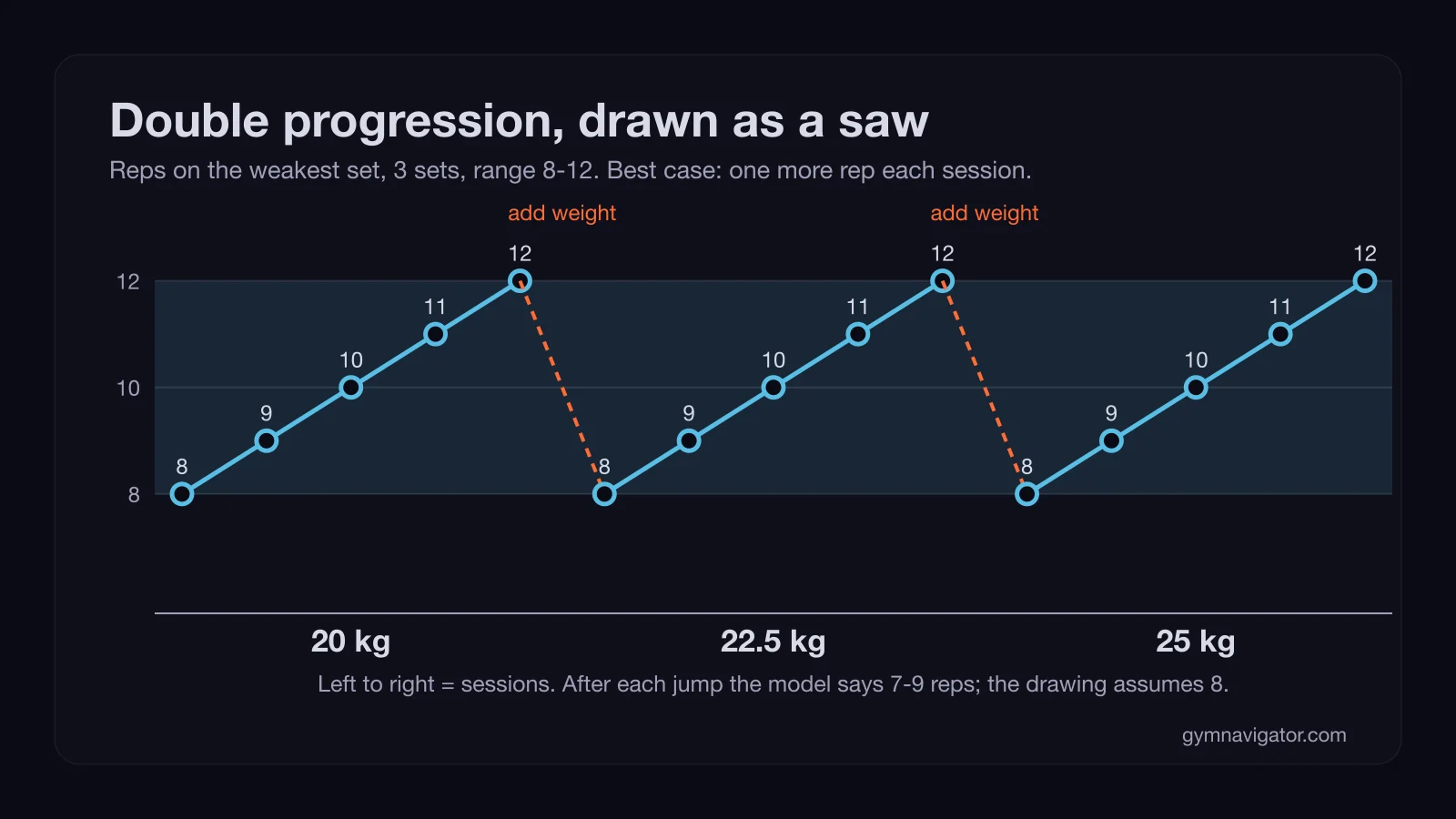 Original chart: the saw-tooth pattern of double progression, best case.
How far do the reps fall after a jump? I modeled it with two published one-rep-max formulas. Epley estimates a 1RM as weight x (1 + reps / 30), and Brzycki as weight x 36 / (37 - reps). I took a lifter who just hit 12 reps and asked each formula how many reps the next weight would allow.
| Jump after hitting 12 reps | Size of jump | Reps to failure at the new weight (model) |
|---|---|---|
| 20 kg to 21 kg | 5.0% | 10.0 to 10.8 |
| 20 kg to 22.5 kg | 12.5% | 7.3 to 8.9 |
| 20 kg to 25 kg | 25.0% | 3.6 to 5.8 |
| 40 kg to 42.5 kg | 6.3% | 9.5 to 10.4 |
| 40 kg to 45 kg | 12.5% | 7.3 to 8.9 |
| 60 kg to 62.5 kg | 4.2% | 10.3 to 11.0 |
| 60 kg to 65 kg | 8.3% | 8.8 to 9.9 |
Read the middle rows. A 12.5 percent jump drops you to about 7 to 9 reps to failure, which is the bottom of an 8 to 12 range. That's the design logic: the range is wide enough to absorb a normal dumbbell step. Take the 25 percent jump and the model says 4 to 6 reps, which is a different exercise.
These are model numbers, so treat them as bands. The formulas are built for estimating a maximum, and aWikipedia summary of 1RM predictionnotes that they diverge after about 10 repetitions. I'm using them backward and past that point, so the two columns are a range, not a forecast.
How long does a climb take? With three sets of 8 to 12 you're moving from 24 total reps to 36. If you add one rep to every set each session, that's 4 sessions. If you add one rep in total per session, it's 12. At two sessions a week that's between 2 and 6 weeks per jump, and at three a week between about 1.3 and 4. Linear's 2.5 kg every session looks generous next to that. Double progression's best case is 2.5 kg every fourth session.
So why bother? Because it lasts. And because the thing you're logging is a rep, which you can always add, rather than a plate, which you sometimes can't.
Method 3: Reps in Reserve
The third method adds load by effort rather than by a fixed rule. You pick a target for how many reps you should have left, and you nudge the weight until the set matches it.
Reps in reserve (RIR) is that count. The source isHelms, Cronin, Storey and Zourdos (2016)in the Strength and Conditioning Journal, which lays out an RIR-based rating of perceived exertion scale: RPE 10 means no reps left, RPE 9 means one, RPE 8 means two. (The review's own introduction lists the numbers one step off from its later text, which is a good reminder to say "reps in reserve" and skip the RPE labels.)
The rule works like this. Prescribe 3 sets of 8 at 2 RIR. Use the weight where the eighth rep of the first set leaves you two clean reps. Next week, if that weight now leaves three in the tank, add load. If it leaves one, hold it.
Can a beginner really tell two reps left from four? That's the right worry, and I'll get to it. First, here's what one rep of reserve is worth in percentages. Take a set of 5 and apply the same two formulas.
| Set of 5 ended at | Reps to failure | Share of 1RM, Epley | Share of 1RM, Brzycki |
|---|---|---|---|
| 0 RIR | 5 | 85.7% | 88.9% |
| 1 RIR | 6 | 83.3% | 86.1% |
| 2 RIR | 7 | 81.1% | 83.3% |
| 3 RIR | 8 | 78.9% | 80.6% |
Each extra rep in reserve is worth roughly 2 to 3 percentage points of your maximum. This is model arithmetic, and the Helms review calls its own RIR-to-percentage table a conceptual guide because individual variation is large.
There are two honest limits. First, the review reports that lifters judge RIR best when a set is near failure, and that experienced lifters judge it better than novices. If you've lifted for three weeks, your "2 reps left" is a guess with wide error bars. The authors advise novices to practice the scale alongside normal training before relying on it. Second, there's one small trial.Helms and colleagues (2018)compared RPE-based loading with percentage-based loading for 8 weeks in resistance-trained men, squatting and benching three times a week. Both groups got stronger and bigger. The between-group differences weren't statistically significant, although the authors' magnitude-based analysis leaned toward a small strength edge for the RPE group.
Method 4: Percentage-Based Plans
The fourth method hands the decision to a table. You estimate a maximum, set working weights as percentages of it, and the plan tells you what to lift and when.
The best-known version is Jim Wendler's 5/3/1. AsBoostcamp's methodology pagedescribes it, the plan runs off a training max set at about 90 percent of your true 1RM, over a four-week cycle: 65, 75 and 85 percent of that training max in week one, 70, 80 and 90 in week two, 75, 85 and 95 in week three, and a deload at 40, 50 and 60 in week four. The last set of the working weeks is "as many reps as possible". Between cycles the upper-body training maxes go up 5 lb and the lower-body ones 10 lb.
I ran an invented lifter through it. Say a lifter does a squat of 80 kg for 5. Epley gives an estimated 1RM of 93.3 kg and Brzycki 90.0 kg. Take 90 percent of the Epley figure, 84 kg, and round to the nearest 2.5 kg for a training max of 85 kg.
| Week | Three working weights (kg) | Reps |
|---|---|---|
| 1 (5s) | 55, 65, 72.5 | 5, 5, 5+ |
| 2 (3s) | 60, 67.5, 77.5 | 3, 3, 3+ |
| 3 (5/3/1) | 65, 72.5, 80 | 5, 3, 1+ |
| 4 (deload) | 35, 42.5, 50 | 5, 5, 5 |
Notice what the table says about week 3. The heaviest set, 80 kg for one rep or more, is the same weight this lifter already squatted for 5. That's the training max doing its job: the plan keeps you submaximal.
The jump between cycles, 10 lb, is 4.5 kg, or 5.3 percent of an 85 kg training max. That's inside the ACSM window. Over a four-week cycle it's a slow climb, and it's a different animal from linear progression's every-session jump.
Where does it go wrong? The weakness is the first line of the method, not the last. Everything hangs on the estimated max. The Wikipedia summary above cites a study finding an estimate can be off by 10 percent or more in some cases, and the Helms review notes that a 1RM is not stable in novice populations. Put those together. If your starting estimate is 10 percent high, every weight in the table above is 10 percent high with it, which is the same size as the top of ACSM's whole jump window.
Does the Method Actually Matter?
Maybe less than the internet argues. Ina 2022 PeerJ trial by Plotkin and colleagues, 43 resistance-trained adults were split into two groups for 8 weeks. Both trained four lower-body exercises, four sets each, twice a week, starting at a weight that allowed 8 to 12 reps. One group (LOAD) added weight each session while holding reps in the 8 to 12 range. The other (REPS) kept the starting weight and added reps.
Both improved their squat 1RM by roughly 19 to 22 kg. Thigh muscle growth leaned slightly toward the rep-progression group, and strength leaned slightly toward the load group, and the authors called the differences of questionable practical significance. Their conclusion was that both strategies are viable over an 8-week cycle.
The trial has limits that the authors list themselves: dropouts, a young and moderately trained sample, only legs, and a short window. It tells you nothing about year three. It does tell you the argument between "add weight" and "add reps" matters less than whether you add something.
Which Method Should You Use?
| Method | What you add | Needs | Breaks when |
|---|---|---|---|
| Linear | A fixed jump every session | A bar, plates, a log | The first miss; jump is too big or too small for the load |
| Double progression | Reps first, then weight | A rep range, a log | The weight step is far above 10 percent of the load |
| Reps in reserve | Load until effort matches a target | Practice judging effort | You can't tell 1 rep left from 4 |
| Percentage-based | Weights from a table | A trustworthy max estimate | The max estimate is wrong |
My picks, and they're opinions. Use linear on the barbell lifts for as long as it works, and plan the exit before you start: when you've missed the same weight twice, move that lift to double progression. Use double progression on dumbbell, cable and machine work from day one, because those weight steps are coarse and a rep range absorbs them. Add RIR as a sanity check on both. Leave percentage plans until you have months of logged sets to estimate a max from.
The part I hold most firmly is the last one. Percentage plans are the worst first choice for a beginner, because they ask for the one number a beginner doesn't have. The arithmetic above shows what a wrong number costs.
If you'd rather see it inside a full plan, ourbeginner full-body programruns linear first and names double progression as the next step, and theworkout-center exercise librarylists the lifts. For the kit side, the size of eachadjustable dumbbell stepdecides how smooth a rep-based climb feels.
What Should You Log?
Four columns: date, exercise, weight, and reps per set. Add a fifth, RIR, if you're using it.
Without that log none of the four methods can be run. Every rule above is a rule about last session. A note on your phone is enough.
One practical question worth checking before you start is whether your gym stocks fractional plates, such as 1.25 kg or smaller. A 1.25 kg jump on a 60 kg lift is 2.1 percent, the bottom of ACSM's window, and a 2.5 kg jump on a 20 kg lift is 12.5 percent, so the smaller plates change which method is workable. You canfind a gym near youand ask what's on the plate tree before you sign anything.
Pick one method for one lift, run it for four weeks, and read your own log. That's a better experiment than another article.