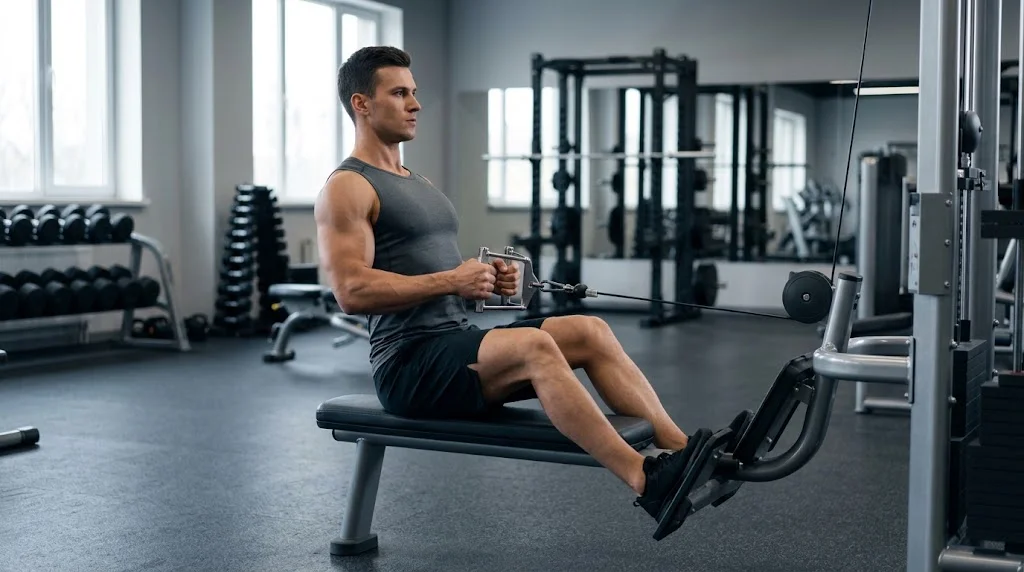
The single arm seated cable row is a unilateral horizontal pull performed on a low cable with a single handle that trains the lats and mid back one side at a time. Compared with the two-handedseated cable row, the free hand cannot help, so the working lat has to finish the pull on its own and the trunk has to resist the twist the cable creates. The handle can also travel further past the ribs, which lengthens the range at the end of the pull. Coaches program it as a back accessory after the main row or pull-up work.
What Muscles Does the Single Arm Seated Cable Row Work?
- Primary: Latissimus dorsi, rhomboids, middle trapezius
- Secondary: Posterior deltoid, biceps brachii, brachialis
- Tertiary: Obliques (anti-rotation), erector spinae, forearm flexors (grip)
How Do You Set Up for the Single Arm Seated Cable Row?
Set the pulley at its lowest position and attach a single D-handle. Sit with both feet flat on the footplate and your knees slightly bent. Sit tall, chest up and shoulders level. Reach forward with one hand and take a neutral grip on the handle, then rest the free hand on your thigh. Let the stack lift so the cable is tight and your working shoulder is stretched forward.
How Do You Perform the Single Arm Seated Cable Row?
- Square your shoulders to the machine and brace your trunk so your torso is fixed before the arm moves.
- Pull the handle toward your lower ribs, driving your elbow straight back along your side rather than out or up.
- Finish with your elbow behind your torso and the handle beside your hip, which tells you the lat has shortened fully.
- Squeeze for one second with your shoulder blade pulled toward your spine and your shoulders still level.
- Extend your arm slowly over two to three seconds, letting the shoulder blade glide forward at the very end.
- Stop with the cable tight and your shoulders square, then start the next rep from that stretched position.
What Are the Key Form Cues?
- Drive the elbow, not the hand: Think of pushing the elbow into the wall behind you during the pull so the lat does the work instead of the biceps.
- Pin the opposite hip: Press the non-working side of your pelvis into the bench through the whole rep to stop the torso twisting toward the stack.
- Keep your collarbones facing the machine as the handle passes the ribs.
- Let the shoulder blade reach at the end of the eccentric, then pull it back before the elbow bends.
- Breathe out through the squeeze and in as the arm extends.
What Are the Most Common Mistakes?
- Loading the stack too heavy: The torso rocks back to start the pull and the handle stops short of the ribs, so drop a plate until the elbow clears the torso every rep.
- Twisting the shoulders toward the stack: Rotating adds fake range and unloads the lat, so keep both shoulders level and move only the arm.
- Shrugging the working shoulder: Lifting it toward the ear shifts the pull into the upper traps, so set the blade down and back before the elbow bends.
- Cutting the stretch short: Stopping the eccentric halfway keeps the lat short, so let the arm straighten and the blade glide forward.
- Rounding the lower back at the stretch: Flexing the lumbar spine against the cable's pull loads the discs, so hold the tall seat and let only the shoulder reach.
What Are the Best Single Arm Seated Cable Row Variations?
- Two-hand seated cable row: Both arms pull a V-handle, removing the twist for beginners.
- Single arm high cable row: Set the pulley at head height so the pull runs downward into the lower lat.
- Single arm rotational cable row: Start turned toward the stack and rotate open as you pull to load the obliques.
- Single arm underhand cable row: A supinated grip adds bicep work and keeps the elbow tight to the ribs.
- Single arm standing cable row: A split stance replaces the bench so the hips hold you still.
How Do You Progress the Single Arm Seated Cable Row?
- Add one plate on the stack once you finish every set with the elbow behind your torso and the shoulders level.
- Work from 10 reps up to 15 per side before moving up a plate.
- Add a fourth set once three sets of 15 per side are clean.
- Add a two-second squeeze at the ribs, or slow the eccentric to four seconds, once the load stalls.
How Should You Program the Single Arm Seated Cable Row?
Program it as a back accessory after your heavy row, pull-up or deadlift work. Train it one to two times per week for 3 to 4 sets of 10 to 15 reps per side, resting 45 to 60 seconds between sides and 60 to 90 seconds between full sets. Pair it with a chest press or push-up on the same day so the horizontal push and pull stay balanced.