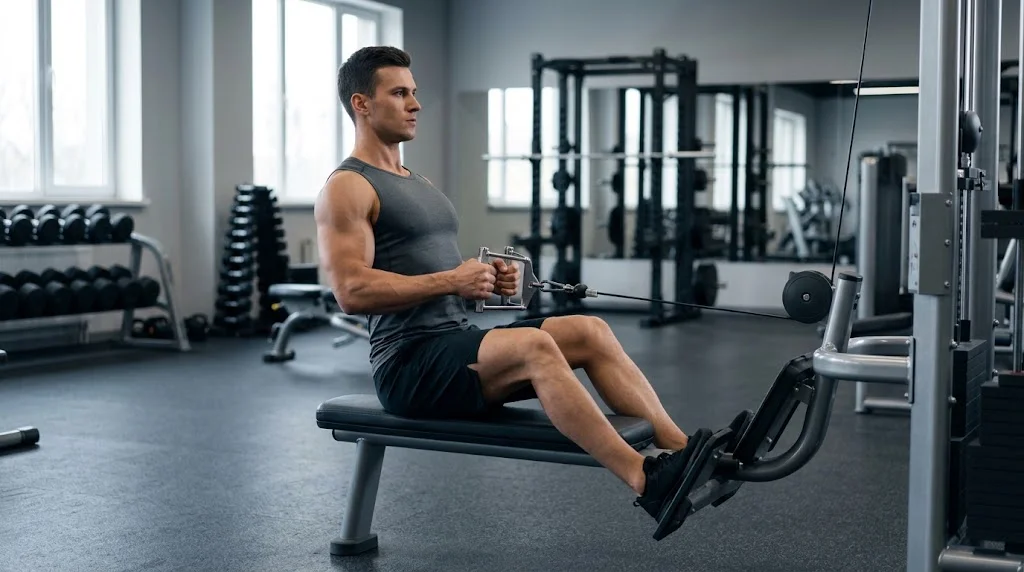
The single-arm cable pull-down is a unilateral vertical pulling exercise performed standing at a high pulley, drawing one handle from overhead to the ribs to train the lats. One hand on the cable changes two things against a two-handed pull-down: the arm can travel its own path, so the shoulder blade reaches further down and the lat gets a longer contraction, and the pull tries to turn and tilt your trunk, so the obliques on the free side have to hold you square. Lifters use it as abackaccessory after rows or vertical pulls.
What Muscles Does the Single-Arm Cable Pull-Down Work?
- Primary: latissimus dorsi
- Secondary: teres major, lower trapezius, biceps brachii
- Tertiary: rhomboids, external obliques, forearm flexors
How Do You Set Up for the Single-Arm Cable Pull-Down?
Set the pulley above head height and clip on a single stirrup handle. Stand facing the machine, half a step back, with the leg on your working side slightly behind. Take the handle in one hand with your palm facing in, arm reaching straight overhead. Put your free hand on your hip, brace your abs and pull your ribs down. Let the working shoulder rise toward your ear until the cable is tight.
How Do You Perform the Single-Arm Cable Pull-Down?
- Set your torso upright with a small forward lean and your hips square to the machine.
- Pull your shoulder blade down first, dropping it toward the opposite hip before the elbow bends.
- Drive your elbow down and back until the handle reaches the side of your ribs.
- Squeeze the lat for one count with the elbow tight to your side and the shoulder blade held down.
- Let the arm travel back overhead over three counts, allowing the shoulder to rise at the very top.
- Finish at full reach with the cable still tight, ready to pull again.
What Are the Key Form Cues?
- Lead with the shoulder blade, not the hand: start every rep by pulling the blade down so the lat moves the arm rather than the biceps.
- Stay square to the pulley: resist the twist the single cable puts on you by keeping both hip bones pointed forward.
- Keep your working elbow pointing down through the pull instead of drifting out to the side.
- Reach tall at the top and let the lat stretch, since that range is why you pull one arm at a time.
- Keep your grip relaxed enough to feel the pull in your armpit, not your forearm.
What Are the Most Common Mistakes?
- Loading the stack too heavy: the whole body pumps to move the handle and the lat only finishes the rep, so drop the weight until the trunk stays quiet.
- Leaning away from the machine as you pull: bodyweight replaces lat work and the pull turns into a side bend, so keep your torso angle fixed.
- Rotating the shoulders open on the pull: the chest turns away, the range gets shorter and the obliques stop doing their job.
- Cutting the top short: stopping before the arm is straight skips the stretched position that this variation exists to train.
- Curling the handle in: the elbow bends before the shoulder blade moves and the biceps take over the pull.
What Are the Best Single-Arm Cable Pull-Down Variations?
- Kneeling single-arm cable pull-down: both knees down, removing the balance demand for beginners.
- Half-kneeling single-arm cable pull-down: one knee down, locking the pelvis so the trunk cannot lean.
- Reverse-grip single-arm pull-down: palm turned up, pulling the elbow tighter to the ribs.
- Standing cable pull-down: the same vertical pull with a bar in both hands and heavier loading.
- Single-arm straight-arm pull-down: the elbow stays locked, taking the biceps out of the pull.
How Do You Progress the Single-Arm Cable Pull-Down?
- Move up one plate on the stack once you finish all sets at the top of the rep range with a still trunk.
- Build from 8 to 15 reps per arm at each weight before adding a plate.
- Take the work from two to four sets per arm, starting each set with your weaker side.
- Slow the return to a four-count, then pause two counts at full reach to add range.
How Should You Program the Single-Arm Cable Pull-Down?
Run it as an accessory late in a pulling session, after chin-ups, pulldowns or barbell rows have taken the heavy work. Two or three sessions a week fit, for 3 to 4 sets of 8 to 15 reps per arm with 45 to 75 seconds of rest between sides. Pair it with a horizontal row so the mid-back gets work in a plane this vertical pull leaves out.