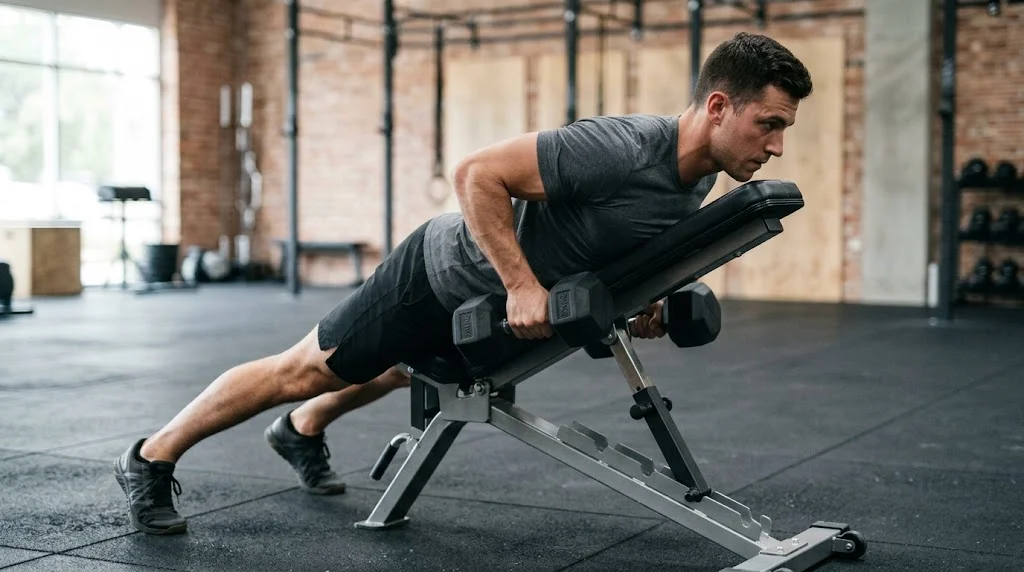
The incline prone dumbbell row is a chest-supported rowing exercise performed face down on an incline bench with a dumbbell in each hand that trains the upper back and lats. With the torso resting on the pad, the lower back and hamstrings are taken out of the lift, so every rep is limited by the back muscles rather than by how long you can hold a bent-over position. The bench angle also fixes the pull direction, which makes it easy to feel the shoulder blades move. Lifters program it as a mid-session accessory onbackdays after the main pull.
What Muscles Does the Incline Prone Dumbbell Row Work?
- Primary: Latissimus dorsi, rhomboids, middle trapezius
- Secondary: Posterior deltoids, biceps brachii, brachialis, lower trapezius
- Tertiary: Forearm flexors, erector spinae, rotator cuff stabilising the shoulder
How Do You Set Up for the Incline Prone Dumbbell Row?
Set an adjustable bench to about 45 degrees and place a dumbbell on the floor either side of the top end. Lie face down along the pad with your chest on the upper half and your chin just past the top edge. Plant your feet on the floor behind you. Reach down and grip both dumbbells with a neutral grip, arms hanging straight, shoulder blades relaxed forward.
How Do You Perform the Incline Prone Dumbbell Row?
- Set your chest on the pad and let the dumbbells hang directly below the shoulders.
- Pull the elbows back and up, driving them past the ribs toward the hips.
- Stop when the dumbbells reach the sides of your lower ribs and the shoulder blades are fully pulled together.
- Squeeze for one second at the top without lifting the chest off the pad.
- Lower under control until the arms hang straight and the shoulder blades slide forward again.
- Let the dumbbells hang for a beat at the bottom, then start the next rep.
What Are the Key Form Cues?
- Elbows to hip pockets: drive the elbows back toward the hips rather than straight up toward the ceiling.
- Chest glued to the pad: the sternum stays pressed down through the whole rep so the back, not the torso, moves the weight.
- Let the shoulder blades reach forward fully at the bottom so each rep starts from a stretch.
- Keep the wrists neutral and the grip firm, thinking of the hands as hooks.
- Exhale as the elbows drive back and inhale on the lowering.
What Are the Most Common Mistakes?
- Going too heavy: the chest lifts off the pad and the rep becomes a heave with momentum; drop the weight until the torso stays still.
- Rowing with the arms only: the elbows bend but the shoulder blades never retract, so the biceps do the work; start each rep by pulling the blades together.
- Flaring the elbows out wide: the pull shifts onto the rear delts and the lats disengage; keep the elbows tracking along the ribs.
- Shrugging the shoulders toward the ears: the upper traps take over at the top; pull down and back instead.
- Cutting the bottom short: half-range reps skip the stretch that loads the lats, so let the arms hang fully.
What Are the Best Incline Prone Dumbbell Row Variations?
- Chest-supported dumbbell row: a steeper bench angle, which lets a beginner learn the pattern with less lat stretch.
- Incline barbell row: the same position with a barbell, a heavier progression.
- Wide grip incline dumbbell row: elbows travel out to the sides, shifting emphasis to the rear delts and upper back.
- Single arm incline prone row: one dumbbell at a time, a unilateral version that lets you fix the weaker side.
- Incline prone cable row: cables from a low pulley keep tension at the bottom of the range.
How Do You Progress the Incline Prone Dumbbell Row?
- Add 5 pounds per hand once all sets reach the top of the rep range with the chest on the pad.
- Build reps from 8 to 12 per set before moving up in weight.
- Add a set at a time from 3 sets to 4.
- Add a two second hold at the top squeeze, then a three second lowering count.
How Should You Program the Incline Prone Dumbbell Row?
Program the incline prone dumbbell row as the second or third movement on a back day, after pull-ups or a heavy barbell row. Train it one to two times per week for 3 to 4 sets of 8 to 12 reps, resting 60 to 90 seconds between sets. Pair it with a vertical pull such as a lat pulldown so the back is trained in two directions in one session.