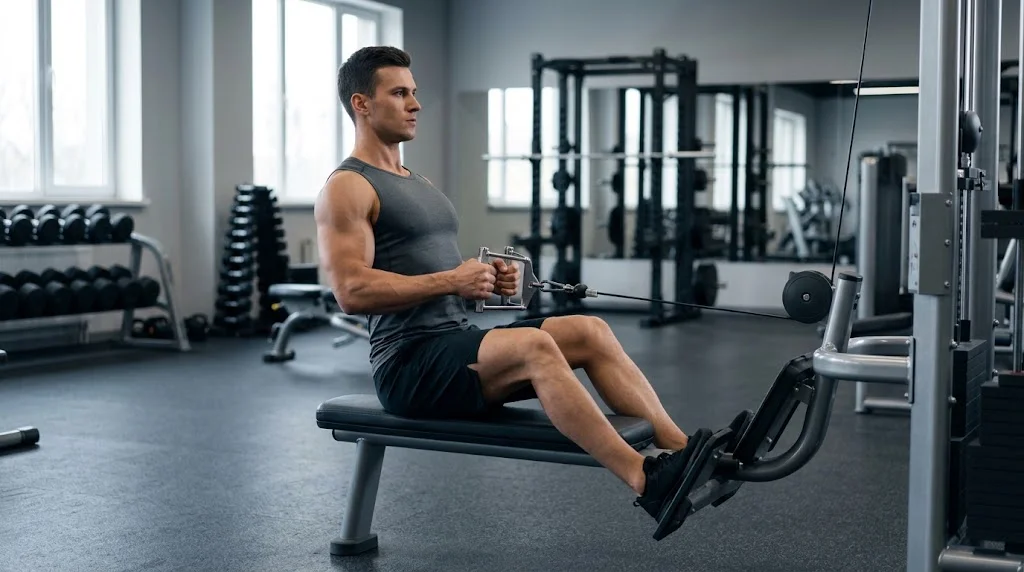
The seated supported row is a machine rowing exercise performed sitting with the chest against a pad, pulling two handles toward the ribs to train the midbackand lats. The pad holds the torso, so the lower back and hamstrings stay out of the lift and the set ends when the back fails, not when the posture does. The pad also blocks the lean-back a cable row allows, so every rep pulls the same distance. Coaches program it as a beginner back builder or as a heavy row when the lower back is already tired.
What Muscles Does the Seated Supported Row Work?
- Primary: Latissimus dorsi (lats), rhomboids, middle trapezius
- Secondary: Posterior deltoid, biceps brachii, brachialis
- Tertiary: Forearm flexors (grip), lower trapezius, erector spinae
How Do You Set Up for the Seated Supported Row?
Set the seat so the handles sit at lower-chest height when you sit tall, and set the chest pad so the handles are just within reach with straight arms. Sit with the feet flat and the sternum resting on the pad. Take the handles with a neutral or overhand grip, arms long, shoulders down, and let the weight stretch the lats before the first pull.
How Do You Perform the Seated Supported Row?
- Set the shoulders down and the chest on the pad, arms straight, so the stack is just off its stop.
- Drive the elbows back along the sides of the ribs, pulling the handles toward the lower chest.
- Stop when the elbows pass the torso and the handles are at the ribs; the shoulder blades are fully drawn together.
- Hold the squeeze for one count, keeping the sternum on the pad and the neck long.
- Return the handles slowly, letting the shoulder blades slide apart until the arms are straight.
- Let the lats stretch for a beat at full reach without lifting the chest off the pad, then start the next pull.
What Are the Key Form Cues?
- Elbows to the back pockets: think of pulling the elbows down and back past the ribs rather than the hands to the chest.
- Chest stays glued to the pad: the sternum pressing forward is what keeps the torso out of the lift.
- Let the shoulder blades move: apart at the front, together at the back, on every rep.
- Keep the wrists straight so the handles pull through the forearm and not the fingers.
- Breathe out as the handles reach the ribs to keep the ribs down against the pad.
What Are the Most Common Mistakes?
- Loading the stack so heavy the torso rocks off the pad to start it: the lower back does the first half, so reduce the weight until the chest never leaves the pad.
- Shrugging the shoulders toward the ears as the handles come in: the upper traps take over from the rhomboids, so pull the shoulders down before the elbows drive back.
- Cutting the return short: the lats never reach the stretch and each rep gets shorter, so straighten the arms fully.
- Pulling with the arms and curling the wrists: the biceps and forearms fail before the back, so keep the wrists neutral and lead with the elbows.
- Setting the seat too low: the handles come in at the shoulders and the pull turns into a rear delt row, so raise the seat.
What Are the Best Seated Supported Row Variations?
- Hammer Strength seated low row: a plate-loaded chest-supported row with independent arms and a lower pull line.
- Seated cable row: the same seated pull without the chest pad, harder because the torso must hold itself.
- Wide-grip seated supported row: an overhand grip on the wide handles shifts the work toward the rear delts and upper back.
- Single-arm seated supported row: one handle at a time, letting the torso resist rotation against the pad.
- Chest-supported dumbbell row: an incline bench replaces the machine pad, the same pattern with free weights.
How Do You Progress the Seated Supported Row?
- Add one plate on the stack once you complete all sets at 12 reps with the chest on the pad throughout.
- Work from 8 reps per set up to 12 before the next plate.
- Add a set at a time up to 4 sets, or a second back session in the week.
- Hold the handles at the ribs for a two-count and take three counts on the return before adding more load.
How Should You Program the Seated Supported Row?
Place the seated supported row early in a back session as the first row, or after pull-ups as the main horizontal pull. Train it 1 to 2 times per week for 3 to 4 sets of 8 to 12 reps, resting 60 to 90 seconds between sets. Pair it with a lat pulldown for the vertical pull and a rear delt fly to finish the upper back.