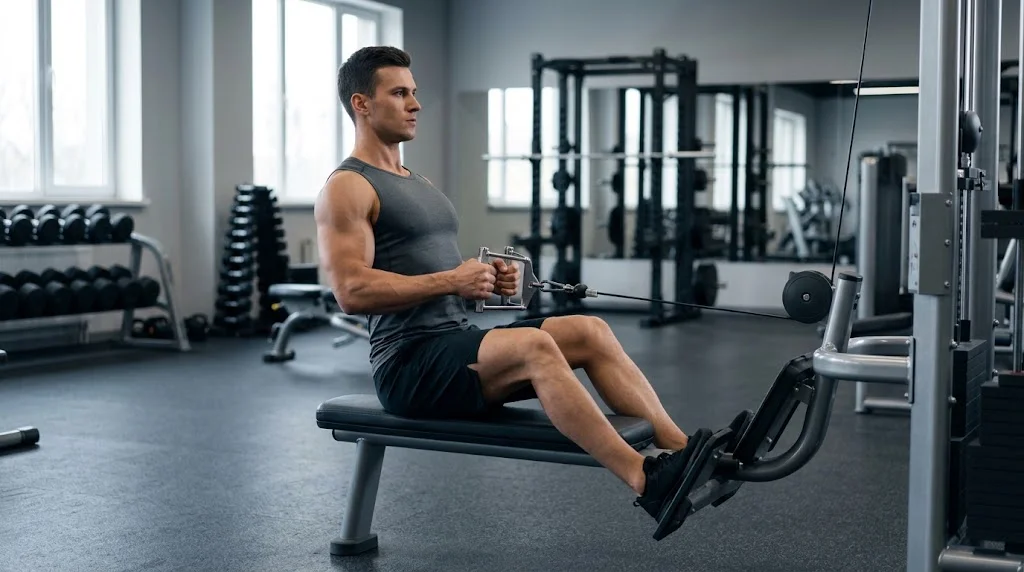
The seated low row machine is a chest-supported rowing exercise performed on a plate-loaded machine with low handles, training the lats and midbackalong a fixed path. The chest pad takes the job of holding your torso still, so the lower back and hamstrings do nothing and the load goes straight into the pull. The handles sit below the chest and travel toward the hips, which drives the elbows down and back and biases the lats over the upper traps. Lifters use it as a second row on a pull day or as the main row for beginners.
What Muscles Does the Seated Low Row Machine Work?
- Primary: Latissimus dorsi (lats), rhomboids
- Secondary: Middle and lower trapezius, posterior deltoid (rear delt), biceps brachii
- Tertiary: Forearm flexors, erector spinae, teres major
How Do You Set Up for the Seated Low Row Machine?
Load the machine evenly on both sides. Set the seat so the top of the chest pad sits just below your collarbones and the handles start at the level of your lower ribs. Sit with your feet flat on the footplate or floor, knees bent, and press your sternum into the pad. Reach forward, take the low handles with a neutral or overhand grip, and let the arms straighten until the shoulder blades slide forward.
How Do You Perform the Seated Low Row Machine?
- Set the chest on the pad with the arms long and the shoulder blades reaching toward the handles.
- Pull the elbows down and back toward the hips, driving the handles along their arc.
- Finish with the handles beside the lower ribs, elbows past the torso and shoulder blades pulled together.
- Hold the contraction for one count, chest still glued to the pad.
- Let the handles travel forward under control, straightening the arms over two counts.
- Allow the shoulder blades to protract fully at the end of the arm, then begin the next rep.
What Are the Key Form Cues?
- Elbows to the back pockets: aim the elbows down and behind you, not straight back, so the lats rather than the upper traps carry the row.
- Chest never leaves the pad: the pad is the reference point; if the sternum lifts off it, the rep has become a heave.
- Think of the hands as hooks and pull with the elbows.
- Let the shoulder blades glide forward at the end of each rep before the next pull.
- Keep the neck long and the gaze straight ahead through the whole set.
What Are the Most Common Mistakes?
- Loading more plates than the back can move: the torso rocks off the pad and the hips drive the handles, so pick a load that keeps the sternum pinned for every rep.
- Shrugging the shoulders toward the ears as the handles arrive: the upper traps take over from the lats, so pull the shoulders down before the elbows come back.
- Stopping the arm short at the front: the shoulder blades never protract and the lats lose their stretch, so let the handles travel fully forward.
- Yanking with the biceps: the elbows bend before they travel and the forearms fatigue first, so lead with the elbows.
- Setting the seat too low: the handles finish at the shoulders and the movement becomes a high row for the traps, so raise the seat until the handles end at the lower ribs.
What Are the Best Seated Low Row Machine Variations?
- Chest-supported dumbbell row: the same supported pull on an incline bench, for gyms without the machine.
- Wide grip seated cable low row: the cable version with no chest pad, adding a trunk demand.
- Single arm seated low row machine: one handle at a time, letting the working side reach further.
- Underhand seated low row machine: palms up shifts more load to the lower lats and biceps.
- Seated high row machine: handles set above the chest and pulled toward the face, biasing the rear delts and upper back.
How Do You Progress the Seated Low Row Machine?
- Add one small plate per side once every set reaches the top of the rep range with the chest still on the pad.
- Work from 8 reps per set up to 12 before adding a plate.
- Add a fourth set once three sets no longer produce a hard last rep.
- Hold the contraction for two counts, or slow the return to three, before you add another plate.
How Should You Program the Seated Low Row Machine?
Program the seated low row machine as the second pull on a back day after a pull-up or a barbell row, or as the main row for a beginner, one to two times a week. Work 3 to 4 sets of 8 to 12 reps with 60 to 90 seconds of rest between sets. Pair it with a lat pulldown so the back trains a vertical pull in the same session.