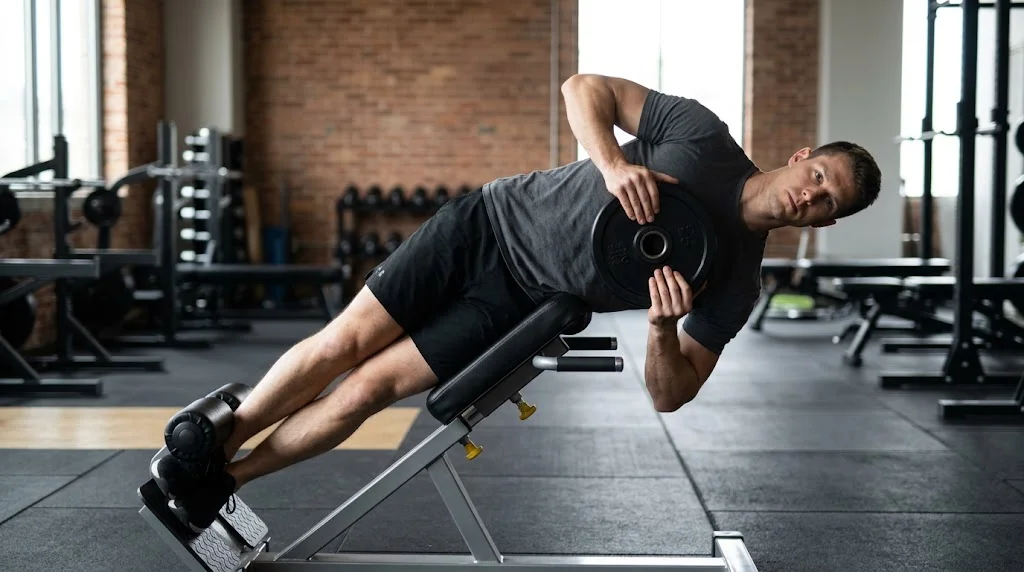
The Roman chair reverse crunch is an abdominal exercise performed hanging from the armrests of aRoman chairthat trains the lower abs by curling the pelvis up toward the ribs. Unlike a bench reverse crunch, your torso hangs vertical with the back against the pad, so the legs hang as a full-length lever and gravity pulls straight down on the pelvis through the whole rep. The armrests take your bodyweight, which removes the grip limit of a hanging bar version. Lifters run it as a core accessory late in a session.
What Muscles Does the Roman Chair Reverse Crunch Work?
- Primary: Rectus abdominis (lower abs)
- Secondary: Hip flexors (iliopsoas, rectus femoris), external obliques
- Tertiary: Serratus anterior, latissimus dorsi, forearm flexors
How Do You Set Up for the Roman Chair Reverse Crunch?
Step onto the foot rests and place a forearm on each armrest with the elbows bent to 90 degrees and the hands wrapped around the grips. Press your upper back into the pad. Push the shoulders down away from the ears so the torso does not sink between the pads. Step off the foot rests and let both legs hang straight, feet together, ribs pulled down toward the hips. Tension starts here.
How Do You Perform the Roman Chair Reverse Crunch?
- Lock the shoulders down on the armrests and let the legs hang straight with the feet together.
- Bend the knees and draw them upward toward the chest, keeping the shins level with the floor.
- Curl the pelvis up toward the ribs once the thighs pass horizontal, so the lower back peels off the pad.
- Hold the top for one count with the knees near chest height and the abs fully shortened.
- Lower the pelvis first, letting the lower back settle on the pad, then let the knees travel down under control.
- Straighten the legs to a dead hang, stopping the swing completely before the next rep.
What Are the Key Form Cues?
- Tilt the pelvis, not just the knees: the rep is done when your hip bones roll toward your ribs, so think of tipping a bucket rather than lifting your thighs.
- Push down through the forearms: driving the elbows into the pads keeps the shoulders from shrugging and the torso from sagging.
- Exhale hard through the top so the ribs stay pinned down while the pelvis curls.
- Feel the lower abs pull the knees up rather than the hips throwing them.
- Take twice as long to lower as you took to lift.
What Are the Most Common Mistakes?
- Swinging the legs up with momentum: the pelvis never tilts and the hip flexors do the lifting, so start every rep from a dead, motionless hang.
- Stopping when the thighs reach horizontal: this is a knee raise, not a reverse crunch, and the abs barely shorten, so keep curling until the lower back leaves the pad.
- Letting the shoulders shrug up to the ears: the torso slumps between the pads and the arms lose their base, so drive the elbows down.
- Arching the lower back on the way down: the lumbar spine extends under the weight of the legs while the abs are stretched, so let the lower back touch the pad before the knees drop.
- Dropping the legs fast into the hang: the swing that follows wrecks the next rep, so control the descent to a stop.
What Are the Best Roman Chair Reverse Crunch Variations?
- Bench reverse crunch: the same pelvic curl lying flat, where the bench takes the bodyweight; the regression.
- Straight-leg Roman chair reverse crunch: legs stay long through the lift, roughly doubling the lever length.
- Roman chair oblique knee raise: knees curl toward one shoulder, shifting load to the obliques.
- Single-leg Roman chair reverse crunch: one leg lifts while the other hangs, adding an anti-rotation demand.
- Hanging reverse crunch bent knees: the same movement from a pull-up bar, where grip limits the set.
How Do You Progress the Roman Chair Reverse Crunch?
- Add a light ankle weight once you complete every set of 15 with a full pelvic curl.
- Work from 10 reps per set up to 15 before adding load, then drop back to 10.
- Start with 2 sets and add a third once the last rep of set two still curls the pelvis fully.
- Add a 2-second hold at the top, or straighten the legs, before adding external load.
How Should You Program the Roman Chair Reverse Crunch?
Program the Roman chair reverse crunch as a core accessory in the last third of a session, after your squats, deadlifts or main upper body lifts, two to three times a week. Do 2 to 4 sets of 10 to 15 reps with 45 to 60 seconds of rest between sets. Pair it with a plank or a dead bug so the abs train both curling and bracing in the same session.