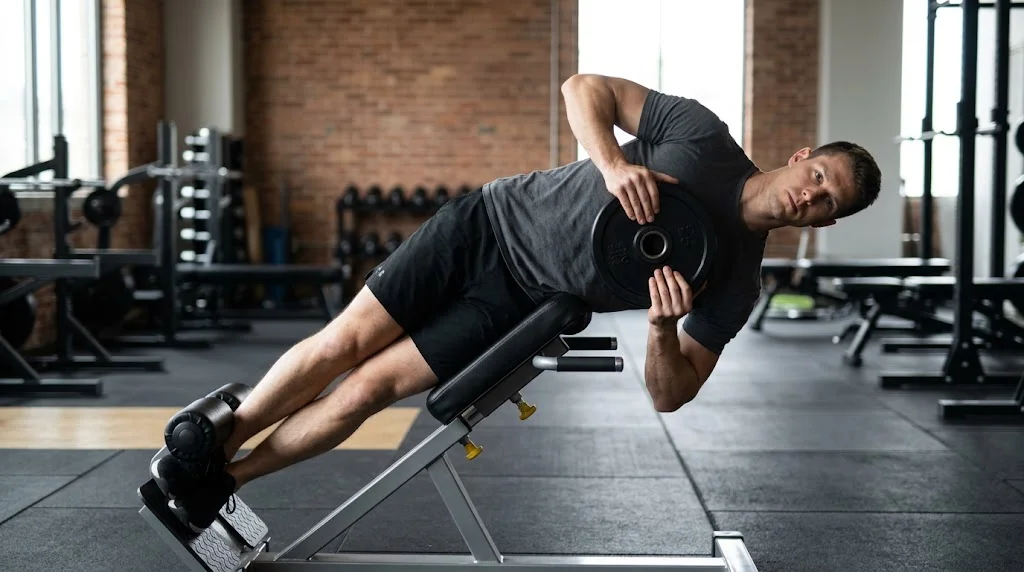
Roman chair leg raises are a core-isolation exercise performed on a vertical captain's chair station, where you support your body on padded armrests and raise your legs to work thelower abdominalsand hip flexors through a full range of motion. Unlike floor-based leg raises, the improved, supported position removes any assistance from pushing off the ground, so the abs alone control both the raise and the lowering of the legs. It is a staple lower-ab exercise for lifters who want to isolate the abdominals without loading the spine axially.
What Muscles Does the Roman Chair Leg Raises Work?
- Primary: Rectus abdominis (lower fibers), hip flexors (iliopsoas)
- Secondary: Obliques, transverse abdominis
- Tertiary: Quadriceps (isometric extension endurance), forearms and grip (isometric support)
How Do You Set Up for the Roman Chair Leg Raises?
Step into aRoman chair(captain's chair) station and rest your forearms on the padded arm supports with your back flat against the pad, gripping the handles if provided. Let your legs hang straight down with a slight bend in the knees, keeping your torso upright and core braced - this is your starting position.
How Do You Perform the Roman Chair Leg Raises?
- Brace your core and press your lower back into the pad before initiating any leg movement
- Raise your legs by flexing at the hips, bringing your knees or straight legs up until your thighs are at least parallel to the floor
- Curl your pelvis slightly at the top of the movement to fully engage the lower abs rather than stopping at hip flexion alone
- Pause briefly at the top where the ab contraction is greatest
- Lower your legs back down slowly, resisting gravity rather than letting them drop
- Stop just short of a full dead hang to keep tension on the abs before starting the next rep
- Repeat for the desired number of reps, keeping your torso still throughout
What Are the Key Form Cues?
- Keep your lower back pressed against the pad; a back that arches away signals the hip flexors are taking over from the abs
- Move with control in both directions; swinging the legs turns the exercise into a momentum-driven motion rather than a strength one
- Bend the knees if straight-leg raises cause excessive hip flexor dominance or lower back strain
- Exhale as you raise your legs and keep your ribcage pulled down to maintain abdominal engagement
- Keep your upper body still and stacked on the pads; don't rock your torso backward for momentum
What Are the Most Common Mistakes?
- Using momentum to swing the legs up: swinging reduces abdominal tension and can strain the hip flexors and lower back - slow the tempo and remove the bounce.
- Stopping the range at hip flexion only: raising just to horizontal without the pelvic curl at the top underuses the lower abs - add a small posterior pelvic tilt at the top of each rep.
- Letting the lower back arch off the pad: an unsupported arch shifts the load to the hip flexors and lumbar spine - keep the back flat against the support throughout.
- Dropping the legs on the way down: an uncontrolled eccentric skips the phase where much of the muscle-building stimulus occurs - lower for 2-3 seconds every rep.
- Using straight legs before you're ready: attempting full straight-leg raises without adequate hip flexor and core strength often causes form breakdown - regress to bent knees until control improves.
What Are the Best Roman Chair Leg Raises Variations?
- Hanging leg raise: performed from a pull-up bar instead of a supported station, adding a grip and shoulder stability demand
- Knee raise: bent-knee version that shortens the lever and eases the movement for beginners
- Windshield wipers: adds a rotational component by sweeping the raised legs side to side, emphasizing the obliques
- Weighted leg raise: holding a dumbbell between the feet increases resistance for advanced trainees
- Floor-supported leg raise: performed lying on the floor or a bench, reducing the stabilization demand versus the Roman chair version
How Do You Progress the Roman Chair Leg Raises?
- Start with bent-knee raises before progressing to straight-leg versions, since straight legs create a longer, harder lever
- Add a pelvic tilt at the top once basic reps are controlled, to increase lower-ab recruitment
- Slow the eccentric phase to increase time under tension before adding difficulty elsewhere
- Progress to hanging leg raises once the supported version is easy for 3 sets of 15+ reps, since hanging removes the arm support
- Add ankle weights or hold a dumbbell between the feet once bodyweight reps are no longer challenging
How Should You Program the Roman Chair Leg Raises?
Include Roman chair leg raises 2-3 times per week as part of a core-focused block, typically toward the end of a session since fatigued hip flexors can compromise heavier lower-body lifts performed afterward. Work in the 10-15 rep range for 3-4 sets, resting 45-60 seconds between sets. Because the station removes lower-back loading, it is a good choice for lifters who need to build ab strength while managing spinal load elsewhere in their program.