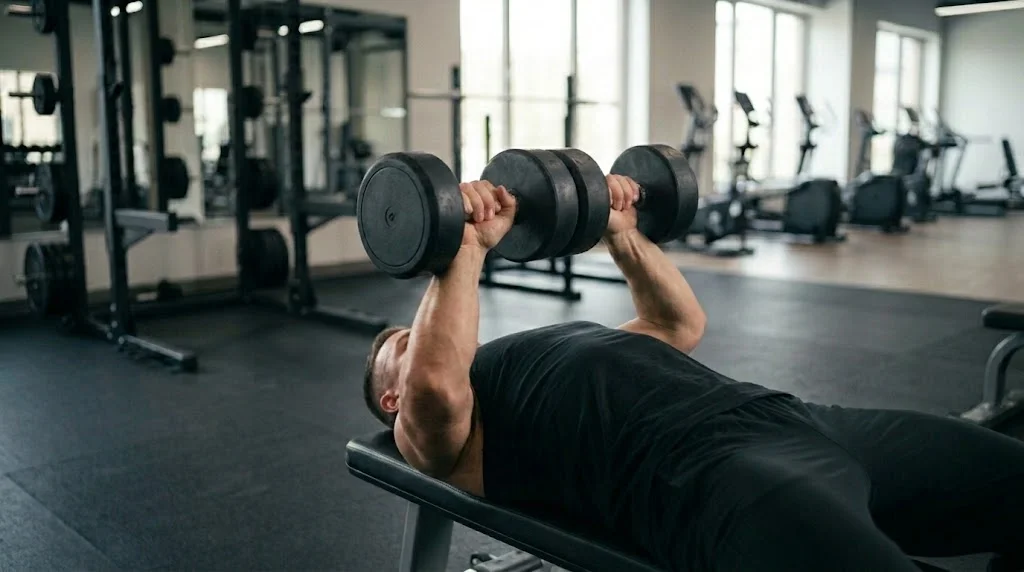
The tricep pushdown machine is a seated isolation exercise performed on a lever machine, pressing two handles down from chest height to full elbow extension to train thetriceps. The machine fixes the path and the seat fixes the torso, so unlike a cable pushdown there is no bar to drift forward and no way to lean on the weight, which suits learning where the elbow should stay. The lever arm also loads the lockout harder than a cable does, so the last few degrees of extension get the most tension. Lifters program it as a late arm accessory.
What Muscles Does the Tricep Pushdown Machine Work?
- Primary: Triceps brachii (lateral and medial heads)
- Secondary: Triceps brachii long head, anconeus
- Tertiary: Latissimus dorsi, posterior deltoid, wrist flexors
How Do You Set Up for the Tricep Pushdown Machine?
Set the seat so the handles sit at the height of your lower chest when you are upright and your upper arms hang beside your ribs. Select a weight you can lock out slowly. Sit with your feet flat, hips back in the seat and chest against the pad if the machine has one. Take the handles in an overhand grip, wrists straight, elbows bent past ninety degrees and pinned to your sides.
How Do You Perform the Tricep Pushdown Machine?
- Pin both elbows to your ribs and set the forearms just above parallel to the floor.
- Press the handles down by straightening the elbows only, the upper arms staying motionless.
- Lock the elbows out fully when the arms are straight and the handles sit beside your thighs.
- Squeeze the triceps for one count at the bottom without leaning the shoulders forward.
- Return the handles under control over two counts until the elbows are bent past ninety degrees again.
- Stop before the stack settles so the triceps stay loaded, then begin the next rep.
What Are the Key Form Cues?
- Elbows are hinges, not levers: picture them bolted to your ribs so the only thing that moves is the forearm.
- Drive the heels of the hands down: pushing through the base of the palm keeps the wrist straight and the load on the triceps rather than the fingers.
- Keep the shoulders down and back as the handles reach the bottom.
- Feel the lockout squeeze in the outer arm before you let the handles rise.
- Let the handles rise only as far as your elbows stay tucked.
What Are the Most Common Mistakes?
- Loading the machine so heavy the shoulders dive forward: the chest and front delts press the handles down and the triceps only finish, so drop the weight until the torso stays still.
- Flaring the elbows out as the handles descend: the movement turns into a decline press and the shoulder takes load meant for the elbow, so keep the elbows brushing your ribs.
- Stopping short of lockout: the last part of extension, where the lever arm is heaviest, is skipped, so straighten the arms fully every rep.
- Letting the stack slam at the top: the eccentric is lost and the elbow takes a jolt at its most bent, so lower the handles over two counts.
- Bending the wrists back under the handles: the forearm flexors give out before the triceps do, so keep the knuckles in line with the forearm.
What Are the Best Tricep Pushdown Machine Variations?
- Triceps pushdown: the cable version, with a free path that demands more control of the elbow position.
- Single-arm machine pushdown: one handle at a time, the free hand bracing so the trunk stays square.
- Neutral-grip machine pushdown: turning the handles so the palms face each other keeps the wrists more comfortable for lifters with elbow discomfort.
- Rope tricep pushdown: a rope attachment lets the hands spread at the bottom for a harder lateral-head contraction.
- Bench dip: the same elbow extension pattern loaded with body weight and no machine.
How Do You Progress the Tricep Pushdown Machine?
- Add one plate or the machine's smallest increment once you complete all sets at 15 reps with the elbows still.
- Build from 10 reps up to 15 before adding weight.
- Add a fourth set before the next weight increase.
- Hold the lockout for two counts and lower over three when the next increment is too heavy to control.
How Should You Program the Tricep Pushdown Machine?
Place the tricep pushdown machine at the end of a push or arm session, after presses and dips. Train it 1 to 2 times per week for 3 to 4 sets of 10 to 15 reps, resting 45 to 60 seconds between sets. Pair it with an overhead triceps extension so the long head, which the pushdown position shortens, gets stretched work in the same session.