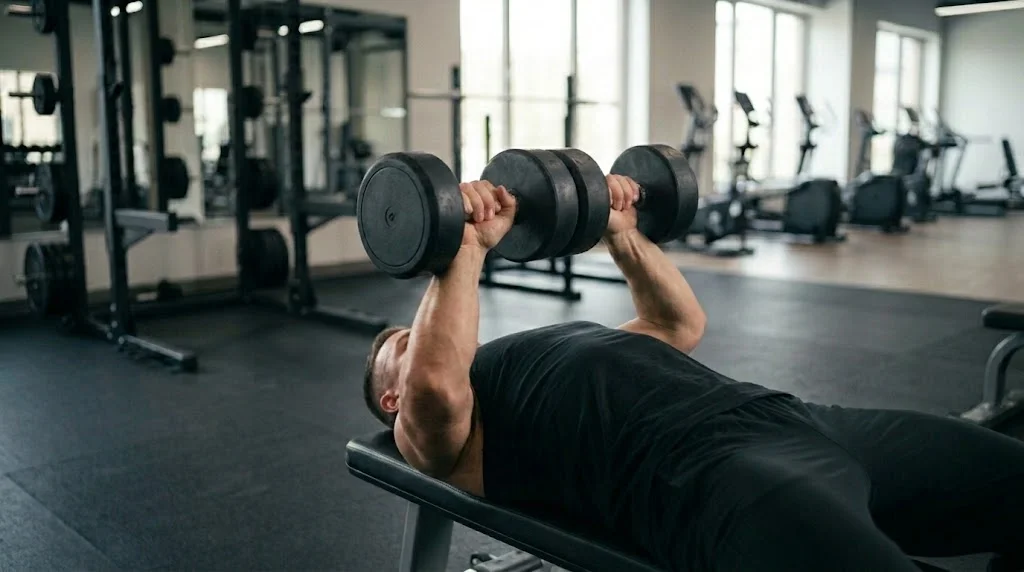
The close grip dumbbell bench press is a compound pressing exercise performed lying on a flat bench with a dumbbell in each hand held closer together than a standard bench press. Narrowing the hand path shifts a larger share of the workload onto thetricepswhile still training the chest and anterior deltoids. Because each arm moves independently, it also allows a deeper stretch at the bottom than a barbell close-grip press and helps address left-right strength imbalances.
What Muscles Does the Close Grip Dumbbell Bench Press Work?
- Primary: Triceps brachii, pectoralis major (sternal head)
- Secondary: Anterior deltoids
- Tertiary: Rotator cuff, forearms (stabilizers)
How Do You Set Up for the Close Grip Dumbbell Bench Press?
Lie back on a flat bench with a dumbbell in each hand, feet flat on the floor and shoulder blades retracted into the bench. Press the dumbbells to full arm extension above your chest, angling your hands so the dumbbells are nearly touching directly over your sternum, palms facing each other or slightly turned inward. Keep your wrists stacked over your elbows before lowering the first rep.
How Do You Perform the Close Grip Dumbbell Bench Press?
- Brace your core and retract your shoulder blades into the bench before initiating the first rep
- Lower the dumbbells together, keeping them close and tracking toward the middle of your chest, elbows tucked at roughly a 30-45 degree angle from your torso
- Descend until the dumbbells reach chest level, feeling a stretch through the chest and triceps
- Press the dumbbells back up in a straight line, keeping them close together throughout the ascent
- Extend fully at the top without letting the dumbbells drift apart or clank together forcefully
- Repeat for the desired number of reps, keeping the tempo controlled on both phases
What Are the Key Form Cues?
- Keep your elbows tucked at a moderate angle rather than flared out to the sides
- Keep the dumbbells tracking close together throughout the entire range of motion
- Retract and keep your shoulder blades pinned to the bench for a stable base
- Drive through a full lockout at the top to maximize triceps activation
- Control the descent; do not let the dumbbells drop quickly toward your chest
What Are the Most Common Mistakes?
- Flaring the elbows out wide: this shifts stress onto the shoulder joint and reduces triceps involvement. Keep the elbows tucked closer to the torso.
- Using a grip so narrow the wrists angle inward: excessive narrowing strains the wrists. Keep the dumbbells roughly aligned with the middle of the chest, not jammed together.
- Loading too much weight: overloading forces a wider elbow flare and a shorter range of motion. Use 50-60% of your standard dumbbell bench press weight to start.
- Bouncing the dumbbells off the chest: this reduces muscle tension and risks shoulder strain. Lower under control and press back up without a bounce.
- Losing shoulder blade retraction: letting the upper back lift off the bench reduces stability and shifts stress to the shoulders. Keep the shoulder blades pinned throughout the set.
What Are the Best Close Grip Dumbbell Bench Press Variations?
- Close grip barbell bench press: fixed bar path variation that allows heavier total loading
- Hex press: pressing the dumbbells together throughout the entire range to maximize inner-chest contraction
- Incline close grip dumbbell press: shifts emphasis toward the upper chest and front delts
- Close grip dumbbell floor press: performed on the floor to shorten the range of motion and reduce shoulder strain
How Do You Progress the Close Grip Dumbbell Bench Press?
- Add weight in small increments (5 pounds per dumbbell) once you can complete all reps with full lockout and control
- Add a 1-2 second pause at the bottom of each rep to remove momentum and increase difficulty
- Progress from a two-arm bench press to single-arm presses for added stability demand
- Increase reps into the 12-15 range before adding significant weight
How Should You Program the Close Grip Dumbbell Bench Press?
Program the close grip dumbbell bench press 1-2 times per week as a secondary pressing movement after your primary bench press work, or as a triceps-focused finisher on push day. Three to four sets of 8-12 reps with 90 seconds of rest works well for most goals. Use a spotter, or train with a weight you can safely lower to the chest and clean back up to the starting position on your own.