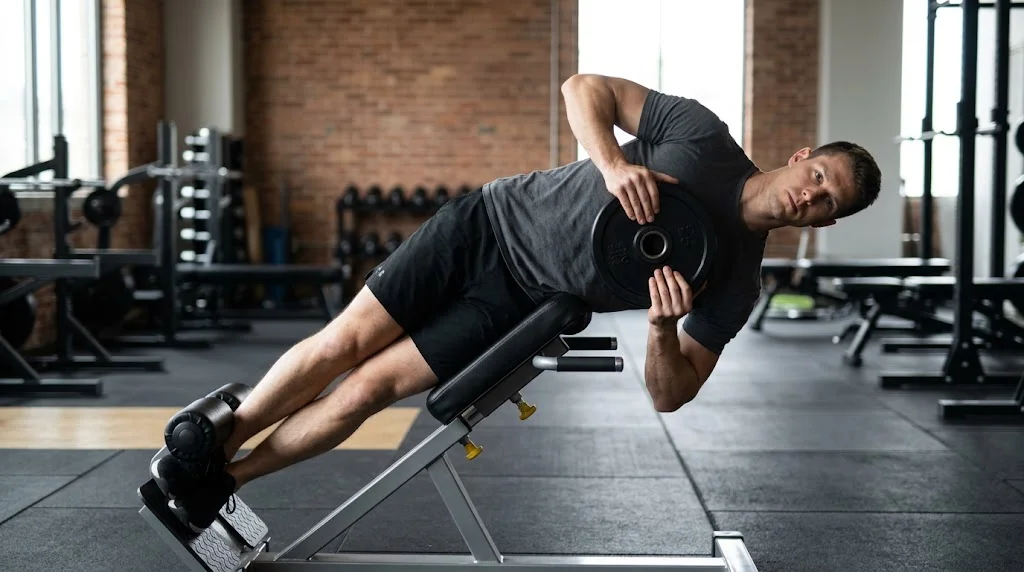
The plate crunch is a weighted floor abdominal exercise performed lying supine with a weight plate held flat against the chest, curling the ribs toward the pelvis to load the upper abs. Theplatesits flat on the sternum, so the load rests directly over the ribs that have to lift it and there is no handle to drift toward the knees the way a dumbbell does. The range stays a crunch, shoulder blades up and lower back down, so the hip flexors stay out. Lifters program it as a loaded core accessory at the end of a session.
What Muscles Does the Plate Crunch Work?
- Primary: Rectus abdominis (upper abs)
- Secondary: Internal and external obliques
- Tertiary: Transversus abdominis, neck flexors, serratus anterior
How Do You Set Up for the Plate Crunch?
Lay a weight plate on the mat beside you and lie on your back with your knees bent to about 90 degrees, feet flat and hip width apart. Pick up the plate with both hands and hold it flat against your upper chest, fingers hooked over the top edge and elbows tucked to your sides. Press your lower back into the mat, tuck your chin and set your eyes on the ceiling.
How Do You Perform the Plate Crunch?
- Pin the plate to your sternum with the elbows in and the lower back pressed into the mat.
- Exhale and curl your ribs toward your pelvis, peeling the head, then the shoulder blades, off the floor.
- Stop when the shoulder blades are clear and the lower back is still down; the plate should be a few inches higher than it started.
- Squeeze for one count at the top, pressing the plate into your chest.
- Lower slowly, laying the shoulder blades and then the head back onto the mat over two counts.
- Reset the chin and the brace with the plate still on the chest before the next rep.
What Are the Key Form Cues?
- Plate rides the ribs: keep it flat and still on the sternum so the load moves only as far as your ribcage curls.
- Shorten the front, not the neck: think of pulling the bottom of the ribcage toward the belt, with the chin staying tucked.
- Keep the elbows pinned to your sides so the arms cannot lever the plate upward.
- Feel the lower back stay heavy on the mat at the top of every rep.
- Exhale through the whole lift and let the ribs sink toward the hips as the air leaves.
What Are the Most Common Mistakes?
- Grabbing a plate too heavy to hold flat: it tips and the arms brace it instead of the abs lifting it, so drop to a plate you can pin still for every rep.
- Sitting up past the shoulder blades: the hip flexors take over once the lower back leaves the mat and the abs only brace, so stop with the lower back down.
- Pushing the plate away from the chest at the top: the arms press the weight up and the lever changes, so keep it glued to the sternum.
- Leading with the chin: the neck flexors strain before the abs shorten, so keep the chin tucked and lift from the sternum.
- Letting the head drop to the floor between reps: the abs relax and every rep restarts from slack, so keep a fist's gap under your head.
What Are the Best Plate Crunch Variations?
- Bodyweight crunch: hands across the chest with no plate, the regression for learning the shoulder-blade range.
- Plate crunch with arms extended: the plate held at arm's length above the chest lengthens the lever.
- Dumbbell crunch: a dumbbell replaces the plate for finer load jumps.
- Plate crunch with oblique reach: the plate travels toward one knee at the top so the obliques rotate the ribcage.
- Plate sit-up: the full rise to sitting with the plate on the chest, adding the hip flexors and a longer range.
How Do You Progress the Plate Crunch?
- Move up one plate size, 5 to 10 pounds, once every set reaches the top of the rep range.
- Work from 12 reps up to 20 per set before each weight jump.
- Add a set per week from 2 up to 4 while the last set keeps the same range as the first.
- Hold the top for two seconds, or extend the arms so the plate sits above the chest, before adding weight.
How Should You Program the Plate Crunch?
Place the plate crunch at the end of a session, after squats, presses or pulls have finished with the trunk, two to three times a week. Work 3 to 4 sets of 12 to 20 reps with 45 to 60 seconds of rest. Pair it with a reverse crunch or hanging leg raise so the lower abs get matching work from the pelvis up.