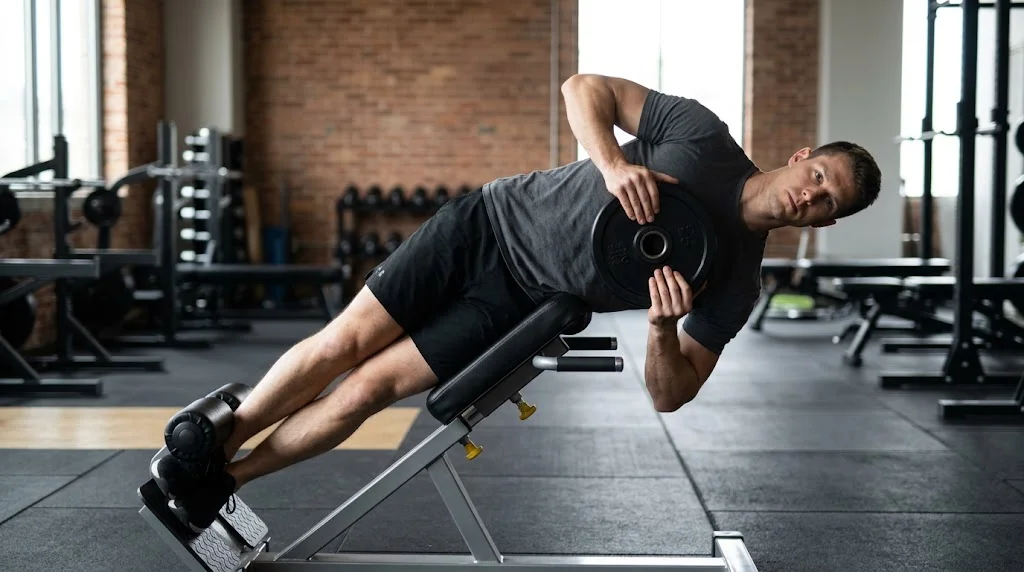
The plate sit-up is a weighted floor core exercise performed lying supine with a weight plate held on the chest, raising the whole torso to a seated position and lowering it. The plate is the only variable that separates it from a bodyweightsit-up: held flat on the sternum it sits far from the hips, so the lever the abs and hip flexors have to lift is long and the resistance is heaviest in the first third of the range. Lifters use it as a loaded core accessory late in a session.
What Muscles Does the Plate Sit-Up Work?
- Primary: Rectus abdominis
- Secondary: Iliopsoas and rectus femoris (hip flexors), internal and external obliques
- Tertiary: Transversus abdominis, neck flexors, erector spinae
How Do You Set Up for the Plate Sit-Up?
Lie on a mat with your knees bent to about 90 degrees and your feet flat, heels a hand's length from your seat. Take a single plate and hold it flat against your sternum with both hands, one on each edge, elbows tucked to your ribs. Press your lower back into the mat, draw the ribs down and set your chin so your gaze is between your knees.
How Do You Perform the Plate Sit-Up?
- Press the plate to your chest and take a breath, ribs down and lower back flat.
- Curl your head and shoulders off the mat, peeling the spine up one segment at a time.
- Keep curling to a seated position, letting the hip flexors finish the range as the plate rises.
- Stop when your chest nears your thighs, torso stacked over the hips, and pause briefly.
- Lower under control, laying the spine back down from the tailbone up to the shoulders.
- Touch your shoulders to the mat and hold the plate on the chest ready for the next rep.
What Are the Key Form Cues?
- Lead with the ribs: think of pulling the bottom of the ribcage toward your pelvis first, not of lifting the plate with your arms.
- Keep the plate glued down: the plate stays flat on the sternum for the whole rep so its weight never shifts toward the knees and shortens the lever.
- Keep the heels pressed into the mat rather than letting them peel up as you rise.
- Feel the abs, not the neck, doing the first few inches of the curl.
- Exhale on the way up and hold the brace as the torso lowers.
What Are the Most Common Mistakes?
- Loading too heavy a plate: the reps turn into a swing off the shoulders and the abs never lengthen under tension, so drop the weight until you can pause at the top.
- Jerking the plate away from the chest to start the rep: the arms throw it and the momentum carries you up, so keep the elbows tucked and the plate pinned.
- Snapping straight up with a flat back: the hip flexors pull on the lumbar spine while the abs stay slack, so curl the spine before the hips join in.
- Dropping back to the mat: the eccentric is where the load builds, so lower for two to three seconds every rep.
- Pulling the chin to the chest with the neck: the neck flexors fatigue first and the position tightens, so keep the chin level and the gaze forward.
What Are the Best Plate Sit-Up Variations?
- Bodyweight sit-up: the same range with no plate, the regression to master first.
- Plate crunch: stopping when the shoulder blades leave the mat keeps the hip flexors out.
- Plate overhead sit-up: holding the plate above the chest lengthens the lever further.
- Twisting plate sit-up: turning the plate toward one knee at the top loads that oblique.
- Decline weighted sit-up: a decline bench adds range and tension at the bottom.
How Do You Progress the Plate Sit-Up?
- Move up one plate size, usually 5 to 10 pounds, once every set hits the top of the rep range.
- Work from 8 reps a set toward 15 before taking a heavier plate.
- Build from 2 sets to 4 across the week as the abs recover between sessions.
- Lower for a three-second count, or hold the top position for two seconds, to add tension at the same weight.
How Should You Program the Plate Sit-Up?
Run the plate sit-up late in a session, after squats, hinges or presses, as loaded core work. Train it 2 to 3 times per week for 3 to 4 sets of 8 to 15 reps, resting 45 to 75 seconds between sets. Pair it with a plank or a side plank so the trunk trains resisting movement alongside producing it.