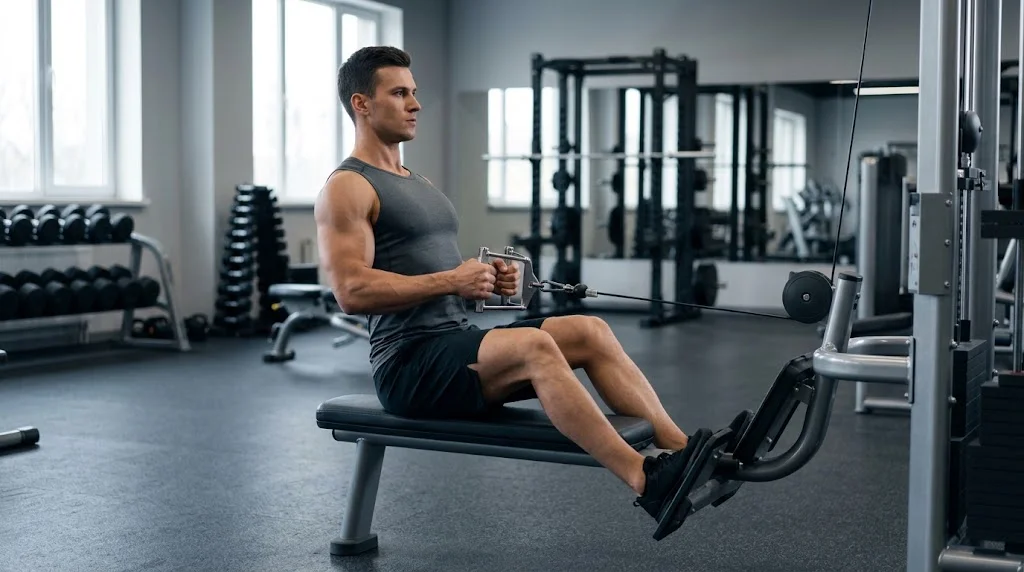
The cable shrug is an isolation exercise that targets the upper trapezius by improving the shoulders straight up toward the ears against resistance from a lowcable pulley. Unlike a barbell or dumbbell shrug, the cable keeps constant tension on the traps throughout the entire range of motion, including at the bottom of the rep where free weights tend to unload. The movement is purely a shoulder elevation, with the elbows staying fixed and no rowing or pulling action involved. It's a simple, effective accessory for building trap size and improving shoulder girdle stability.
What Muscles Does the Cable Shrug Work?
- Primary: Upper trapezius
- Secondary: Levator scapulae, middle trapezius
- Tertiary: Forearms and grip muscles, rhomboids (stabilization)
How Do You Set Up for the Cable Shrug?
Attach a straight bar, rope, or handle to a low pulley cable and stand facing the machine with feet shoulder-width apart, knees slightly soft. Grip the attachment with an overhand grip, hands roughly shoulder-width apart, and let your arms hang fully extended at your sides with a slight bend in the elbows. Stand tall with your chest up and shoulders relaxed before beginning the first rep.
How Do You Perform the Cable Shrug?
- Set your stance with feet shoulder-width apart and the cable attachment held at arm's length
- Keep your arms straight with only a slight elbow bend that stays fixed throughout the set
- improve your shoulders straight up toward your ears, driving the movement entirely from the shoulder girdle
- Avoid rolling the shoulders forward or backward; the path should be a straight vertical line
- Pause and squeeze at the top of the movement where the traps are maximally contracted
- Lower the shoulders back down under control, allowing a full stretch at the bottom without letting the weight stack rest
- Repeat for the desired number of reps, keeping the torso still throughout
What Are the Key Form Cues?
- Move only your shoulders: the elbows, wrists, and torso should stay static throughout each rep
- Shrug straight up, not in a rolling or circular motion, to keep the load on the upper traps
- Keep your core braced and chest up to avoid leaning forward into the movement
- Pause briefly at the top for a full contraction rather than bouncing through the rep
- Let the shoulders drop fully at the bottom of each rep to get a complete stretch under tension
What Are the Most Common Mistakes?
- Using momentum or bouncing the weight: this reduces trap engagement and increases the chance of straining the neck. Slow the tempo and control every rep.
- Bending the elbows to help lift the weight: this turns the movement into a row and takes work away from the traps. Keep the arms fixed and straight.
- Rolling the shoulders in a circular motion: contrary to popular belief, this doesn't add benefit and can irritate the shoulder joint. Shrug in a straight vertical line.
- Using excessive weight: overloading the exercise limits range of motion and forces a shortened, jerky rep. Choose a weight that allows a full stretch and full contraction.
- Leaning forward or backward during the shrug: this shifts tension off the traps and onto the lower back. Keep the torso upright and stationary.
What Are the Best Cable Shrug Variations?
- Barbell shrug: performed with a barbell instead of a cable, allowing heavier loading but losing constant tension at the bottom
- Dumbbell shrug: dumbbells allow a slightly greater range of motion and independent arm movement
- Behind-the-back cable shrug: standing facing away from the machine to shift emphasis slightly, useful for variety
- Single-arm cable shrug: isolates one side at a time to address strength imbalances between shoulders
How Do You Progress the Cable Shrug?
- Increase the weight in small increments once you can complete all reps with a full range of motion
- Add a one to two second pause at the top of each rep to increase peak contraction time
- Slow the eccentric (lowering) phase to increase time under tension
- Progress from moderate reps (10-12) toward heavier, lower-rep sets (6-8) as trap strength improves
How Should You Program the Cable Shrug?
Include cable shrugs in aback, shoulder, or trap-focused session 1-2 times per week, typically after heavier compound pulls like deadlifts or rows. Use 3-4 sets of 10-12 reps with a controlled tempo and full range of motion, resting 60-90 seconds between sets. Because the cable maintains tension throughout, it's an effective way to finish trap training without needing very heavy loads.