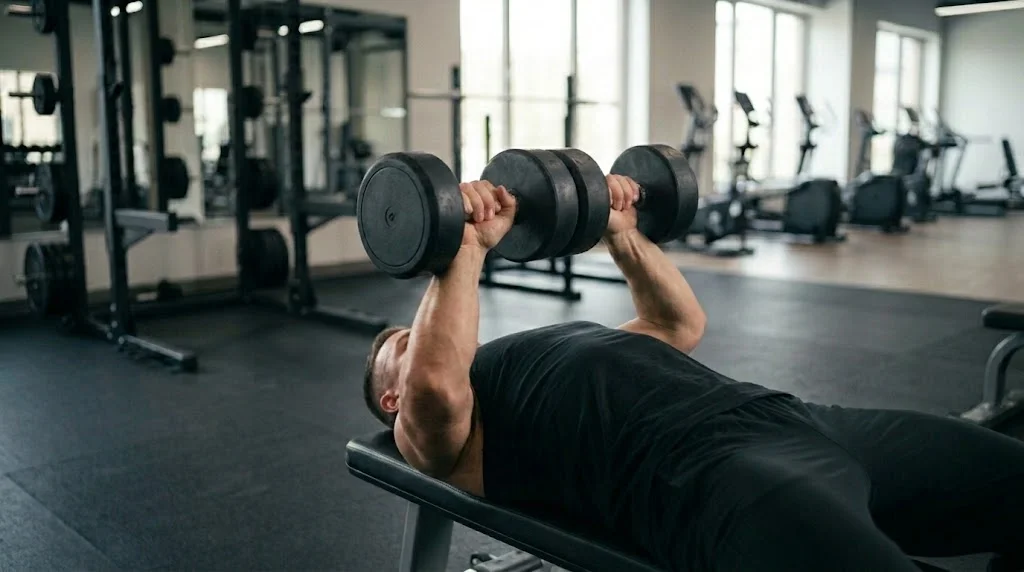
The incline chest press with resistance bands is a compound pressing movement performed on an incline bench with a band anchored behind you, training theupper chestagainst rising tension. Unlike a dumbbell press, the band is lightest at your chest and heaviest at lockout, so the clavicular pecs and front delts get the most load where they are strongest and your shoulders take little strain in the stretched position. The incline sets the press line toward your upper chest rather than your sternum. Beginners and home lifters use it as their main upper chest press early in a session.
What Muscles Does the Incline Chest Press with Resistance Bands Work?
- Primary: pectoralis major, clavicular head (upper chest)
- Secondary: anterior deltoid (front delt), triceps brachii
- Tertiary: serratus anterior, rotator cuff, rectus abdominis (bracing)
How Do You Set Up for the Incline Chest Press with Resistance Bands?
Set the bench to a 30 to 45 degree incline. Loop the band around the bench frame or a low anchor behind the bench so both ends meet at chest height when you lie back. Sit down, plant your feet flat, and press your upper back into the pad. Take a handle in each hand with an overhand grip and bring your fists beside your lower chest, elbows below your wrists, band already taut.
How Do You Perform the Incline Chest Press with Resistance Bands?
- Set your elbows roughly 45 degrees from your torso and your wrists stacked over them, band taut at your chest.
- Press the handles up and slightly inward along the incline until your arms are straight above your upper chest.
- Stop at lockout with your hands nearly touching and your elbows extended but not jammed; the band is at its tightest here.
- Hold for one count, squeezing your chest while keeping your shoulder blades pressed into the pad.
- Lower over two to three counts, letting your elbows travel down and out until your hands return beside your lower chest.
- Settle at the bottom with the band still taut and your shoulders pinned, ready for the next rep.
What Are the Key Form Cues?
- Keep your shoulder blades on the pad: they stay pulled back and down through lockout; only your arms move.
- Drive the handles together: push in as well as up so your chest, not your triceps, finishes the rep.
- Feel the band load your chest more with every inch and match it by pressing harder into the top.
- Keep your wrists straight over your elbows so the band pulls through your forearms, not your fingers.
- Keep your feet flat and your ribs down so the bench does the supporting, not your lower back.
What Are the Most Common Mistakes?
- Using a band that is too heavy: you shorten the press and let your elbows drop toward your hips; pick a band you can lock out for every rep of the set.
- Letting the handles drift forward: the band pulls your hands toward the anchor, so pressing straight up fights the wrong line; press along the incline slightly away from the anchor.
- Flaring your elbows to 90 degrees: with the shoulders open under the stretched band the front of the shoulder capsule takes the load; keep your elbows angled in.
- Arching off the bench: lifting your upper back turns the incline into a flat press; keep your back on the pad.
- Snapping into lockout: extending your elbows fast against a stretched band jolts the joint; finish the last inches under control.
What Are the Best Incline Chest Press with Resistance Bands Variations?
- Floor band chest press: lying flat with the band under your back, an easier entry for beginners.
- Single-arm incline band press: one handle at a time, forcing your core to resist rotation.
- Incline bench press with resistance band: a barbell incline with bands added, for lifters who want heavy loading.
- Band incline fly: elbows nearly straight and a wide arc, shifting work toward the stretch of the upper chest.
- Standing incline band press: the band anchored low behind you and pressed up at an angle.
How Do You Progress the Incline Chest Press with Resistance Bands?
- Move up one band resistance, or add a second light band, once you can lock out every rep at the top of your range.
- Work from 10 to 15 reps before changing bands.
- Add a fourth set once three sets feel easy at the same band.
- Shorten the band by gripping lower on it, or pause two counts at lockout, when a heavier band is not available.
How Should You Program the Incline Chest Press with Resistance Bands?
Program the incline chest press with resistance bands as the first press of a chest or upper body session, before fly and triceps work. Train it two to three times a week for 3 to 4 sets of 10 to 15 reps, resting 60 to 90 seconds between sets. Pair it with a band row or a face pull in the same session so the shoulders get balanced pushing and pulling work.