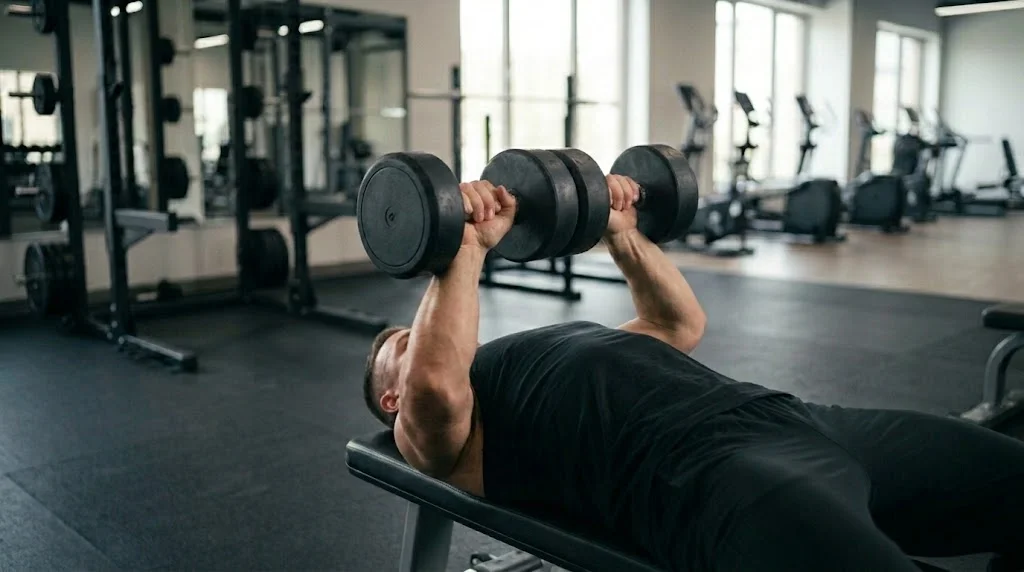
The incline dumbbell fly is an isolation exercise that develops the upper (clavicular) portion of thechestby moving the arms through a wide arc while lying on an inclinedbench. Setting the bench between 15 and 30 degrees emphasizes the upper pec fibers without adding significant load on the front shoulders or triceps. Because the movement isolates the chest through a long stretch-to-contraction range, it complements heavier pressing exercises that place less emphasis on that portion of the muscle.
What Muscles Does the Incline Dumbbell Fly Work?
- Primary: Pectoralis major, clavicular (upper) head
- Secondary: Anterior deltoids, pectoralis minor
- Tertiary: Biceps, forearms, rotator cuff (stabilizers)
How Do You Set Up for the Incline Dumbbell Fly?
Set an adjustable bench to a 15-30 degree incline and lie back with a dumbbell in each hand, arms pressed straight up over your upper chest and palms facing each other. Keep a soft, fixed bend in your elbows and plant your feet flat on the floor for a stable base. Retract your shoulder blades into the bench before starting the first rep.
How Do You Perform the Incline Dumbbell Fly?
- Press the dumbbells to full arm extension above your upper chest, palms facing inward
- Lower the dumbbells out to the sides in a wide arc, keeping the elbow bend constant throughout
- Continue the descent until your upper arms are roughly parallel to the floor and you feel a deep stretch across the chest
- Reverse the arc, driving the dumbbells back together over your upper chest using chest contraction, not shoulder or arm drive
- Squeeze the chest at the top of the movement where the dumbbells nearly touch
- Repeat for the desired number of reps, keeping the tempo controlled on both the lowering and lifting phases
What Are the Key Form Cues?
- Keep the same slight elbow bend throughout the set; don't let your arms straighten into a press
- Lower the weights only as far as your shoulder mobility comfortably allows
- Keep the bench angle shallow (15-30 degrees) to keep the emphasis on the chest rather than the shoulders
- Move slowly through the stretch at the bottom, since that portion of the range produces most of the training stimulus
- Keep your shoulder blades pinned to the bench to prevent the shoulders from rounding forward
What Are the Most Common Mistakes?
- Using excessive weight: heavy dumbbells force the elbows to bend more (turning the fly into a press) and put the shoulder in a vulnerable stretched position under load. Choose a moderate weight that allows a controlled full arc.
- Setting the bench too steep: angles beyond 45 degrees shift emphasis onto the front deltoids instead of the chest. Keep the incline between 15 and 30 degrees.
- Straightening the elbows: locking the arms transfers stress to the elbow joint and reduces chest tension. Maintain a fixed, soft bend throughout.
- Cutting the range of motion short: stopping the descent early reduces the stretch that drives chest development. Lower until you feel a full stretch across the chest.
- Bouncing at the bottom: rebounding out of the stretch relies on momentum instead of muscle control and increases strain on the shoulder. Lower under control and reverse the motion smoothly.
What Are the Best Incline Dumbbell Fly Variations?
- Flat dumbbell fly: targets the mid chest with the bench set horizontal
- Cable incline fly: uses pulleys instead of dumbbells to keep tension on the chest throughout the entire range, including the top
- Decline dumbbell fly: shifts emphasis toward the lower chest fibers
- Single-arm incline fly: unilateral variation that addresses strength imbalances between sides
How Do You Progress the Incline Dumbbell Fly?
- Increase the dumbbell weight in small increments only once you can complete every rep with a full, controlled stretch
- Add a 1-2 second pause at the top of the movement to increase peak contraction time
- Slow the eccentric phase to 3-4 seconds to increase time under tension
- Progress from a two-arm fly to a single-arm version to increase stability demands
How Should You Program the Incline Dumbbell Fly?
Program incline dumbbell flies as a chest isolation or finishing movement 1-2 times per week, after heavier pressing exercises like the barbell or dumbbell bench press. Three sets of 12-15 reps with 60 seconds of rest works well for hypertrophy. Choose a weight you can control through the full stretch on every rep rather than one that forces you to shorten the range of motion.