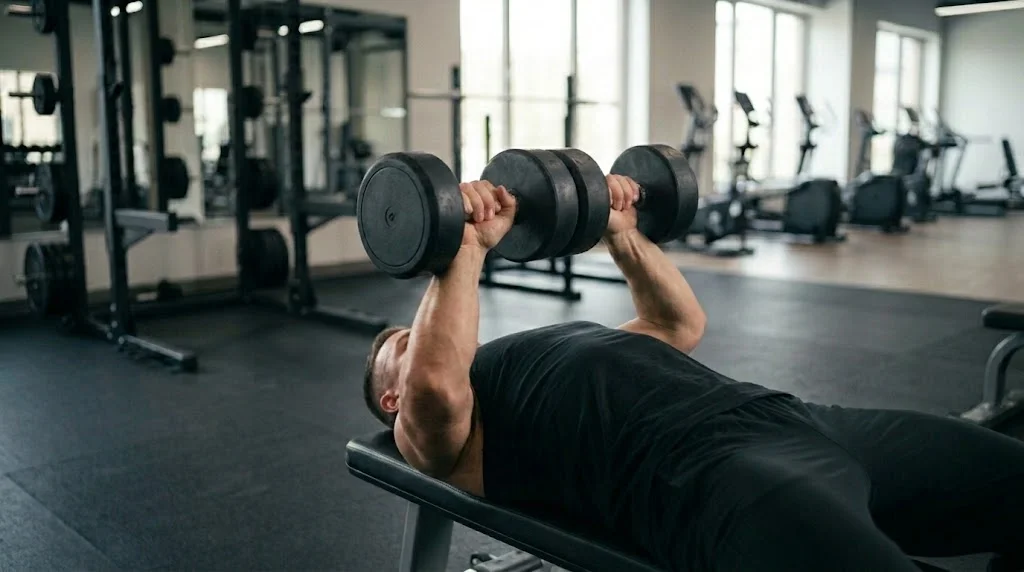
The rear delt seated fly is a dumbbell isolation exercise performed bent forward on the end of a flat bench, raising the arms out to the sides to train the posterior deltoid without lower back fatigue. Because your chest rests near your thighs, the torso cannot swing to help the dumbbells up, and the seat takes the hamstrings and spinal erectors out of the picture that a standing bent-over raise demands. The angle puts the rear delt directly against gravity at the top. Lifters program it late in a shoulder or pull session, after rows and presses.
What Muscles Does the Rear Delt Seated Fly Work?
- Primary: Posterior deltoid (rear delt)
- Secondary: Rhomboids, middle trapezius, infraspinatus and teres minor (rotator cuff)
- Tertiary: Erector spinae, triceps brachii, forearm flexors
How Do You Set Up for the Rear Delt Seated Fly?
Place a pair of light dumbbells on the floor at the end of a flat bench. Sit on the edge with your feet together and flat, then hinge forward until your chest rests just above your thighs with a flat back. Grasp the dumbbells with a neutral grip so they hang under your knees, elbows slightly bent. Let the shoulder blades hang loose and look at the floor a foot ahead.
How Do You Perform the Rear Delt Seated Fly?
- Set the elbow bend at a soft angle and turn your palms slightly down so the little fingers lead.
- Raise the dumbbells out to your sides, driving the elbows up and wide until the upper arms are level with your back.
- Stop when the elbows are as high as the shoulders; the dumbbells finish in line with your ears, not behind them.
- Hold the top for one second, feeling the rear delts pinch without the shoulder blades snapping together.
- Lower the dumbbells slowly along the same arc until they hang under your knees and the rear delts are stretched.
- Keep the chest on the thighs and the dumbbells off the floor, then start the next rep from the hang.
What Are the Key Form Cues?
- Lead with the elbows: the hands follow; if your hands rise first the biceps and forearms take over.
- Chest stays on the thighs: any lift of the torso is the lower back doing what the rear delts should.
- Aim the dumbbells at the walls beside you rather than up toward the ceiling.
- Keep the shoulder blades quiet through the middle of the rep; they may finish the last few degrees, not start the lift.
- Turn the thumbs slightly down at the top to keep the rear delt, not the lateral head, doing the work.
What Are the Most Common Mistakes?
- Picking dumbbells you have to heave: the torso bounces off the thighs and the traps finish the rep; use a load you can pause at the top.
- Sitting up between reps: the rear delt loses its position against gravity and the movement turns into a lateral raise; stay folded for the whole set.
- Pulling the elbows back toward the hips: the movement becomes a row and the lats take it; keep the arm path out to the side.
- Swinging the dumbbells behind the head at the top: the shoulder rolls into internal rotation under load, the position that pinches the rotator cuff under the acromion; stop with the hands in line with the ears.
- Shrugging the shoulders toward the ears: the upper traps take the work and the neck stiffens; pull the shoulders away from the ears before each rep.
What Are the Best Rear Delt Seated Fly Variations?
- Reverse pec deck: a machine version with chest support, the easiest way to learn the arm path.
- Dumbbell rear deltoid raise bent over: the standing version, harder because the lower back holds the hinge.
- Incline bench rear delt fly: chest down on a low incline bench for zero torso movement.
- Single-arm seated rear delt fly: one dumbbell at a time with the other hand on the bench, for a weaker side.
- Cable rear delt fly: crossed cables from a low pulley keep tension through the whole arc.
How Do You Progress the Rear Delt Seated Fly?
- Add 2.5 to 5 pounds per hand once you can hold the top position for a second on every rep of every set.
- Work from 12 reps up to 20 before adding weight.
- Add a set per week, from 3 up to 4 or 5.
- Slow the lowering phase to three seconds, or add a two-second hold at the top with the same dumbbells.
How Should You Program the Rear Delt Seated Fly?
Place the rear delt seated fly late in a shoulder or pull session, after rows and any pressing, when the rear delts are warm but not fatigued. Train it two to three times per week for 3 to 4 sets of 12 to 20 reps with 45 to 60 seconds of rest. Pair it with a face pull or a lateral raise so the shoulder gets rear and side work in the same block.