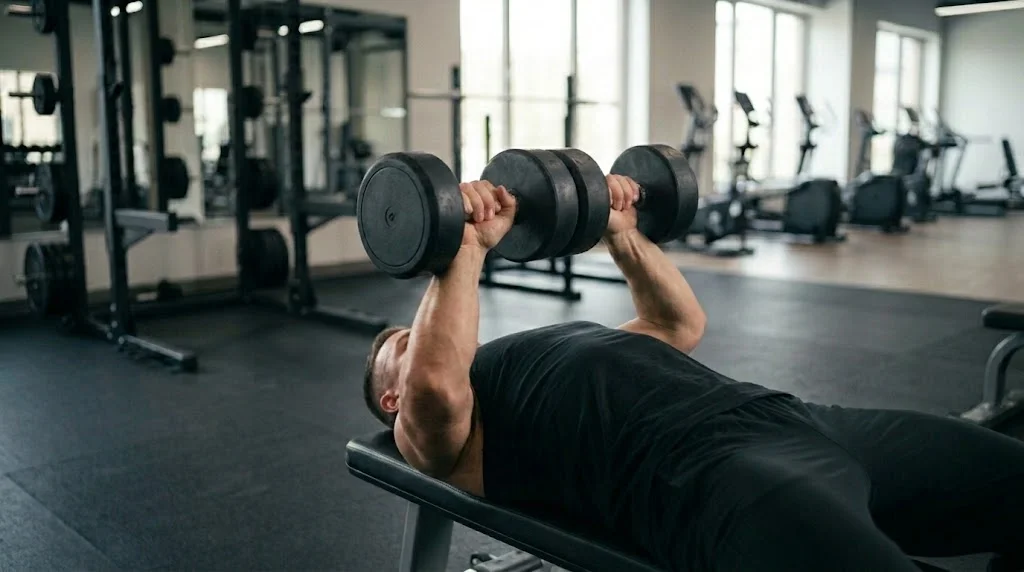
The French press is an overhead triceps extension, typically performed seated with anEZ barlowered behind the head. Because the upper arms stay fixed in a vertical, overhead position, the long head of thetricepsis placed under a deep stretch at the bottom of each rep, making this one of the more effective single-joint exercises for building the back of the upper arm. It requires more shoulder mobility than exercises like the close-grip bench press, so a controlled, moderate load is more valuable here than heavy weight.
What Muscles Does the French Press Exercise Work?
- Primary: Triceps brachii (long head emphasis)
- Secondary: Triceps brachii (lateral and medial heads)
- Tertiary: Anterior deltoids, core stabilizers (isometric)
How Do You Set Up for the French Press Exercise?
Sit on an upright bench with your feet flat on the floor. Grip an EZ bar with a shoulder-width, palms-up (or angled) grip on the bent portions of the bar, and press it overhead until your arms are fully extended and vertical. This is your starting position - upper arms close to your ears, elbows pointing forward, core braced to keep your ribs from flaring.
How Do You Perform the French Press Exercise?
- Keep your upper arms stationary and pointed toward the ceiling throughout the entire set
- Bend at the elbows only, slowly lowering the bar behind your head until you feel a deep stretch in the triceps
- Stop the descent once your forearms are roughly parallel to the floor or you reach a comfortable end range
- Reverse the motion by contracting the triceps to extend your elbows and press the bar back overhead
- Fully extend your arms at the top without locking out aggressively or letting the shoulders shrug
- Repeat for the desired number of reps, keeping the upper arms fixed on every rep
What Are the Key Form Cues?
- Lock the upper arms in place: Any forward or backward drift of the elbows turns the movement into a shoulder exercise
- Control the lowering phase: A slow, deliberate descent behind the head maximizes the stretch on the long head of the triceps
- Keep elbows pointed forward, not flared out to the sides, to keep tension on the triceps
- Brace your core to prevent your lower back from arching as the weight moves overhead
- Use a spotter or lighter load when performing this seated, since the bar path travels close to the head
What Are the Most Common Mistakes?
- Flaring the elbows out: Letting the elbows drift wide shifts stress toward the shoulders and reduces triceps isolation.
- Using too much weight: Excess load forces the upper arms to swing forward, turning the exercise into a partial overhead press.
- Cutting the range of motion short: Stopping before a full stretch behind the head reduces long-head activation, the exercise's main advantage.
- Arching the lower back: Overextending the spine to help move the weight increases lumbar strain and reduces triceps work.
- Rushing the eccentric: Dropping the bar quickly behind the head is both less effective and increases the risk of elbow or shoulder strain.
What Are the Best French Press Exercise Variations?
- Standing French press: Removes the bench and adds core and balance demands
- Single-arm dumbbell overhead extension: Unilateral version that addresses left-right strength imbalances
- Lying French press (skull crusher): Performed on a flat bench with the bar lowered toward the forehead instead of overhead
- Cable overhead triceps extension: Provides constant tension throughout the range, unlike free-weight versions
- Incline French press: Changes the angle of resistance for a different stretch and loading curve
How Do You Progress the French Press Exercise?
- Add weight in small increments: Triceps respond well to gradual loading - add 2.5-5 pounds per side once all sets hit the top of the rep range with clean form
- Build up reps before adding load: Progress toward 12-15 controlled reps before increasing the weight on the bar
- Add a pause at full stretch: Holding briefly at the bottom of the range increases time under tension and long-head recruitment
- Progress toward a standing version: Once seated form is solid, standing French presses add core and stability demands
- Superset with a compound press: Pairing this with close-grip bench press or dips increases total triceps volume as strength improves
How Should You Program the French Press Exercise?
Program the French press 2-3 times per week as a triceps isolation exercise, typically after compound pressing movements like the bench press or overhead press. Use 3-4 sets of 8-12 reps for hypertrophy, keeping rest periods at 60-90 seconds. Because the stretched position places real stress on the elbows and shoulders, prioritize strict form and a controlled tempo over maximal loading.