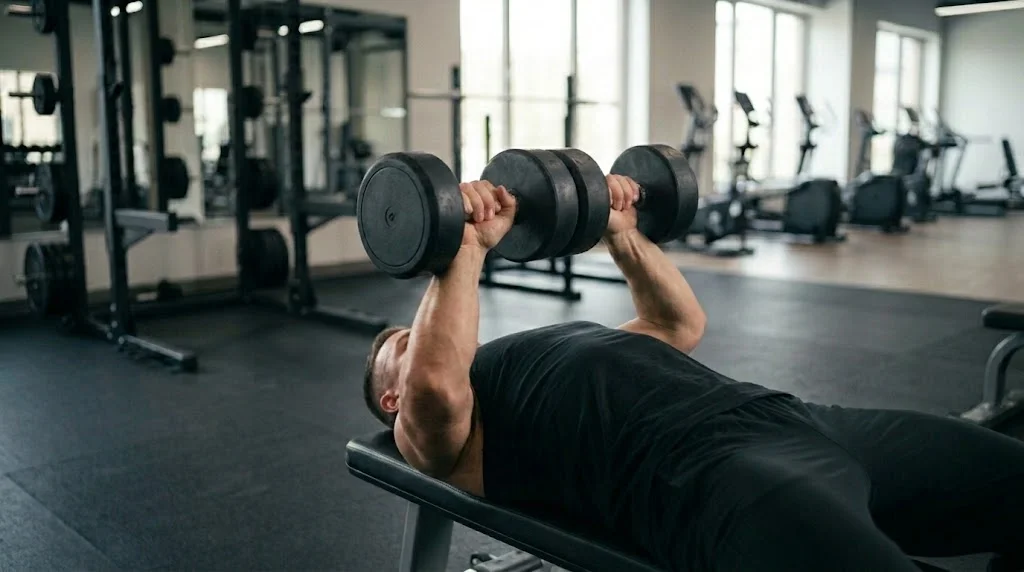
The lying French press, also known as the EZ-bar skull crusher, is a single-joint triceps exercise performed flat on a bench with a Z-shaped (EZ) bar. Bending only at the elbow to lower the bar toward the forehead isolates thetriceps brachiithrough a long range of motion under constant tension. The EZ bar's angled grips let the wrists sit in a more natural position than a straight bar, reducing wrist strain during the extension. It is commonly used as a triceps-building accessory after heavier pressing work.
What Muscles Does the French press lying on bench with Z bar Work?
- Primary: Triceps brachii (long, lateral, and medial heads)
- Secondary: Anconeus
- Tertiary: Wrist flexors and extensors (isometric grip stabilizers)
How Do You Set Up for the French press lying on bench with Z bar?
Lie flat on abenchwith your feet planted on the floor and your head, shoulders, and upper back fully supported. Grip the EZ bar on the angled inner grips, hands roughly shoulder-width apart, and lift it to arm's length directly above your shoulders. This is your starting position, with elbows extended but not locked and upper arms perpendicular to the floor.
How Do You Perform the French press lying on bench with Z bar?
- Brace your core and fix your upper arms in place, pointing straight up toward the ceiling
- Bend only at the elbows, lowering the bar in a controlled arc toward your forehead or just behind it
- Keep your upper arms stationary throughout the descent - only the forearms should move
- Lower until your forearms are roughly parallel to the floor or you feel a full triceps stretch
- Pause briefly at the bottom without letting the bar rest on your head
- Extend your elbows back to the starting position, driving through the triceps to full lockout
- Repeat for the desired number of repetitions, keeping the elbow path consistent every rep
What Are the Key Form Cues?
- Keep the elbows fixed and pointed at the ceiling: Movement should come only from the forearms, not from the shoulders drifting forward or back
- Control the descent: A slow, deliberate lowering phase is where most of the triceps stretch and stimulus occurs
- Choose a bar path slightly behind the head if you feel elbow strain lowering straight to the forehead
- Keep your feet flat and glutes engaged to avoid arching off the bench as the weight gets heavier
- Use a spotter or lighter load when trying a new weight, since the bar travels close to your face
What Are the Most Common Mistakes?
- Letting the elbows travel backward, toward the shoulders during the lower: This turns the movement into a pullover and shifts load off the triceps onto the lats and chest; keep the upper arms vertical throughout.
- Flaring the elbows outward: Widening the elbows reduces triceps tension and increases stress on the elbow joint; keep them tracking roughly parallel, pointed at the ceiling.
- Using too much weight: Excess load causes the bar to drift toward the face or forces the elbows to flare; drop the weight and prioritize a full, controlled range of motion.
- Arching the lower back off the bench: This is a sign the weight is too heavy or the core isn't braced; keep the lower back flat and feet planted.
- Bouncing the bar off the forehead: Using momentum at the bottom removes tension and risks injury; pause under control before pressing back up.
What Are the Best French press lying on bench with Z bar Variations?
- Standing EZ-bar overhead extension: Shifts the stretch to a fully overhead position and adds core stabilization demand
- Single-arm dumbbell skull crusher: Unilateral variation that addresses strength imbalances between arms
- Cable rope overhead extension: Provides constant tension and a different resistance curve than free weight
- Decline EZ-bar skull crusher: Increases stretch on the long head of the triceps by adjusting bench angle
- Close-grip bench press: A compound pressing alternative that still heavily loads the triceps
How Do You Progress the French press lying on bench with Z bar?
- Add weight in small increments: Triceps recover quickly, but the elbow joint does not - add 2.5-5 pounds per side only when form stays clean for all sets
- Build toward 12 reps before loading further: Increase reps within the 8-12 range before adding weight to the bar
- Add a controlled pause at the bottom: Pausing just short of the forehead increases time under tension without adding load
- Progress to a decline bench: A slight decline increases stretch on the long head once flat-bench form is mastered
- Alternate with single-arm dumbbell work: Unilateral sets expose and correct side-to-side strength imbalances as loads increase
How Should You Program the French press lying on bench with Z bar?
Program the lying EZ-bar French press one to two times per week as a triceps accessory following heavier compound pressing like bench press or overhead press. Use 8-12 reps for 3-4 sets with a controlled tempo, resting 60-90 seconds between sets. Because the bar travels close to the face and the elbow joint is under significant stress at the bottom, prioritize strict form and a spotter over chasing heavier loads.