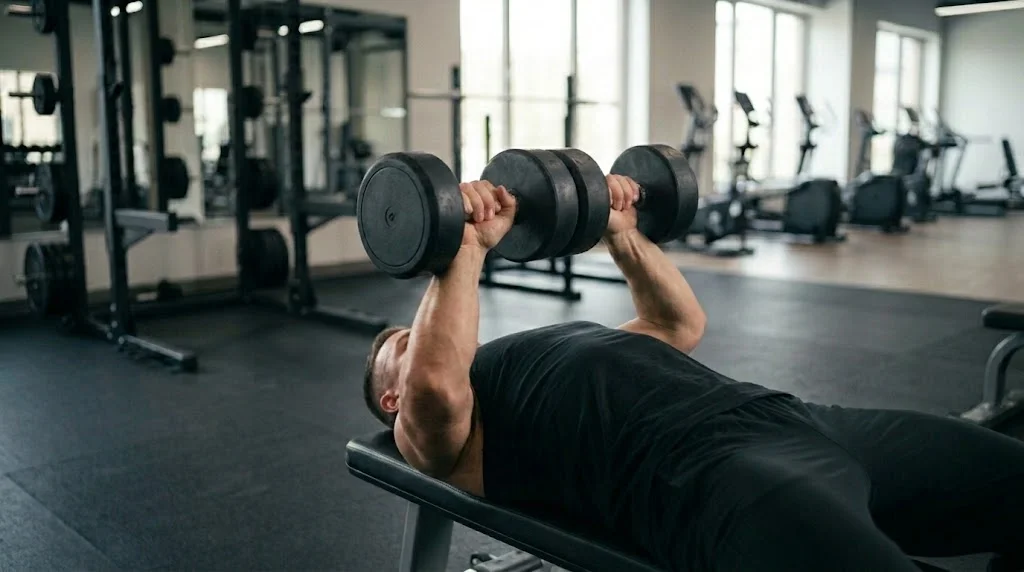
The incline barbell bench press is a compound pressing movement performed on abenchset to a 30-45 degree angle. By changing the angle of the torso, it shifts emphasis toward the upper (clavicular) fibers of thepectoralis majorand the anterior deltoids. It is a cornerstone exercise for building a complete, well-proportioned chest and pressing power overhead-adjacent lines.
What Muscles Does the Incline Barbell Bench Press Work?
- Primary: Pectoralis major (clavicular/upper head)
- Secondary: Anterior deltoid, triceps brachii
- Tertiary: Serratus anterior, pectoralis minor
How Do You Set Up for the Incline Barbell Bench Press?
Set an adjustable bench to roughly 30-45 degrees and lie back with your feet flat on the floor. Position your eyes under or just behind the bar, retract and depress your shoulder blades, and maintain a slight natural arch in your lower back. Grip the bar slightly wider than shoulder-width with a full grip (thumbs wrapped) and unrack it to a position over your upper chest.
How Do You Perform the Incline Barbell Bench Press?
- Unrack the bar and bring it to a stable starting point directly over your upper chest with arms extended
- Lower the bar under control toward the upper portion of your chest, just below the collarbone, keeping elbows at roughly a 45-75 degree angle relative to your torso
- Touch lightly at the upper chest without bouncing the bar
- Drive the bar up and slightly back toward the starting position, pressing through your chest and triceps
- Lock out at the top with the bar over your upper chest, keeping shoulder blades retracted
- Repeat for the desired reps, maintaining tension and a stable, set torso throughout
What Are the Key Form Cues?
- Keep the shoulder blades retracted and down: This protects the shoulders and creates a stable pressing base
- Touch high on the chest: The bar should meet your upper chest, not your sternum, to keep tension on the upper pecs
- Drive your feet into the floor: Leg drive stabilizes the body and supports a stronger press
- Control the descent: Lower the bar deliberately rather than dropping it to maintain tension and protect the shoulders
- Keep wrists stacked over elbows: A straight wrist transfers force efficiently and reduces strain
What Are the Most Common Mistakes?
- Setting the bench too steep: Angles above 45 degrees shift work to the front delts and away from the chest.
- Flaring the elbows excessively: Letting elbows reach 90 degrees stresses the shoulder joint - keep them moderately tucked.
- Bouncing the bar off the chest: Using momentum reduces muscle stimulus and risks injury.
- Losing the arch and scapular set: Letting shoulders round forward removes the stable base and exposes the joint.
- Lifting the hips off the bench: Excessive arching or hip lift turns the movement into a flat press and reduces control.
What Are the Best Incline Barbell Bench Press Variations?
- Incline dumbbell bench press: Greater range of motion and independent arm work
- Incline Smith machine press: Fixed bar path for added stability when training alone
- Low-incline barbell press: A shallower angle bridging flat and incline pressing
- Reverse-grip incline press: Underhand grip that further emphasizes the upper chest
- Paused incline press: A pause at the chest to build strength out of the bottom
How Do You Progress the Incline Barbell Bench Press?
- Increase weight gradually: Add small increments once you complete all reps with clean form
- Add reps before load: Work toward 8-12 controlled reps before increasing the bar weight
- Use tempo work: Slow the eccentric to 3-4 seconds to build control and time under tension
- Add paused reps: A 1-2 second pause at the chest develops bottom-end strength
How Should You Program the Incline Barbell Bench Press?
Program the incline barbell bench press 1-2 times per week, often as a primary upper-body pressing movement or directly after flat pressing. It responds well to 6-12 reps for hypertrophy and 3-6 reps for strength, with 2-3 minutes of rest between heavier sets. Because the angle places more demand on the shoulders, prioritize a thorough warm-up and conservative loading to keep the joint healthy.