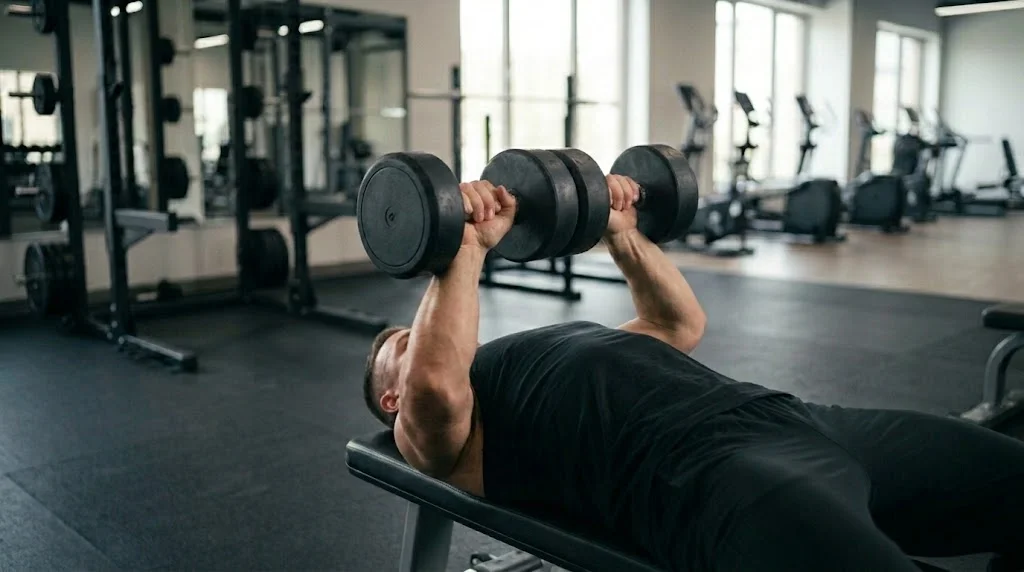
The decline barbell bench press is a horizontal pressing exercise performed on abenchangled 15 to 30 degrees head-down, with the feet secured under a roller pad. The decline angle changes the line of the press so the bar travels toward the lower chest, which recruits the sternal fibers of the pectoralis major more heavily than a flat or incline press. Because the shoulders sit in a less extended position at the bottom, many lifters find it more comfortable on the front delts and easier to keep the shoulder blades pinned. The shorter range of motion also means most people can handle more weight here than on a flat bench.
What Muscles Does the Decline Barbell Bench Press Work?
- Primary: Pectoralis major (lower, sternal fibers)
- Secondary: Triceps brachii, anterior deltoid
- Tertiary: Serratus anterior, core stabilizers
How Do You Set Up for the Decline Barbell Bench Press?
Set an adjustable bench to a 15 to 30 degree decline and hook your feet securely under the leg pads before lying back. Lie down with your eyes roughly under the bar, plant your upper back and glutes on the bench, and pull your shoulder blades back and down. Grip the bar slightly wider than shoulder width with a full thumb-around grip, and unrack it to a position directly over your lower chest with the elbows locked. A spotter is worth using here because the head-down position makes bailing out awkward.
How Do You Perform the Decline Barbell Bench Press?
- Unrack the bar and let it settle over your lower chest with straight arms and the shoulder blades retracted
- Take a breath and brace your midsection before the bar starts moving
- Lower the bar under control toward the lower portion of your chest, just below the nipple line
- Tuck the elbows to roughly 45 degrees from your torso rather than letting them flare straight out
- Touch the chest lightly without bouncing the bar off your ribcage
- Press the bar back up in a slight arc toward the starting point, driving through your palms
- Lock out and repeat, keeping the shoulder blades set for the entire set
What Are the Key Form Cues?
- Keep the shoulder blades pinned: Retract and depress the scapulae before the first rep and hold that position throughout
- Press to the lockout point, not straight up: The bar path curves slightly back toward the rack at the top
- Squeeze the bar hard: A tight grip increases upper-body tension and stabilizes the press
- Control the descent: Take about two seconds to lower the bar so the chest stays loaded
- Keep the head on the bench: Lifting the head to watch the bar breaks your upper back position
What Are the Most Common Mistakes?
- Bouncing the bar off the chest: Using the ribcage as a springboard removes tension from the chest and risks injury.
- Flaring the elbows to 90 degrees: Full flare puts the shoulder joint in a vulnerable position and reduces chest drive.
- Loading too heavy because the range is short: The shorter stroke tempts lifters into weights they cannot control at the bottom.
- Training without a spotter: The decline position makes it hard to sit up and rack the bar if a rep stalls.
- Letting the feet come loose: If the leg pads are not secure, you slide down the bench and lose your press groove.
What Are the Best Decline Barbell Bench Press Variations?
- Decline dumbbell press: Free-weight version with a longer range of motion and independent arms
- Decline close-grip bench press: Narrower grip shifting emphasis onto the triceps
- Decline Smith machine press: Fixed bar path allowing safer training without a spotter
- Reverse-grip decline press: Supinated grip increasing upper chest involvement
- Weighted dip: A bodyweight alternative that loads the lower chest in a similar line
How Do You Progress the Decline Barbell Bench Press?
- Increase weight gradually: Add 5 pounds once you can complete every rep with a controlled two second descent
- Increase reps first: Work up to 10 to 12 clean reps before adding load
- Add a pause: Hold the bar one second on the chest to remove any bounce and build starting strength
- Balance your pressing: Pair decline work with incline pressing so the whole chest develops evenly
How Should You Program the Decline Barbell Bench Press?
Use the decline barbell bench press as a primary or secondary press in your chest session, typically for 6 to 10 reps. Rest 2 to 3 minutes between working sets. It works well as the main press on a second weekly chest day when the flat bench is already covering your heavy pressing, or as a follow-up movement after incline work when lower chest thickness is the goal. Because the decline angle limits how far the shoulders extend, it is often a good substitute for lifters whose front delts get irritated by flat benching.
Frequently Asked Questions
What does the decline bench press work that the flat bench does not?
The decline bench press biases the lower, sternal fibers of the pectoralis major more than a flat press does. The 15 to 30 degree head-down angle also shortens the range of motion and keeps the shoulders in a less extended bottom position, which is why many lifters press more weight on a decline with less front-shoulder discomfort.
Is the decline bench press worth doing?
Yes, the decline bench press is worth including if lowerchestthickness is a goal or if flat benching irritates your shoulders. It should complement flat and incline pressing rather than replace them, since the three angles together develop the full chest.
How much weight should I use on the decline bench press?
Most lifters can decline press 5 to 10 percent more than their flat bench because the range of motion is shorter. Start lighter than that until you are comfortable with the head-down position, and always use a spotter or safety pins, since racking a failed rep is harder on a decline bench.