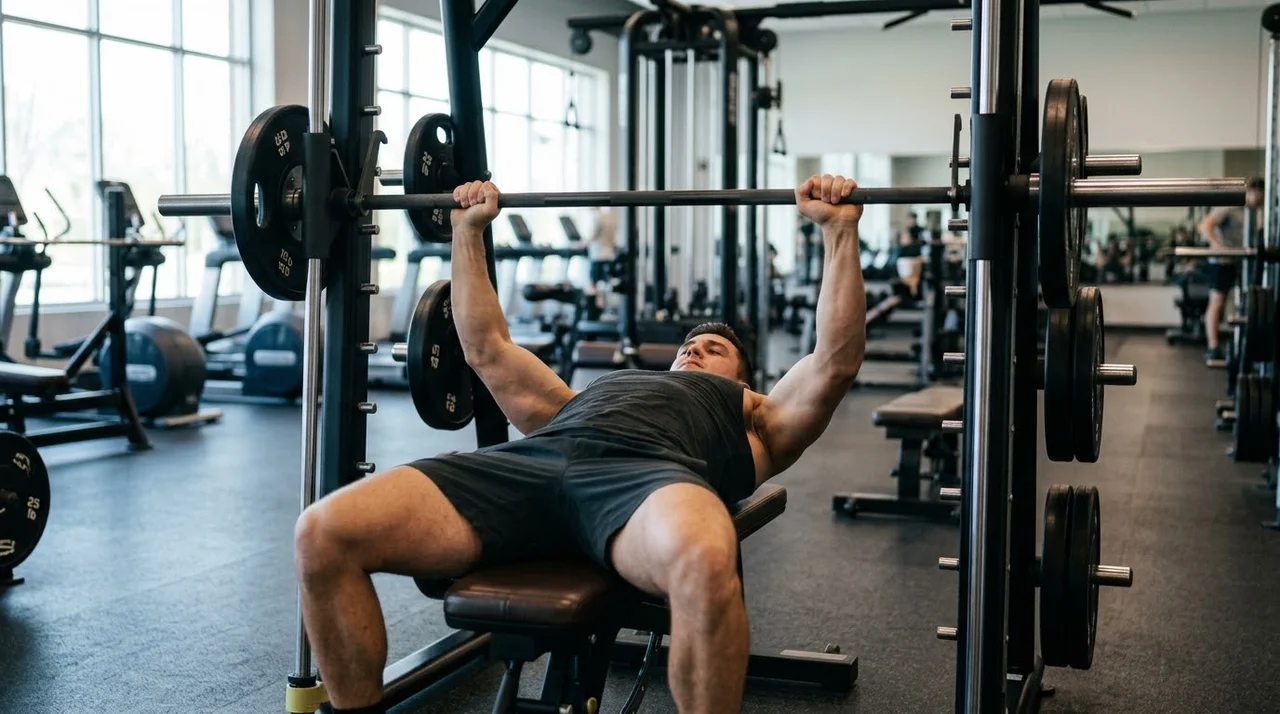
The Smith machine bench press is a chest press performed with a barbell fixed to vertical rails, so the bar travels in a single straight line. Removing the need to balance the bar means thechest,triceps, and front deltoids can work without stabilizers cutting the set short, and the rotating safety hooks let you rack the bar at any height if a rep stalls. That makes it a practical way to train heavy or to failure when no spotter is available. The fixed path also makes it easy to hit the same touch point every rep, which is useful when the goal is consistent, repeatable chest work rather than maximal free-weight strength.
What Muscles Does the Smith Machine Bench Press Work?
- Primary: Pectoralis major
- Secondary: Triceps brachii, anterior deltoid
- Tertiary: Serratus anterior, upper back stabilizers
How Do You Set Up for the Smith Machine Bench Press?
Position a flat bench centered under the Smith machine bar and lie down so the bar sits directly over your mid to lower chest. Because the bar path is fixed, adjust the bench position rather than your body until the line is right. Plant your feet flat on the floor, press your upper back into the bench, and pull your shoulder blades together and down. Grip the bar slightly wider than shoulder width, then rotate the bar to unhook it from the safety catches and hold it at arm's length.
How Do You Perform the Smith Machine Bench Press?
- Unhook the bar by rotating your wrists and press it up to a straight-arm start position
- Take a breath and brace with the shoulder blades pinned back and down
- Lower the bar under control toward your mid to lower chest over two to three seconds
- Tuck the elbows to roughly 45 degrees rather than flaring them straight out
- Touch the chest lightly without letting the bar rest or bounce
- Press back up along the rails until the arms are extended
- Rehook the bar at the top by rotating your wrists once the set is finished
What Are the Key Form Cues?
- Set the bench, not your body: Slide the bench to match the fixed bar path instead of shifting your torso
- Keep the shoulder blades retracted: A pinned upper back protects the shoulders and improves leverage
- Feet planted, hips down: Stay in contact with the bench so you press from a stable base
- Control the descent: Without a spotter, a slow eccentric is your safety margin
- Know where the hooks are: Practice the racking rotation with light weight before going heavy
What Are the Most Common Mistakes?
- Bench positioned wrong: If the bar lands on the throat or the belly, the bench needs to move, not your press.
- Bouncing the bar off the chest: The fixed path makes bouncing easy and it removes tension while risking rib injury.
- Flaring the elbows to 90 degrees: A full flare puts the shoulder in a vulnerable position under a fixed bar path.
- Forgetting to unhook fully: A partially rotated bar can catch on the safety pins mid-rep.
- Treating it as equal to free-weight bench: The Smith machine removes stabilizer demand, so numbers do not transfer directly.
What Are the Best Smith Machine Bench Press Variations?
- Incline Smith machine press: Bench angled up to bias the upper chest
- Decline Smith machine press: Head-down angle emphasizing the lower chest
- Close-grip Smith machine press: Narrow hands shifting load onto the triceps
- Paused Smith machine press: One to two second pause on the chest to build starting strength
- Barbell bench press: Free-weight version requiring full stabilization
How Do You Progress the Smith Machine Bench Press?
- Increase weight gradually: Add 5 pounds once you complete all reps with a controlled descent
- Increase reps: Build to 10 to 12 reps before moving up in load
- Add a pause: Hold the bar one second at the chest to remove any rebound
- Train to failure safely: Use the hooks to push the last set closer to failure than you would free-weight
How Should You Program the Smith Machine Bench Press?
Use the Smith machine bench press for 3 to 4 sets of 6 to 12 reps on chest or push days. Rest 2 to 3 minutes between heavier sets. It fits well as a primary press when training alone, or as a volume movement after free-weight pressing. Since the machine handles stabilization, this is a good place to push intensity techniques like drop sets or rest-pause work that would be unsafe with a loose barbell.
Frequently Asked Questions
Is the Smith machine bench press as effective as a barbell bench press?
The Smith machine bench press builds the chest, triceps, and front delts effectively, and the fixed path lets you press safely to failure without a spotter. It recruits fewer stabilizer muscles than a free barbell, so strength gained on the Smith machine does not transfer one-to-one to free-weight benching.
Where should the bench be positioned under the Smith machine?
Place the bench so the bar touches your mid to lower chest at the bottom of the press. Because the bar path is fixed, you adjust the bench position, not your body: if the bar lands near your throat or your belly, slide the bench, test with an empty bar, and only then load it.
Can I train to failure on the Smith machine bench press?
Yes, training to failure is one of the main advantages of the Smith machine bench press, because rotating the wrists hooks the bar onto the safety catches at any height. That makes it the right place for drop sets and rest-pause work that would be unsafe with a free barbell and no spotter.