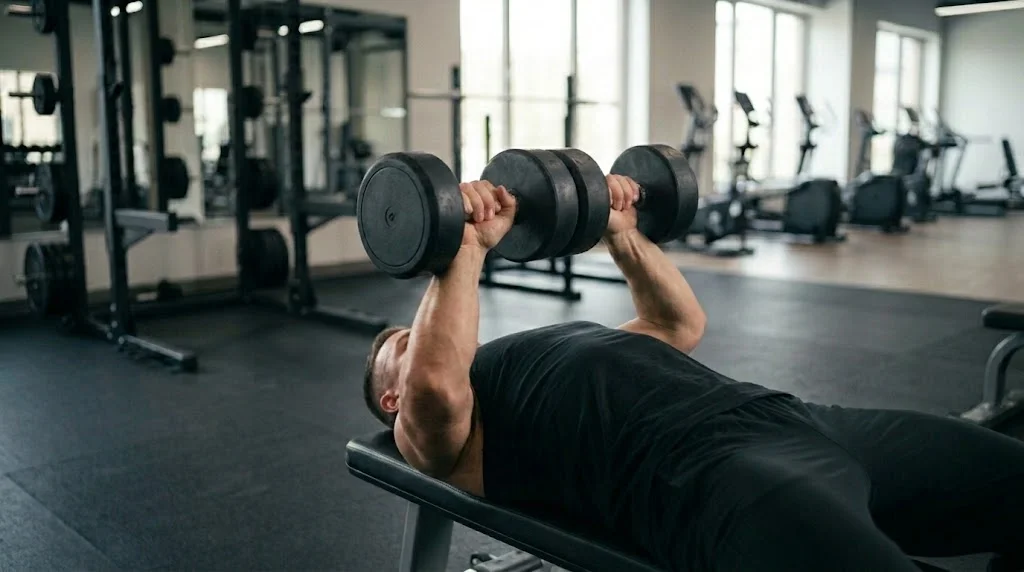
The hammer military press is a standing overhead dumbbell press performed with a neutral, palms-facing grip that trains the deltoids while the elbows travel in front of the body. Here "hammer" means the grip, not a machine: the handles stay parallel, so the upper arms sit about 30 degrees in front of the shoulders rather than out to the sides, the front delt and upper chest share more of the load, and the joint moves in the scapular plane, which many lifters find easier than a palms-forward press. Lifters program it first on ashoulderday.
What Muscles Does the Hammer Military Press Work?
- Primary: Anterior and lateral deltoid (front and side shoulder)
- Secondary: Triceps brachii, upper trapezius, clavicular pectoralis major (upper chest)
- Tertiary: Serratus anterior, rotator cuff, rectus abdominis
How Do You Set Up for the Hammer Military Press?
Stand with your feet hip to shoulder width apart and a dumbbell in each hand. Clean the dumbbells to your shoulders and turn the handles so your palms face each other, knuckles pointing at the ceiling. Set the elbows just in front of the shoulders and pointing at the floor, wrists stacked over the elbows. Squeeze your glutes, brace your abs and stand tall with the dumbbells resting at collarbone height.
How Do You Perform the Hammer Military Press?
- Set the elbows slightly in front of the shoulders with the handles parallel and the forearms vertical.
- Press both dumbbells straight up, keeping the palms facing each other as the elbows rise past ear height.
- Finish with the arms locked overhead, dumbbells a few inches apart and directly above the shoulders and hips.
- Hold the top for one count, pushing the head slightly forward between the dumbbells so the biceps sit beside the ears.
- Lower under control along the same path until the dumbbells touch down at collarbone height.
- Reset the elbows in front and the palms facing each other, then start the next rep.
What Are the Key Form Cues?
- Thumbs point back at the top: keep the handles parallel all the way up so the elbows stay in front and the grip stays neutral.
- Ribs down, glutes tight: brace before each press so the lower back does not arch as the dumbbells pass your face.
- Drive the elbows up under the dumbbells during the press rather than letting them drift out wide.
- Push your head through at lockout so the dumbbells finish over the middle of the foot.
- Lower the dumbbells until they touch the shoulders on every rep to keep the range full.
What Are the Most Common Mistakes?
- Loading it like a seated press: without a backrest the weight forces a backward lean and a chest press; drop 5 to 10 pounds a hand until you stand tall through every rep.
- Turning the palms forward as the dumbbells rise: the elbows flare and the lift becomes an ordinary military press; keep the handles parallel to the top.
- Arching the lower back to finish the press: the lumbar spine takes the load the shoulders could not move; brace the abs and end the set when the ribs lift.
- Stopping with the dumbbells in front of the head: the lateral delt never reaches its shortest position and the triceps miss lockout; finish over the shoulders.
- Bouncing the dumbbells off the shoulders: the stretch reflex does the first inch of the press; touch down and pause for a count.
What Are the Best Hammer Military Press Variations?
- Seated hammer dumbbell press: a backrest removes the bracing demand for lifters who cannot keep the ribs down standing.
- Single-arm hammer military press: one dumbbell at a time asks the obliques to stop the torso leaning away from the load.
- Standing dumbbell military press: palms forward, elbows out wide, more lateral delt.
- Arnold press: starts palms-in at the chin and rotates to palms-forward at the top.
- Kettlebell hammer press: the bell rests on the forearm, so the wrist works to keep the handle vertical.
How Do You Progress the Hammer Military Press?
- Add 5 pounds a hand once you press every set for the top of the rep range with the palms still facing each other at lockout.
- Build from 6 reps a set to 10 before each dumbbell jump.
- Add a fourth set when three sets no longer leave the front and side delts fatigued.
- Slow the descent to a three-count and pause for one second at the shoulders before pressing.
How Should You Program the Hammer Military Press?
Place the hammer military press first on a shoulder day or as the second press of an upper-body day after a barbell overhead press, once or twice a week. Work 3 to 4 sets of 6 to 10 reps with 90 to 120 seconds of rest. Pair it with a lateral raise or upright row afterwards, since the neutral grip leaves the side delt less worked than a palms-forward press.