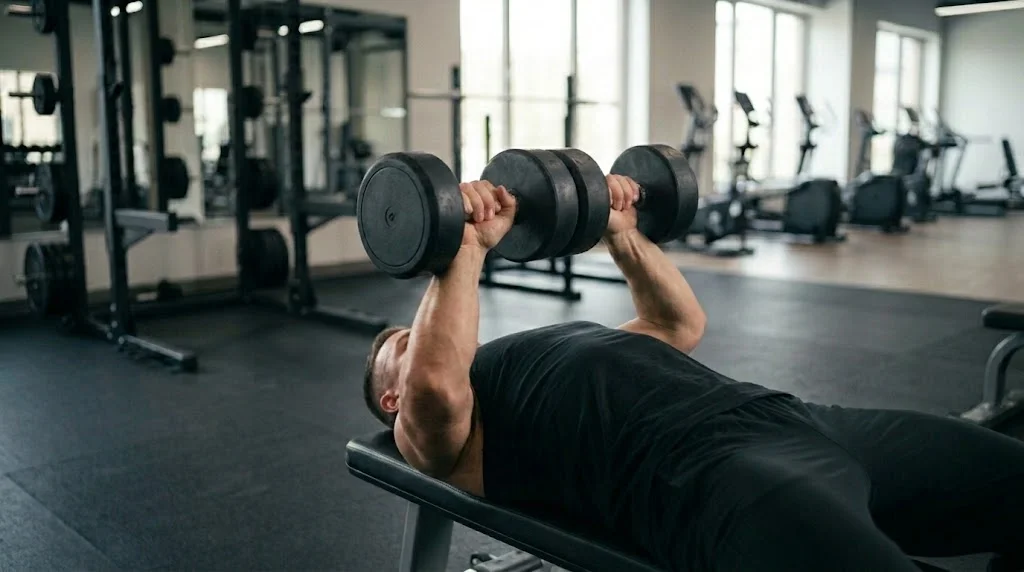
The Swiss ball tricep dip is a bench dip with the hands on a stability ball, adding a balance demand that forces the triceps to control an unstable surface. The ball moves under load, so you cannot grind through a rep with sloppy shoulders the way a fixed bench allows, and the working weight stays lower than on a bar dip. Treat it as a control-focused triceps accessory rather than a strength builder.
What Muscles Does the Swiss Ball Tricep Dip Work?
- Primary: triceps brachii
- Secondary: anterior deltoids, pectoralis major (lower chest)
- Tertiary: abs, serratus anterior, forearm flexors
How Do You Set Up for the Swiss Ball Tricep Dip?
Set a stability ball against a wall so it cannot roll away. Sit in front of it and place your palms on top of the ball, fingers pointing forward and hands about shoulder-width apart. Walk your feet out until your legs bend at 90 degrees with the heels on the floor. Straighten your arms and lift your hips off the ground.
How Do You Perform the Swiss Ball Tricep Dip?
- Press your hands into the ball and set the shoulder blades down before the first rep.
- Bend your elbows and lower your hips straight down, keeping them close to the ball.
- Keep the elbows pointing back, tracking over the hands rather than flaring outward.
- Stop when the upper arms reach parallel to the floor, or when the shoulders start to shrug.
- Press through your palms to straighten the arms without locking them out hard.
- Pause at the top to steady the ball, then start the next rep.
What Are the Key Form Cues?
- Keep the chest up: leaning forward moves the load onto the shoulders and off the triceps.
- Hips close to the ball: drifting forward turns the dip into a long, shallow slide.
- Spread your fingers wide to steady the ball under your hands.
- Move slowly, since speed on an unstable surface is what pushes the shoulders out of position.
- Keep your heels planted so the legs help control the descent.
What Are the Most Common Mistakes?
- Letting the shoulders shrug up: a shrugged descent grinds the front of the shoulder and takes the triceps out.
- Going too deep: the bottom of a dip with the hands behind you is the position most likely to irritate the shoulder.
- Using a ball that rolls: an unsupported ball on a smooth floor slides out mid-set, so wedge it against a wall.
- Straightening the legs too early: long legs load the arms heavily before the balance has been trained.
- Locking the elbows hard: snapping into extension under bodyweight adds joint stress for no extra muscle work.
What Are the Best Swiss Ball Tricep Dip Variations?
- Bench dip: the same movement on a stable surface, for building strength first.
- Feet-elevated Swiss ball dip: putting the feet on a bench adds load to the arms.
- Parallel bar dip: a stronger version with the whole bodyweight on the arms.
- Close-grip push-up: a floor alternative that trains the triceps without the shoulder position.
- Weighted bench dip: a plate on the thighs adds resistance once bodyweight is easy.
How Do You Progress the Swiss Ball Tricep Dip?
- Build to 12 to 15 controlled reps before you make the exercise harder.
- Straighten your legs one notch at a time to add load.
- Add a two-second pause at the bottom, where the balance demand peaks.
- Add a plate on the thighs only when the ball stays still through every rep.
How Should You Program the Swiss Ball Tricep Dip?
Use the Swiss ball tricep dip at the end of a pressing session, for 3 sets of 10 to 15 reps with 45 to 60 seconds of rest. Twice a week is enough directtricepswork alongside pressing. It pairs well with an overhead triceps extension, which loads the long head in the stretched position this dip barely reaches.