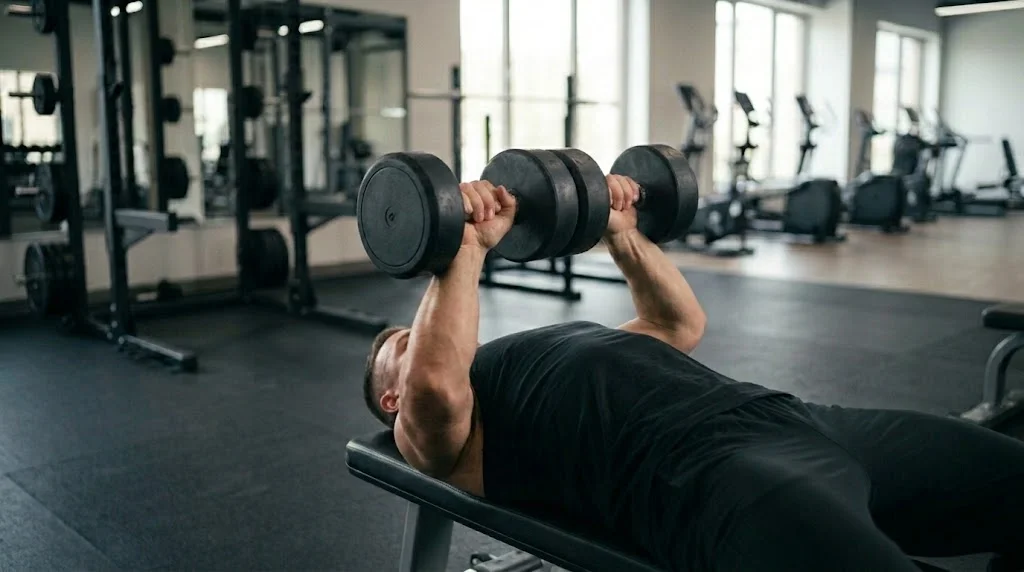
The French press on a stability ball is a dumbbell triceps extension performed while lying supine on a stability ball, combining classic overhead elbow-extension work with added core-stability demands. It isolates thetricepsthrough a full stretch-to-contraction range while forcing the abs, glutes, and hips to keep the torso from rolling off the ball. Because the ball removes the fixed support a bench provides, this variation suits lifters who already have solid triceps extension technique and want an extra stability challenge.
What Muscles Does the French Press on Stability Ball Work?
- Primary: Triceps brachii (all three heads)
- Secondary: Core stabilizers (rectus abdominis, obliques, glutes)
- Tertiary: Anterior deltoids (isometric stabilization at the shoulder)
How Do You Set Up for the French Press on Stability Ball?
Sit on the stability ball holding a dumbbell in each hand (or one dumbbell gripped with both hands), then walk your feet forward and roll down until your head, neck, and upper back rest on the ball, hips lifted so your torso stays roughly parallel to the floor. Set your feet flat, knees bent to about 90 degrees, hip-width apart. Press the dumbbell(s) to full arm extension above your face, palms facing each other, upper arms pointed straight up.
How Do You Perform the French Press on Stability Ball?
- Brace your core and glutes to hold a stable, flat bridge across the ball before moving any weight
- Fix your upper arms in place, pointed toward the ceiling, and keep them stationary for the entire set
- Bend only at the elbows, lowering the dumbbell(s) back behind your head until your forearms are roughly parallel to the floor
- Pause briefly at the bottom where you feel a full stretch through the triceps
- Extend your elbows to press the dumbbell(s) back to full lockout above your face, squeezing the triceps at the top
- Repeat for the desired reps while keeping your hips level and the ball still beneath you
What Are the Key Form Cues?
- Keep your upper arms vertical and motionless - only the forearms travel
- Keep your hips up in a stable bridge; don't let them sag toward the floor
- Control the descent so the weight doesn't drop toward your head
- Keep elbows tracking forward, not flared out to the sides
- Brace your core throughout to keep the ball from rolling under you
What Are the Most Common Mistakes?
- Flaring the elbows outward, which shifts load onto the shoulders and reduces triceps isolation - keep elbows pointed forward
- Letting the hips sag, which reduces core engagement and can strain the lower back - squeeze the glutes and keep hips level with the knees
- Using too heavy a dumbbell, which compromises elbow position and ball balance - start light and add weight gradually
- Letting the upper arms drift during the rep, turning the movement into a shoulder press - lock the upper arms in place
- Losing balance on the ball, a sign of insufficient core control - master the bridge position with no weight before loading it
What Are the Best French Press on Stability Ball Variations?
- Skull crusher on a flat bench: removes the balance demand so you can load the triceps more heavily
- Single-dumbbell two-hand French press: keeps both hands on one dumbbell for symmetric loading
- Single-arm dumbbell French press on the ball: unilateral version that addresses side-to-side imbalances
- Cable overhead triceps extension: a standing, constant-tension alternative using a rope attachment
- EZ-bar French press on a bench: bar variation that allows heavier loading with less wrist strain
How Do You Progress the French Press on Stability Ball?
- Practice the bridge position with light or no weight until it's rock solid before adding load
- Add weight in small 2.5-5 pound increments as elbow control improves
- Slow the eccentric (lowering) phase to increase time under tension
- Progress to the single-arm variation once you can control 10-12 solid reps on both sides
How Should You Program the French Press on Stability Ball?
Program the French press on a stability ball as a triceps isolation or finishing movement 1-2 times per week, typically after heavier pressing compounds. Use 2-3 sets of 10-15 reps with a light-to-moderate dumbbell and 60-75 seconds of rest between sets. Prioritize a stable bridge and full range of motion over adding weight.