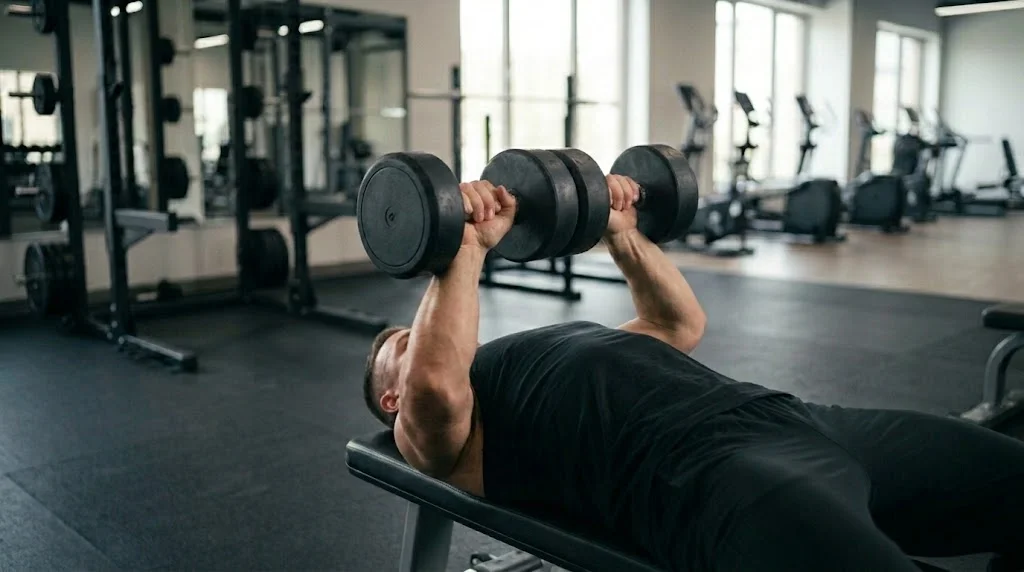
The supine kettlebell horn tricep extension is a lying isolation exercise performed with both palms clamped on the horns of one kettlebell to train thetriceps. The horn grip puts a hand on each vertical side of the handle, so the bell hangs below your wrists and the load pulls back over your forehead instead of sitting on top of your fists. That hanging mass keeps tension on the long head at full elbow flexion, where a dumbbell goes slack. Use it as an arm accessory after pressing.
What Muscles Does the Supine Kettlebell Horn Tricep Extension Work?
- Primary: Triceps brachii (long head)
- Secondary: Triceps brachii (medial and lateral heads), anconeus
- Tertiary: Forearm flexors (grip), anterior deltoid, rectus abdominis
How Do You Set Up for the Supine Kettlebell Horn Tricep Extension?
Stand one kettlebell on the end of a flat bench, sit down, and grip the horns with one palm on each vertical side. Lie back with your feet flat on the floor and your shoulder blades and hips pressed into the pad. Press the bell to arm's length over your chest, then rock the upper arms back until the elbows point at the ceiling and the bell hangs behind your hands.
How Do You Perform the Supine Kettlebell Horn Tricep Extension?
- Set the upper arms vertical with the elbows over your shoulders and the bell hanging past your wrists.
- Bend the elbows, letting the bell travel back and down toward the bench behind your head.
- Stop when the bell brushes the pad behind your crown and your forearms rest close to your biceps.
- Hold the stretched position for one count with the horns squeezed and the upper arms unmoved.
- Straighten the elbows and drive the bell back up along the same arc until the arms lock over your chest.
- Squeeze the triceps at the top, then rock the upper arms back to reset the hanging load.
What Are the Key Form Cues?
- Pinch the horns: Squeeze both handles inward all rep long so the bell cannot rotate out of your palms.
- Elbows point at the ceiling: Keep them stacked over the shoulders while only the forearms swing.
- Let the weight sit behind your knuckles rather than balanced above them.
- Keep the ribs down and the lower back flat on the bench as the bell passes overhead.
- Feel the stretch deep in the back of the armpit at the bottom before you reverse.
What Are the Most Common Mistakes?
- Loading a bell you can only press: the elbows flare and drift toward your hips, so drop to a size you can lower slowly.
- Gripping the handle across the top instead of the horns: the bell rides on your fists and the long head loses its stretch, so reset the hands to the sides.
- Letting the elbows swing wide: the shoulders take over and the load shifts to the chest, so hold the upper arms narrow.
- Lowering onto the crown of your head: the bell rests on bone and can pinch the neck, so aim it past your head to the pad.
- Arching the lower back to finish a rep: the ribs flare and the hips lift off the bench, so stop the set there.
What Are the Best Supine Kettlebell Horn Tricep Extension Variations?
- Floor horn extension: the floor stops the bell early, useful while you learn the arc.
- Seated overhead horn extension: an upright torso lengthens the long head further.
- Single arm kettlebell horn extension: one bell, one hand on the horn, exposing side to side gaps.
- Incline horn extension: a 30-degree bench angles the arc back behind the head.
- Two dumbbell skull crusher: the same elbow path with the load stacked above the hands.
How Do You Progress the Supine Kettlebell Horn Tricep Extension?
- Move up one bell size, usually 4 to 8 pounds, once every set hits the top of the rep range.
- Build from 10 to 15 reps at the current bell before you change bells.
- Add a fourth set when three no longer leave the back of the arms burning.
- Lower for a three-count and hold the bottom for two when the next bell is too big a jump.
How Should You Program the Supine Kettlebell Horn Tricep Extension?
Run the supine kettlebell horn tricep extension late in a push or arm session, after bench pressing and dips. Train it 1 to 2 times per week for 3 to 4 sets of 10 to 15 reps, resting 45 to 60 seconds between sets. Pair it with a pushdown so the lateral head gets work in a short-arm position too.