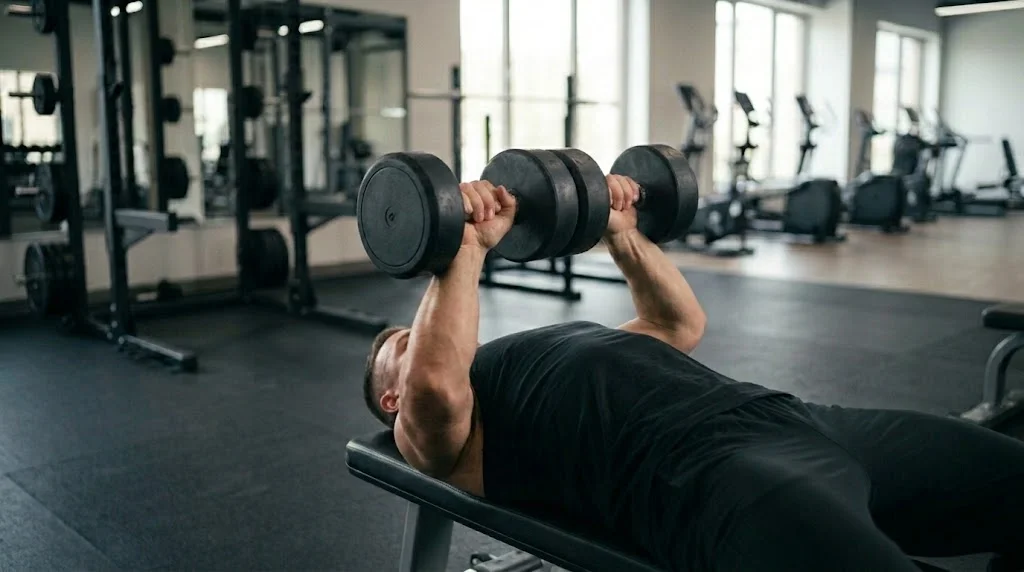
The supine barbell French curl is a lying triceps extension performed on a flat bench with a barbell, lowering the bar toward the forehead to train thetricepsthrough a long range. Despite the word curl in the name, nothing curls: the elbows are the only joint that moves. Lying flat puts the long head under stretch when the bar is behind the head, and the straight bar loads both arms evenly, which the dumbbell version cannot. Lifters program it as the first triceps accessory after pressing, usually with an EZ bar swapped in when the wrists complain.
What Muscles Does the Supine Barbell French Curl Work?
- Primary: Triceps brachii (long and lateral heads)
- Secondary: Anconeus, triceps medial head
- Tertiary: Pectoralis major, anterior deltoid, forearm flexors (grip)
How Do You Set Up for the Supine Barbell French Curl?
Set a flat bench and load a barbell you can press for 15 clean reps. Lie on your back with your feet flat on the floor and your head at the end of the bench. Take an overhand grip just inside shoulder width, press the bar to arm's length above your chest, then angle your upper arms back so the bar sits over your forehead with the elbows pointing at the ceiling.
How Do You Perform the Supine Barbell French Curl?
- Fix your upper arms at a slight backward angle and point the elbows at the ceiling.
- Bend the elbows to lower the bar in an arc toward the top of your forehead over two counts.
- Stop when the forearms pass parallel to the floor and the bar hovers just above the hairline.
- Pause for one count with the triceps under full stretch and the elbows still.
- Extend the elbows to drive the bar back up along the same arc until the arms are straight.
- Reset the elbow position over the forehead, wrists straight, before starting the next rep.
What Are the Key Form Cues?
- Elbows stay narrow: keep them no wider than the shoulders through the lowering phase; flaring puts the load on the shoulders.
- Upper arms do not move: the humerus stays angled back the whole rep and only the forearm swings.
- Feel the stretch behind the upper arm at the bottom before you drive up.
- Keep the wrists straight and knuckles pointing back so the bar tracks over the forehead, not the face.
- Push the bar up and slightly back rather than straight up to keep tension on the long head at the top.
What Are the Most Common Mistakes?
- Loading too heavy and bouncing the bar off the bottom: the stretch reflex does the work and the elbows take the rebound, so drop the weight until a two-count lower is controlled.
- Letting the elbows flare wide: the movement becomes a narrow press and the chest takes over, so keep them in line with the shoulders.
- Lowering the bar to the chin or nose: the upper arms drift vertical and the long head loses stretch, so aim for the hairline with the arms angled back.
- Locking out hard and resting at the top: tension leaves the triceps, so stop short of a snap lockout and start the next rep.
- Arching the back and driving with the legs: the bar moves but the triceps do not, so keep the hips and upper back planted on the bench.
What Are the Best Supine Barbell French Curl Variations?
- Dumbbell skull crusher: one dumbbell per hand lets the wrists rotate and fixes strength differences between arms.
- French press lying on bench with Z bar: the EZ bar angles the grip and eases wrist strain, the most common swap.
- Incline French press: a 30 to 45 degree bench puts the arms further overhead for more long head stretch.
- Single dumbbell skull crusher: one arm at a time, the unilateral option.
- Decline cable skull crusher: a cable keeps tension constant at the top where the barbell unloads.
How Do You Progress the Supine Barbell French Curl?
- Add 5 pounds to the bar once you complete all sets at 12 reps with no elbow flare.
- Work from 8 to 12 reps per set before adding weight again.
- Move from 3 to 4 sets per session before pushing load or reps.
- Slow the lowering phase to three counts and add a one-count pause at the bottom stretch.
How Should You Program the Supine Barbell French Curl?
Program the supine barbell French curl as the first triceps accessory after your bench or overhead pressing, when the elbows are warm but the arms are still fresh. Train it 1 to 2 times per week for 3 to 4 sets of 8 to 12 reps, resting 60 to 90 seconds between sets. Pair it with a cable pressdown to add a short-range, high-rep finisher after the long-range work.