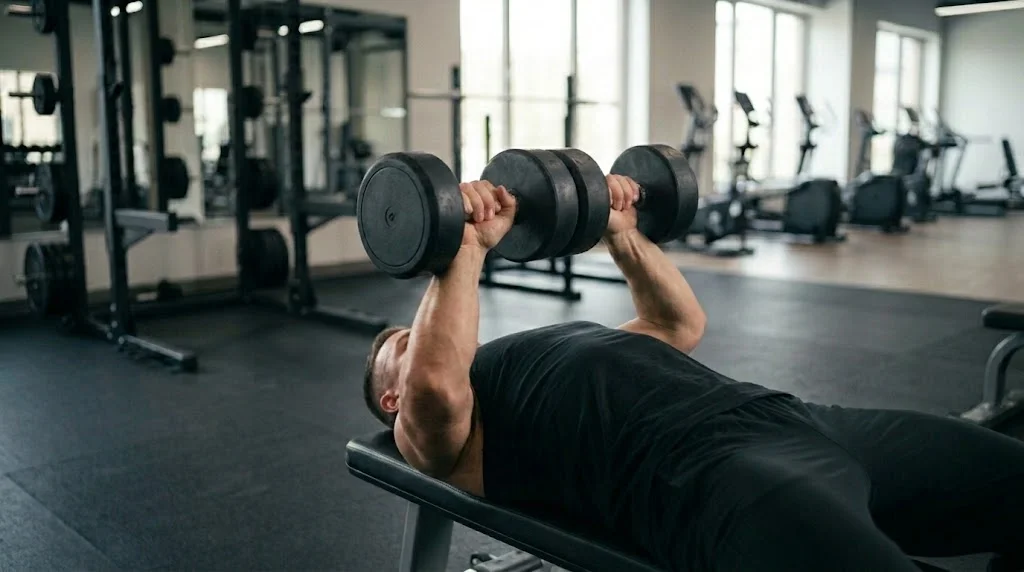
The kettlebell chest fly with leg raise is a lying combination exercise that pairs a dumbbell-style chest fly with a straight-leg raise, training thechestand core at the same time. Performed on aflat benchor the floor, it isolates the pectoral muscles through an arcing fly motion while the legs stay lifted and straight, creating continuous tension through the abdominals and hip flexors. Because both movements happen simultaneously, it demands more coordination and core control than a standard chest fly. It works best as a finishing or conditioning exercise rather than a primary chest-building movement.
What Muscles Does the Kettlebell Chest Fly with Leg Raise Work?
- Primary: Pectoralis major, rectus abdominis
- Secondary: Anterior deltoids, hip flexors, obliques
- Tertiary: Triceps (stabilizing elbow bend), quadriceps
How Do You Set Up for the Kettlebell Chest Fly with Leg Raise?
Lie flat on a bench or on the floor holding a kettlebell in each hand, arms extended straight above your chest with palms facing each other and a slight bend in your elbows. Raise your straight legs off the surface to roughly a 45-degree angle, feet together. Press your lower back into the bench or floor and brace your core before starting the first rep.
How Do You Perform the Kettlebell Chest Fly with Leg Raise?
- Keep your legs raised and still at roughly 45 degrees throughout the set, using your abs to hold the position
- Lower the kettlebells out to the sides in a wide arc, maintaining the slight bend in your elbows
- Descend until your upper arms are roughly parallel to the floor, feeling a stretch across the chest
- Reverse the arc by squeezing your chest to bring the kettlebells back together above your chest
- Pause briefly at the top with the kettlebells nearly touching, chest fully contracted
- Repeat for the desired number of reps without letting your legs drop or your lower back arch off the surface
What Are the Key Form Cues?
- Brace before you move: Set your core and press your low back down before lowering the weights
- Keep the elbow bend constant: A fixed slight bend protects the elbows and keeps tension on the chest rather than the triceps
- Hold the legs steady: The legs should stay nearly motionless - any bouncing means the core has disengaged
- Move the kettlebells in an arc, not a press: The path should resemble hugging a barrel, not pressing straight up
- Exhale on the squeeze: Breathe out as you bring the kettlebells together to help maintain core bracing
What Are the Most Common Mistakes?
- Letting the lower back arch: An arched low back signals the core has lost tension and increases injury risk. Keep the spine pressed into the bench or floor.
- Dropping the legs too low: Lowering the legs past 45 degrees or letting them sag shifts stress into the lower back. Keep them at a controlled angle you can maintain.
- Turning the fly into a press: Pressing the kettlebells straight up instead of arcing them removes chest emphasis. Focus on a wide, controlled arc.
- Using kettlebells that are too heavy: Excess weight forces the arms to bend more and shortens the range of motion. Choose a weight that allows full control.
- Rushing the tempo: Fast, bouncy reps reduce muscle tension in both the chest and core. Slow the movement down, especially the lowering phase.
What Are the Best Kettlebell Chest Fly with Leg Raise Variations?
- Kettlebell chest fly with bent-knee leg raise: Bending the knees reduces core demand, making it more accessible for beginners
- Single-arm kettlebell fly with leg raise: Performing the fly one arm at a time increases anti-rotation core work
- Dumbbell chest fly with leg raise: Using dumbbells instead of kettlebells offers a more even weight distribution for the fly motion
- Kettlebell chest fly with alternating leg lowers: Slowly lowering one leg at a time in place of a static hold adds a dynamic core challenge
- Floor-only kettlebell fly with leg raise: Performing the fly on the floor limits the range of motion, reducing shoulder strain for beginners
How Do You Progress the Kettlebell Chest Fly with Leg Raise?
- Master the fly and the leg raise separately: Build competence in each movement on its own before combining them
- Increase the hold time: Extend how long you can keep the legs raised with good form before adding weight
- Add small weight increments: Progress kettlebell weight in small steps (2-4 kg) once form is consistent
- Slow the eccentric: Lengthen the lowering phase of the fly to increase chest time under tension
- Add controlled leg lowers: Progress from a static leg hold to slow alternating leg lowers for greater core difficulty
How Should You Program the Kettlebell Chest Fly with Leg Raise?
Use the kettlebell chest fly with leg raise 1-2 times per week as a finishing exercise after heavier chest and core work, since it is demanding on coordination and core endurance. Perform 8-12 reps for 2-3 sets, resting 60-90 seconds between sets. It suits intermediate lifters who have already mastered a standard chest fly and a basic leg raise and want to combine both into an efficient superset-style movement.