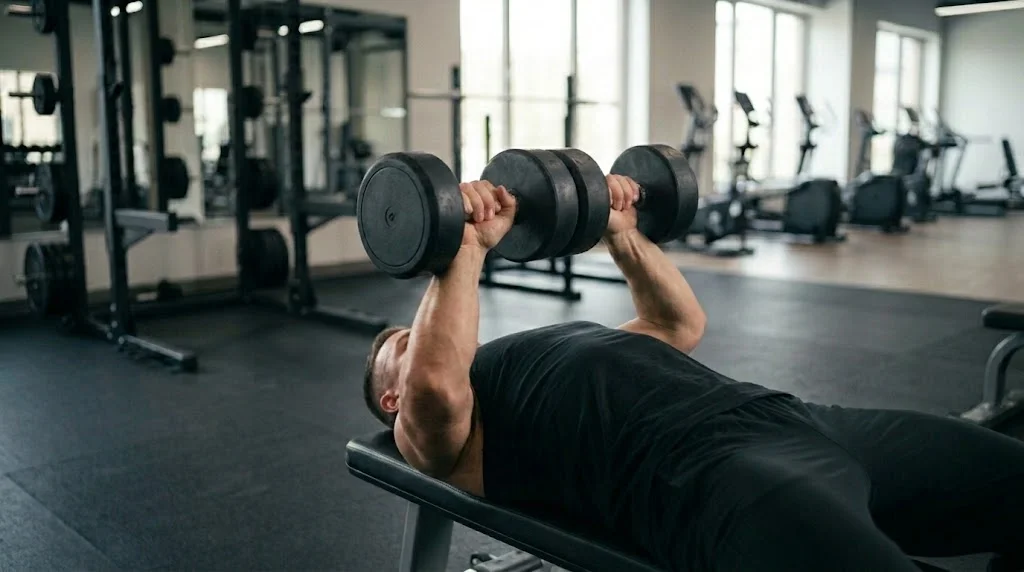
The sandbag floor press is a horizontal press performed lying on the floor with a sandbag held against the chest, training thechestand triceps through a shortened range. The floor stops your upper arms before the shoulder reaches full stretch, and the bag adds a load that shifts in your hands and has to be pinned by the forearms the whole set. Together that makes it a press you can push hard with a cranky shoulder, at the cost of the bottom range. Lifters use it as a main press substitute or a chest accessory.
What Muscles Does the Sandbag Floor Press Work?
- Primary: Pectoralis major (chest)
- Secondary: Triceps brachii, anterior deltoid
- Tertiary: Rectus abdominis, forearm flexors (grip), latissimus dorsi
How Do You Set Up for the Sandbag Floor Press?
Sit on the floor with the sandbag across your thighs. Grip the handles or hug the body of the bag, then roll back onto your shoulders as you pull the bag onto your chest. Lie flat with the knees bent and the feet planted about hip width. Pull the shoulder blades together and down into the floor, tuck the ribs, and settle the bag across the lower chest with the elbows tight to your sides.
How Do You Perform the Sandbag Floor Press?
- Set the elbows at about 45 degrees from your ribs with the bag resting on the lower chest.
- Press the bag straight up off the chest, driving it toward a point over your shoulders.
- Finish with the arms vertical and the bag balanced over the shoulder joints, elbows straight but unlocked.
- Squeeze the chest one count at the top while keeping the bag from rolling toward your face.
- Lower under control until both triceps rest on the floor and the bag touches the chest.
- Let the triceps settle for a beat, keeping tension in the bag, before the next press.
What Are the Key Form Cues?
- Crush the bag inward: pull the handles or the filling toward each other so the load stays one piece rather than sloshing across your palms.
- Bury the shoulder blades: pin them into the floor before the first rep and keep them there all set.
- Press toward the shoulders, not the throat, so the bag stays over the joint.
- Keep the wrists stacked over the elbows as the bag settles.
- Touch the triceps down, do not drop them, so the press starts from tension.
What Are the Most Common Mistakes?
- Filling the bag heavier than you can control: the bag slides off centre and one arm ends up carrying it, so press a load you can hold balanced at the top for five seconds.
- Bouncing the elbows off the floor: the rebound skips the hardest part of the press and drives impact into the elbow, so pause with the triceps resting.
- Flaring the elbows out to 90 degrees: the shoulder rotates out under load at the bottom, so keep them nearer 45 degrees from the ribs.
- Letting the bag drift toward the face: the leverage moves behind the shoulders and the press stalls, so aim over the shoulder joint.
- Driving the heels and arching off the floor: the hips leave the ground and the press becomes a partial incline, so keep the hips down.
What Are the Best Sandbag Floor Press Variations?
- Sandbag bear hug floor press: hugging the bag without handles adds a grip and chest squeeze demand.
- Sandbag floor press with hips bridged: bridging up shortens the range further and loads the glutes to hold position.
- Single-arm sandbag floor press: one end of the bag per hand turns it into an anti-rotation press.
- Neutral grip dumbbell floor press: dumbbells replace the bag, giving a stable load and the same shortened range.
- Sandbag bench press: pressing off a bench restores the bottom range the floor removes.
How Do You Progress the Sandbag Floor Press?
- Add filler in 10 pound steps once you complete all sets at the top of the rep range.
- Work from 6 reps per set up to 12 before adding weight.
- Build from 3 sets to 5 at the same load.
- Add a two-count pause with the triceps on the floor, or press from a dead stop each rep.
How Should You Program the Sandbag Floor Press?
Press it early in an upper body session, either as the main press or straight after a barbell bench. Once or twice a week is enough given the load. Perform 3 to 5 sets of 6 to 12 reps with 90 to 120 seconds of rest. Pair it with a horizontal row so the upper back matches the pressing volume, and follow it with triceps work.