Dumbbell Only Workout Plan
A pair of dumbbells and a bench. That is the whole equipment list, and it is enough for three sessions a week that actually progress.
The week
Day 1
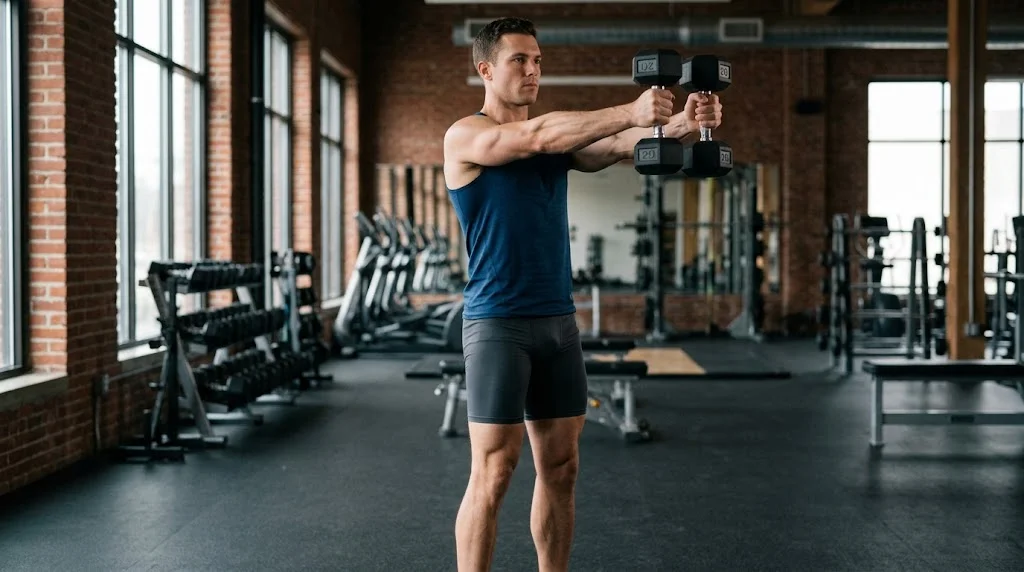
Pressing: chest, shoulders, triceps5 moves · 17 setsIf your heaviest pair is light, slow every rep down to three seconds on the way down. Time under tension is the lever you have when load is fixed.
| Movement | Sets | Reps | Rest |
|---|---|---|---|
Hex PressDumbbells pressed hard against each other for the whole set. The squeeze is what turns a light pair into a hard set. | 4 | 10-12 | 120s |
| 4 | 8-10 | 120s | |
| 3 | 12 | 90s | |
| 3 | 12-15 | 60s | |
| 3 | 10-12 each arm | 60s |
Day 2
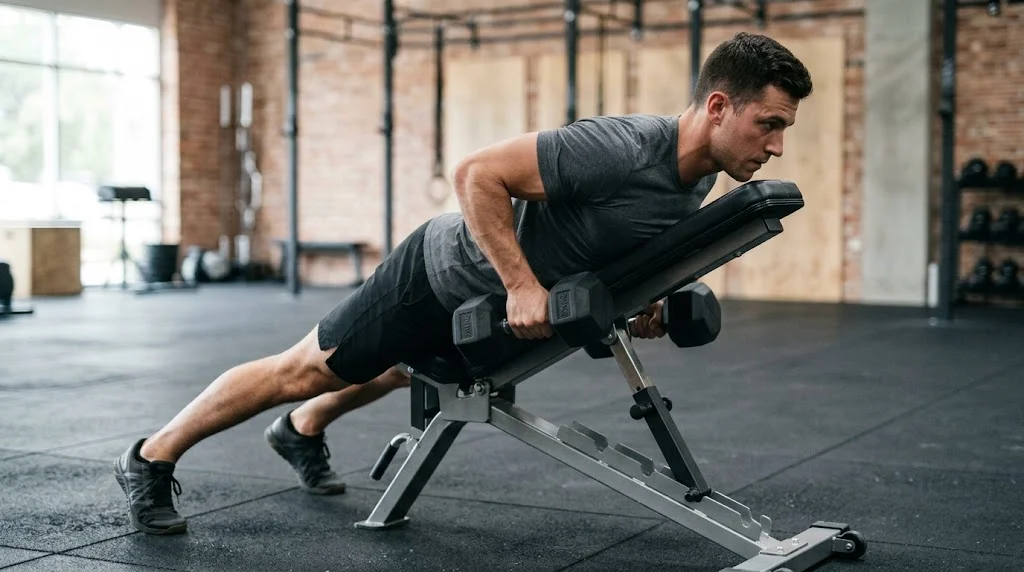
Pulling: back, rear delts, arms6 moves · 20 setsThe hardest session to do well without a cable stack. Rows are the entire back workout here, so treat the first two like the heavy lifts they are.
| Movement | Sets | Reps | Rest |
|---|---|---|---|
3-Point Dumbbell RowOne hand and one knee on the bench. Row toward your hip, not your armpit. | 4 | 10-12 each side | 90s |
| 4 | 10-12 | 90s | |
| 3 | 15-20 | 60s | |
| 3 | 12 | 60s | |
| 3 | 10-12 each arm | 60s | |
| 3 | 20 | 45s |
Day 3
Legs and core5 moves · 17 setsSingle-leg work is the answer to light dumbbells. Half the body holding the same weight doubles what it feels like.
| Movement | Sets | Reps | Rest |
|---|---|---|---|
Dumbbell Death MarchWalk forward lowering one dumbbell at a time to the floor. Hamstrings will be talking to you by the third set. | 4 | 10 each side | 120s |
| 4 | 10 each leg | 120s | |
| 3 | 12-15 | 90s | |
| 3 | 12-15 | 60s | |
| 3 | 15 | 45s |
Weekly sets per muscle
Counted from the rows above, not typed in by hand. A movement that trains three muscle groups is counted for all three, so these add up to more than the 54 sets in the plan.
The constraint is real, and smaller than it looks
No barbell. No cable stack. No machines. A pair of dumbbells and something to lie on.
That rules out roughly two things worth having: very heavy squatting and very heavy deadlifting. Everything else in a normal training week has a dumbbell version that works about as well, and a few that work better.
Sixteen movements across three days. Fifty minutes a session. That's the plan.
Single-limb work is the whole answer to light weights
Here's the problem everyone with a home setup hits. Your dumbbells top out at 20 kg a hand, your legs could squat far more than 40 kg, and a two-legged squat with the weight you own is a warm-up.
So stop squatting on two legs. Asingle leg dumbbell split squatputs the same 40 kg on one leg, which turns a warm-up into a set you have to concentrate on. Four sets of ten each side with that pair is genuinely hard for most people.
The same logic runs through the whole plan. Single-arm French press. Alternating hammer curls. Thedumbbell death march, where you lower one dumbbell at a time while walking forward, which is a hamstring exercise disguised as a party trick.
Day 2 is the one that needs attention
Pressing translates to dumbbells almost perfectly. Legs translate fine once you go single-leg. Pulling is where the constraint actually bites.
Without a pull-up bar or a lat pulldown there's no vertical pulling here at all, and I'm not going to pretend a dumbbell substitute exists. What you get instead is four sets of two different rows, done properly, which covers the mid-back thoroughly and the lats partially.
If you can add one piece of equipment to this setup, make it a doorway pull-up bar. Thirty pounds and it fixes the only real hole in the plan.
Tempo, the lever nobody uses
When you can't add weight, add time.
Three seconds lowering, one second at the bottom, then press. On the hex press that turns a set of twelve from forty seconds of work into seventy. Your chest doesn't know the dumbbells didn't get heavier; it only knows how long it spent under load and how close to failure it got.
This is the single most useful thing to learn if your equipment is fixed, and most people never try it because a slow set with a light weight looks unimpressive. It isn't.
What to buy, if you're buying
One adjustable pair beats a rack of fixed dumbbells for anyone training at home, and it isn't close on either price or floor space. Look for something that goes to at least 24 kg a hand; you'll outgrow 15 kg on presses within a few months and never outgrow 24 on single-arm work.
A flat bench is the second purchase and it opens up about a third of this plan. An adjustable one that inclines is better but not worth waiting for.
Third on the list is a doorway pull-up bar, for the reason above. After that, honestly, nothing. Resistance bands are useful for warm-ups and a poor substitute for load.
Warming up with light weights
Five minutes of anything that raises your pulse, then two sets of the day's first movement with your lightest pair. On Day 3, add ten bodyweight split squats before the death march, because hamstrings going straight into a loaded hinge from cold is the one risky moment in the week.
That's three or four minutes of warm-up. Do you need more? Probably not, and a session that takes fifteen minutes to start is a session that gets skipped on a busy Tuesday.
Two things that go wrong at home
Training in the same five-minute window as the rest of your life. A home gym removes the commute and the commute was doing something useful: it marked the session as a thing you had decided to do. Put the sessions in a calendar with a start time.
Never counting anything. Nobody logs at home. Then six months later the same pair of dumbbells is doing the same sets of ten and the obvious conclusion is that dumbbells don't build muscle, when the real problem is that nothing ever got harder. Write down the weight, the reps and the tempo. A note on your phone is enough.
How the three days sit in a week
Any three non-consecutive days. Monday, Wednesday, Friday is the obvious one. Each session trains a different pattern, so back-to-back days are survivable if your week demands it, though Day 2 after Day 3 is unpleasant in a way you'll only make the mistake of discovering once.
Want a fourth day? Repeat Day 1 with the rep ranges pushed up to fifteen and twenty, which turns it into a volume session rather than a second heavy one. Or look at athree day full body planonce you have gym access, since that's where the barbell work starts paying off.
Frequently Asked Questions
What weight dumbbells do I need?
Adjustable pairs beat fixed ones by a distance if you are buying. If you are stuck with one pair, pick a weight you can press for about ten reps and use rep ranges, tempo and single-leg variations to make it harder rather than shopping for more iron.
Can I run this without a bench?
Mostly. The pressing movements work off the floor instead, which shortens the range at the bottom and is a fair trade. The 3-point row needs something to brace on; a sturdy chair or the edge of a bed does the job. The chest-supported row is the one that genuinely needs a bench, and a single-arm row replaces it.
Will dumbbells alone build muscle?
Yes. Muscle responds to tension and to progressive overload, and neither of those cares what shape the handle is. What dumbbells cost you is the very top end of loading on squats and deadlifts, which matters if you are chasing a one-rep max and barely at all if you are chasing size.
How do I keep progressing when the weight stops going up?
Add reps first, then sets, then slow the eccentric to three or four seconds, then move to single-limb versions of the same movement. Those four levers usually carry someone for a year past the point where they thought they had outgrown their dumbbells.
3 sessions a week