3 Day Full Body Workout Plan
Three sessions a week, every muscle group trained twice, and nothing that needs a training partner or a spotter.
The week
Day A
Squat and press5 moves · 17 setsThe two heavy lifts come first while you are fresh. If you only have 40 minutes, cut the last movement, not the first.
| Movement | Sets | Reps | Rest |
|---|---|---|---|
Smith Machine Hack SquatFeet a step forward of your hips. The fixed bar path is the point; it lets you chase the last two reps without balance failing first. | 4 | 8-10 | 150s |
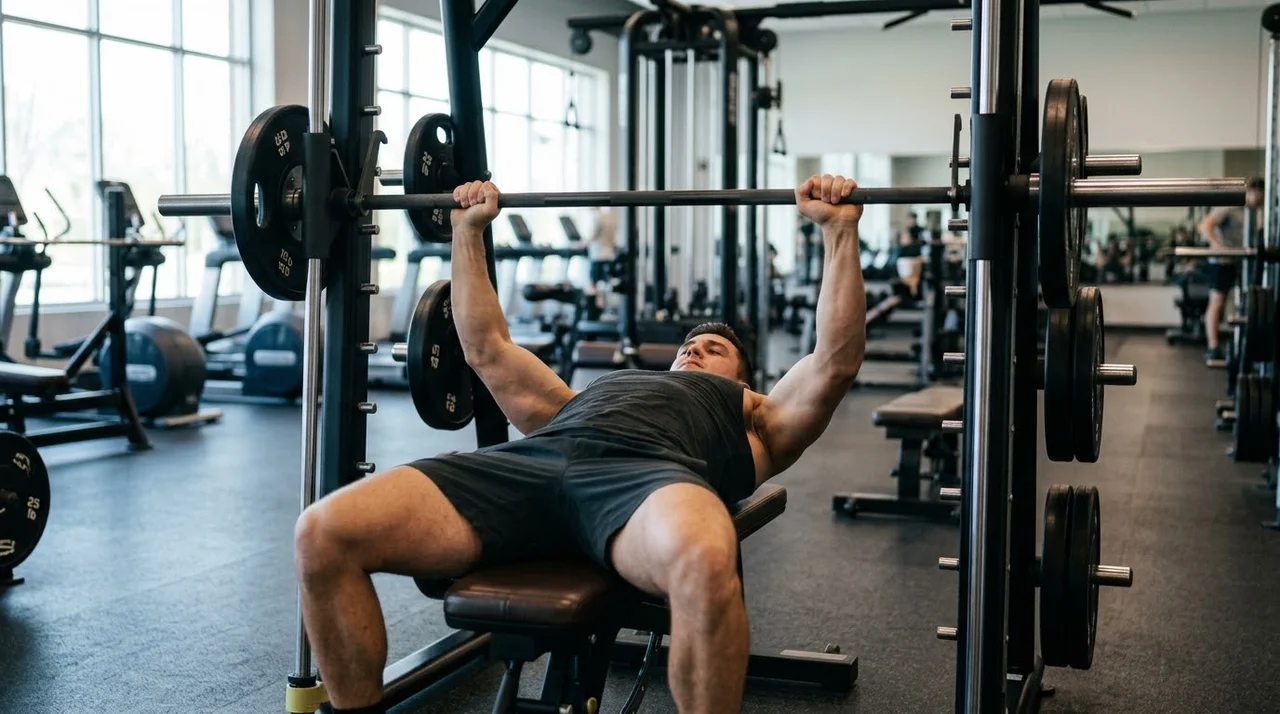 Smith Machine Bench Press: Fixed-Path Chest PressSet the safety pins at chest height on your first session so you can fail a rep alone. Smith Machine Bench Press: Fixed-Path Chest PressSet the safety pins at chest height on your first session so you can fail a rep alone. | 4 | 6-8 | 150s |
Standing Rope Lat PulldownPull the rope apart as your elbows pass your ribs. | 3 | 10-12 | 90s |
| 3 | 10-12 | 90s | |
| 3 | 15 | 45s |
Day B
Hinge and pull5 moves · 17 setsHeaviest session of the three. Eat something two hours before it.
| Movement | Sets | Reps | Rest |
|---|---|---|---|
Trap Bar DeadliftHandles at your sides put the load under your hips instead of in front of them, which is why this and not a straight bar in week one. | 4 | 5 | 180s |
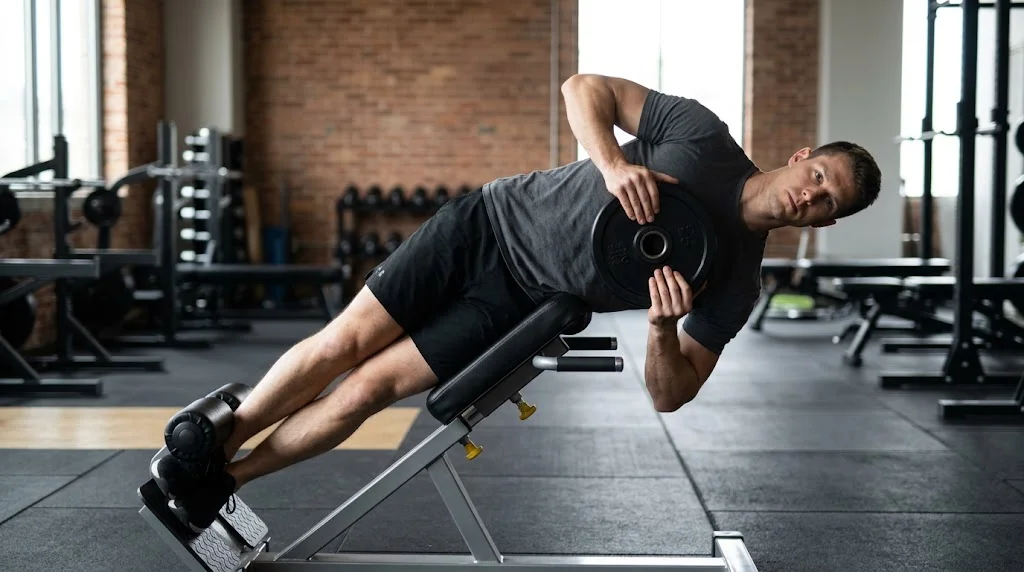
| 4 | 10-12 each side | 90s | |
 Close Grip Dumbbell Bench Press: Chest & TricepsDumbbells pressed together the whole set. You will use less weight than you expect. Close Grip Dumbbell Bench Press: Chest & TricepsDumbbells pressed together the whole set. You will use less weight than you expect. | 3 | 8-10 | 120s |
| 3 | 12-15 | 60s | |
| 3 | 12 each side | 45s |
Day C
Single leg and upper back5 moves · 17 setsThe lightest day on paper and the one that leaves you sorest, because step-ups and rows both punish sloppy tempo.
| Movement | Sets | Reps | Rest |
|---|---|---|---|
Bench Step-UpKnee-height bench. Drive through the top foot and do not push off the floor with the trailing leg. | 4 | 10 each leg | 120s |
| 4 | 8-10 | 120s | |
| 3 | 10-12 | 90s | |
Supinated Grip Lat PulldownUnderhand grip. Different enough from Day A's rope pulldown to be worth the slot. | 3 | 10-12 | 90s |
| 3 | 30-45s hold | 45s |

Weekly sets per muscle
Counted from the rows above, not typed in by hand. A movement that trains three muscle groups is counted for all three, so these add up to more than the 51 sets in the plan.
Why full body beats a split at three days
Split your week three ways by muscle group and each muscle gets one session. Train everything every session and each muscle gets three. That is the whole argument, and it is the reason a chest day, back day, leg day week is the wrong shape for someone training on Monday, Wednesday and Friday.
The catch is session length. Everything in one workout sounds like two hours. It isn't, because you don't need five exercises per muscle when you're hitting that muscle three times a week. Five movements, seventeen or eighteen working sets, and you're out in under an hour.
I've run this structure with people coming back after a decade off, and the part that surprises them isn't the soreness. It's that by week three they stop dreading Day B. Frequency does that. When you squat once a week, every squat session is an event you psych yourself up for. When you squat three times a week, it's just Wednesday.
What each day is actually for
Day A is the technical one. Hack squat and bench press both run on a fixed bar path, which matters more than it sounds: you can push a set close to failure without your balance quitting first. That's hard to get from free weights in month one.
Day B carries the heaviest single lift in the week. Thetrap bar deadliftsits between a squat and a conventional deadlift, with the handles at your sides instead of the bar in front of your shins. Four sets of five. Not more, because this is the movement that eats your recovery for the rest of the week if you get greedy with it.
Day C looks soft on paper. Step-ups, rows, a machine press. Then you try ten step-ups per leg with real weight and discover that single-leg work exposes exactly how much your strong side has been carrying.
Sets, reps and the number that actually moves
Every movement here has a rep range, not a rep number. Take the top of the range as the target and the bottom as the floor. Hit the top on all your sets and you've earned more weight.
Rest is written down for a reason. Ninety seconds feels long when you're standing there. It is not long, and cutting it to forty-five turns a strength set into a conditioning set, which is a different workout with different results. Set a timer. Your phone already has one.
The one number worth tracking is total weight lifted on the first movement of each day. Write it down. Three months from now that number is the only honest answer to whether this worked.
Where the plan expects you to deviate
Missing equipment is normal. Half the gyms in this directory don't have a trap bar, and a Smith machine is far from universal. Both movements have obvious substitutes, and the FAQ below names them.
What isn't optional is the structure: two compounds, then pulling, then pressing, then one core movement. Reorder that and you'll spend your freshest sets on your smallest muscles.
Should you add arm work? If you want to, add one curl and one triceps movement to Day C, at the end, three sets each. You're already hitting both through the pressing and rowing, so treat this as garnish rather than a fourth pillar. Anyone telling you a beginner needs direct arm work on all three days is selling you a longer session, not a better one.
The warm-up, in five minutes
Nobody reads a warm-up section, so here is the short version. Five minutes on a bike or a rower until you're breathing. Then two sets of the day's first movement: one at roughly half your working weight, one at about eighty per cent. Neither counts toward the four sets in the table.
That's it. No foam roller, no mobility circuit. Those things aren't useless, they're just not warm-ups, and a session that takes twenty minutes to start is one you'll find reasons to skip.
The exception is Day B, where a cold hip deserves one extra ramp-up set.
The mistakes that show up in week four
Three of them, in order of how often I've watched them happen.
Adding weight before you've earned it. You hit eight reps on set one, six on set two, five on set three, and next week you load the bar anyway because the first set felt good. Now every set is a grind and nothing progresses. The rule is the top of the range on every set, not on your best one.
Cutting rest to finish faster. Ninety seconds becomes sixty becomes "when I stop feeling out of breath", and within a month the weights have stopped moving and it isn't obvious why. If you're short on time, drop a movement. Don't compress the whole session.
Substituting on the fly. Someone's on the hack squat, so you do leg press, and next week the Smith rack is busy so you do something else again. Three weeks later you've trained legs three times and progressed on nothing. Pick a substitute once and keep it.
What about cardio?
Do it. Twenty to thirty minutes, two or three times a week, on off days or after lifting rather than before. Walking counts.
Will it eat your gains? Not at that volume. The myth comes from studies on people running six days a week while trying to squat heavy, which is nobody reading a three-day plan.
When to stop running this
Eight to twelve weeks, or until progress on the main lifts stalls for two sessions in a row despite good sleep and food. At that point you've usually earned a fourth day, and anupper lower splitis the natural next shape. Don't rush it. The people who get the most out of three days a week are the ones who stayed on three days a week long enough to get strong at it.
Frequently Asked Questions
Can I run this plan on non-consecutive days?
Yes, and you should. Monday, Wednesday, Friday is the classic arrangement. Tuesday, Thursday, Saturday works identically. What matters is a rest day between sessions, because every session trains your legs and your legs need about 48 hours.
What if my gym has no Smith machine or trap bar?
Swap the hack squat for any loaded squat pattern and the trap bar deadlift for a Romanian deadlift or a dumbbell deadlift. The plan cares about the movement, not the implement. Filter the exercise library by the equipment you do have and pick the closest match.
How long before I add weight?
When you hit the top of the rep range on every set of a movement, add the smallest increment your gym stocks next session. On a hack squat that is often 5 kg; on a dumbbell press it may be 4 kg because dumbbells jump in pairs. Expect that to happen every week or two at first and every month or so by session forty.
Is three days a week enough to build muscle?
It is, and the reason is on this page. Every muscle group gets trained twice a week here, which is the frequency most of the research settles on. A fourth day adds volume, not magic, and a plan you finish beats a plan you skip.
3 sessions a week