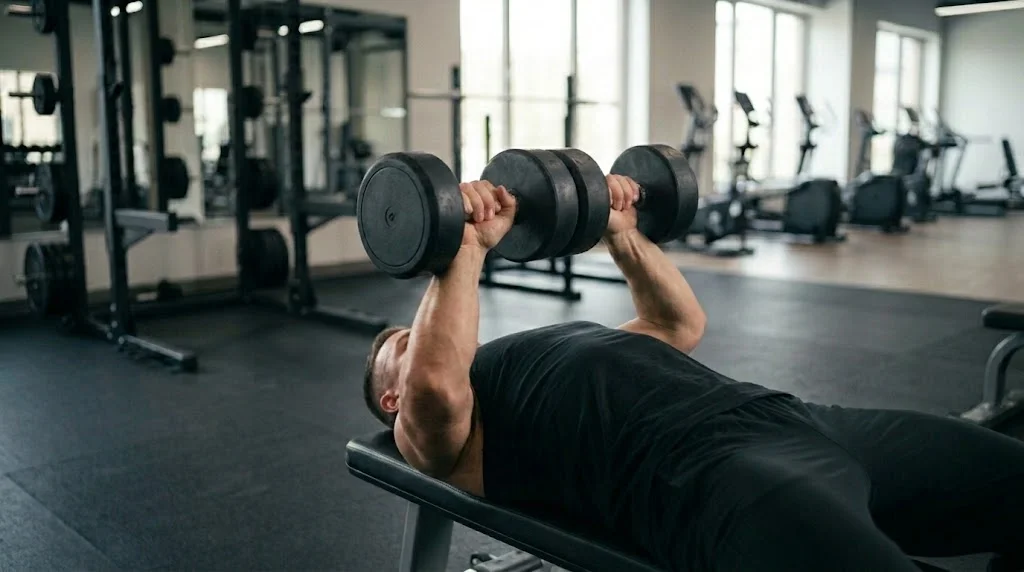
The dumbbell piston press is a bench press variation performed by alternating arms in a continuous, piston-like rhythm - one dumbbell drives upward as the other lowers, so the arms are always moving in opposite directions. This asymmetric loading trains thechest, front shoulders, and triceps while forcing the core and lats to resist rotation and keep the torso square on the bench. Because tension never fully releases from either arm, it builds pressing endurance in addition to raw strength.
What Muscles Does the Dumbbell Piston Press Work?
- Primary: Pectoralis major, anterior deltoids, triceps brachii
- Secondary: Serratus anterior, upper pectoralis
- Tertiary: Core and oblique stabilizers, rotator cuff
How Do You Set Up for the Dumbbell Piston Press?
Lie flat on abenchwith a dumbbell in each hand, feet planted flat on the floor for a stable base. Press both dumbbells to a starting point at chest height with palms facing forward, elbows bent at roughly 90 degrees and tracking slightly below shoulder level. Brace your core and keep your shoulder blades pulled down and back against the bench before starting the first rep.
How Do You Perform the Dumbbell Piston Press?
- Press one dumbbell straight up over your chest until the elbow is fully extended, driving through the palm
- Begin lowering that arm back toward chest height as soon as it locks out, without pausing at the top
- Simultaneously drive the opposite dumbbell upward so the two arms pass each other moving in opposite directions
- Keep the movement continuous, alternating presses without letting either dumbbell rest at the bottom
- Brace your core throughout to prevent your torso from twisting toward the working arm
- Continue alternating for the desired number of total reps, then rack the dumbbells together
What Are the Key Form Cues?
- Stack wrist over elbow: Keep the pressing arm's wrist directly above the elbow at lockout to protect the shoulder
- Resist rotation: Actively brace your obliques so the offset load doesn't pull your hips or shoulders off the bench
- Keep it continuous: The piston action comes from constant opposite-arm movement - don't let both arms pause at the same time
- Drive from the chest: Initiate each press by contracting the pec, not just pushing with the shoulder
- Control the descent: Lower each dumbbell with the same speed you pressed it, rather than letting it drop
What Are the Most Common Mistakes?
- Using dumbbells that are too heavy: Excess load causes the torso to rock side to side with each press, shifting work off the chest and onto momentum. Drop the weight until the bench stays stable.
- Pausing both arms at once: Stopping the rhythm turns this into a standard alternating press and removes the constant-tension benefit. Keep one arm always moving.
- Flaring the elbows out to 90 degrees: This puts unnecessary stress on the shoulder joint at the top. Keep a moderate elbow angle relative to the torso.
- Banging the dumbbells together at the top: Clanking the weights indicates a lack of control and wastes the eccentric portion of the lift.
- Letting the hips or shoulders lift off the bench: This signals the core isn't controlling the asymmetric load; reduce weight and reset your brace.
What Are the Best Dumbbell Piston Press Variations?
- Standing alternating dumbbell press: Removes bench support, adding overhead-press core and stability demand
- Single-arm dumbbell bench press: Isolates one side fully to address strength imbalances before combining arms
- Incline dumbbell piston press: Bench set to 30-45 degrees shifts emphasis to the upper chest and front delts
- Seated alternating shoulder press: Vertical version that targets the deltoids more than the chest
- Kettlebell piston press: Offset kettlebell load increases grip and stabilizer demand
How Do You Progress the Dumbbell Piston Press?
- Increase weight gradually: Add small increments once you can complete all reps with a stable torso
- Slow the eccentric: Take 2-3 seconds to lower each dumbbell to increase time under tension
- Add a brief pause at the bottom: Pausing each dumbbell at chest height before the next press removes stretch-reflex assistance
- Increase total reps: Build to 20-24 total presses (10-12 per arm) before adding weight
How Should You Program the Dumbbell Piston Press?
Program the dumbbell piston press on push or upper-body days, 1-2 times per week, either as a primary chest movement or a finisher after a bilateral press like a barbell or dumbbell bench press. Work in the 8-12 reps per arm range with a weight that lets you keep the torso still, resting 60-90 seconds between sets. Because the exercise demands sustained core bracing, it pairs well earlier in a session before fatigue compromises trunk stability.