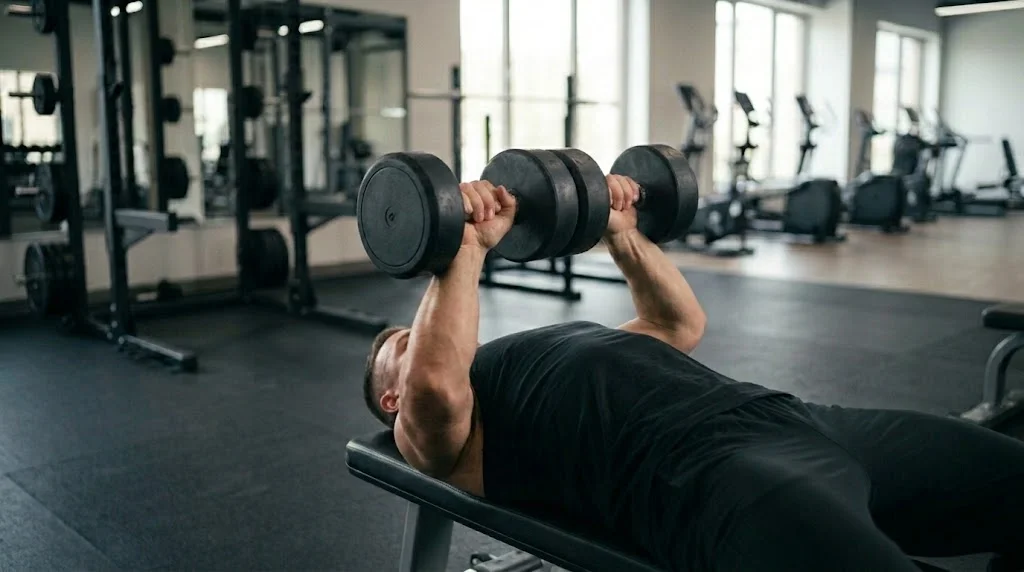
The dumbbell bench press is a fundamental horizontal pressing movement performed lying on a flat bench with a dumbbell in each hand. Because each arm works independently, it demands greater stabilization than a barbell and allows a deeper, more natural range of motion. It is an excellent choice for buildingchest size and strengthwhile addressing left-right imbalances.
What Muscles Does the Dumbbell Bench Press Work?
- Primary: Pectoralis major (sternal/mid head)
- Secondary: Anterior deltoid, triceps brachii
- Tertiary: Serratus anterior, rotator cuff stabilizers
How Do You Set Up for the Dumbbell Bench Press?
Sit on the end of a flat bench with adumbbellresting on each thigh. Lie back while bringing the dumbbells to your shoulders, then set your feet flat on the floor and retract your shoulder blades. Press the dumbbells up so they sit over your chest with arms extended and palms facing forward, maintaining a slight natural arch in your lower back.
How Do You Perform the Dumbbell Bench Press?
- Press the dumbbells up to the starting position over your chest with arms extended and a slight bend in the elbows
- Lower the dumbbells under control out to the sides of your chest, keeping elbows at roughly a 45-degree angle to your torso
- Descend until you feel a comfortable stretch across the chest, with the dumbbells at about chest level
- Press back up and slightly inward so the dumbbells track toward each other near the top
- Stop just short of the dumbbells touching to keep continuous tension on the chest
- Repeat for the desired reps, keeping the shoulder blades set and the movement smooth
What Are the Key Form Cues?
- Keep shoulder blades retracted: Pinch them down and back to create a stable, shoulder-friendly base
- Control both dumbbells evenly: Move them in sync to avoid drifting or imbalance
- Keep wrists firm and stacked: A neutral, straight wrist transfers force and protects the joint
- Maintain elbow position: Keep elbows moderately tucked rather than flared straight out
- Press with the chest: Think about squeezing the pecs together rather than just pushing with the arms
What Are the Most Common Mistakes?
- Flaring the elbows too wide: A 90-degree flare stresses the shoulders - keep a moderate tuck.
- Letting the dumbbells drift toward the head: This shifts load to the shoulders and reduces control.
- Bouncing or rushing the reps: Momentum reduces chest stimulus and increases injury risk.
- Using too heavy a load too soon: Heavy dumbbells are hard to control and set up safely as a beginner.
- Arching the lower back excessively: A small arch is fine, but lifting the hips reduces stability.
What Are the Best Dumbbell Bench Press Variations?
- Incline dumbbell press: Targets the upper chest with the bench at an angle
- Decline dumbbell press: Emphasizes the lower chest fibers
- Neutral-grip dumbbell press: Palms facing each other for a shoulder-friendly pressing path
- Single-arm dumbbell press: Builds core stability and corrects side-to-side imbalances
- Floor dumbbell press: Limits range of motion to reduce shoulder strain
How Do You Progress the Dumbbell Bench Press?
- Increase weight gradually: Move up once you can complete all reps with clean control
- Build reps first: Aim for 10-15 controlled reps before increasing load
- Slow the eccentric: Lower over 3-4 seconds to add time under tension
- Add a pause: Hold briefly at the bottom stretch to build strength and control
How Should You Program the Dumbbell Bench Press?
The dumbbell bench press fits well as a primary or secondary chest movement, performed 1-2 times per week. For beginners, 8-12 reps with moderate weight builds both technique and muscle, with 90-120 seconds of rest between sets. Practice the setup carefully - bringing the dumbbells up from the thighs and back down safely is a skill worth learning early to train confidently and avoid shoulder strain.