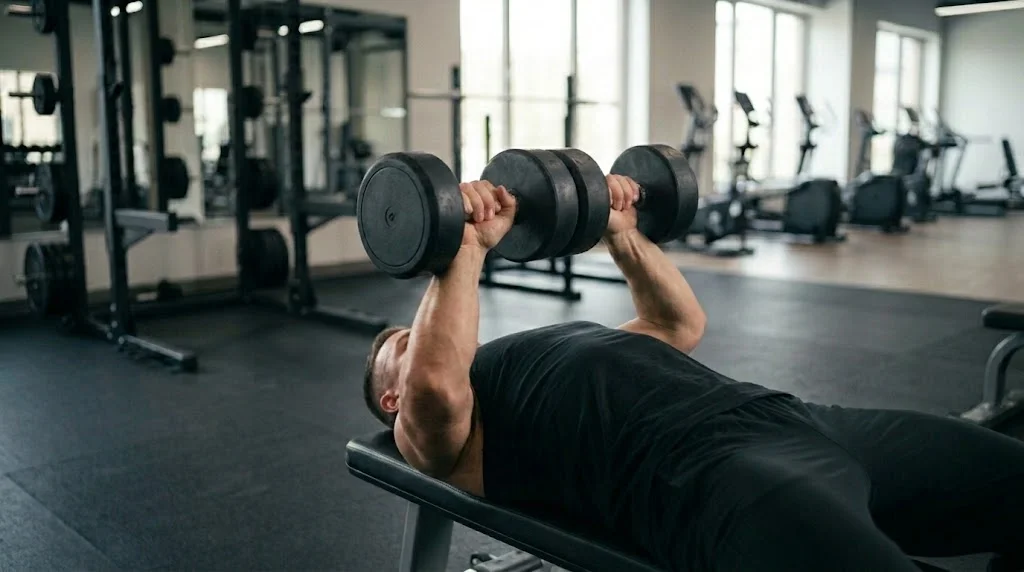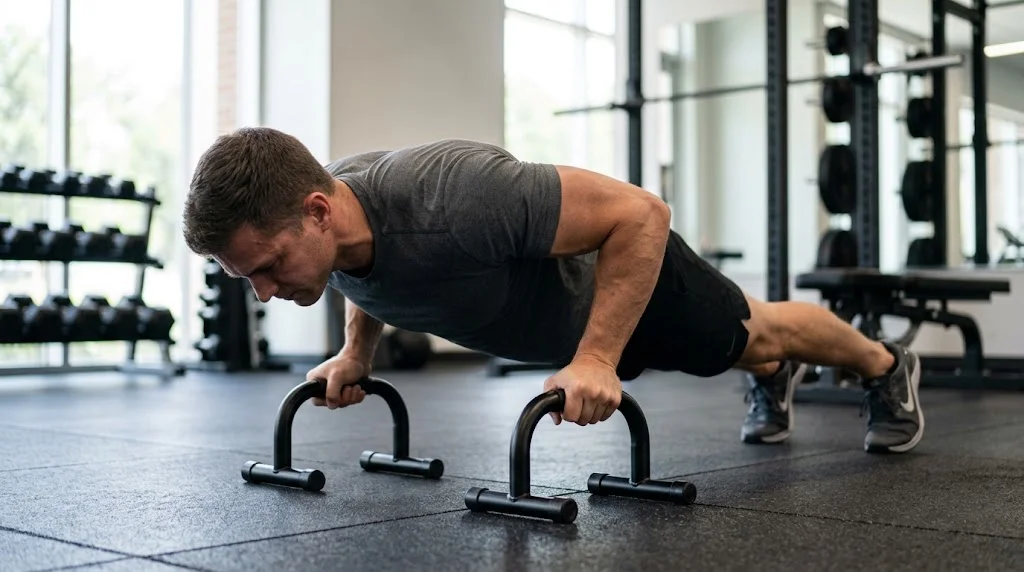
The push-up bars push-up is a bodyweight press performed with your hands on raised handles that trains the chest through a deeper range than a floor push-up allows. The bars lift your hands several inches, so your chest can travel below hand level and the pecs reach a longer stretched position at the bottom. The neutral handle grip also keeps your wrists straight instead of bent back against the floor. Lifters use it as a main press on a bodyweight day or as a finisher after bench work, once the standardpush-upfeels short.
What Muscles Does the Push-Up Bars Work?
- Primary: pectoralis major (sternal and clavicular heads)
- Secondary: anterior deltoid, triceps brachii
- Tertiary: serratus anterior, rectus abdominis, gluteus maximus
How Do You Set Up for the Push-Up Bars?
Place the bars on a firm floor, parallel to each other and slightly wider than shoulder width, handles running front to back. Kneel behind them, grip each handle with a neutral grip and your wrists stacked straight over the bar. Step your feet back to a plank, hip-width apart, with your body in one line from head to heels. Lock your elbows, brace your abs and squeeze your glutes before you lower.
How Do You Perform the Push-Up Bars?
- Set your shoulders down and back in the top plank, with the bars directly under your shoulders.
- Lower your chest between the bars by bending your elbows, keeping them at about 45 degrees from your torso.
- Descend until your chest drops below the handles, or until your front shoulder reaches its comfortable end range.
- Pause for a beat at the bottom with your body still in one straight line and your forearms vertical.
- Press the bars down into the floor to drive your body back up in a smooth line, elbows extending together.
- Finish at full elbow extension with your shoulders over the bars, ready for the next rep.
What Are the Key Form Cues?
- Screw your hands into the handles: a slight outward torque keeps the elbows tracking back and the shoulders seated.
- Reach for depth with your chest, not your chin: the sternum should be the lowest point, finishing between the bars.
- Keep your forearms vertical when you look down at the bottom.
- Push the floor away through the bars rather than lifting your hips first.
- Hold your ribs down so the extra depth comes from the shoulders, not the lower back.
What Are the Most Common Mistakes?
- Setting the bars too wide: the elbows flare to 90 degrees, the range shortens and the front of the shoulder takes the stretch; move the bars in until the forearms stay vertical.
- Dropping the chest past shoulder comfort: the extra depth drives the humeral head forward and loads the front shoulder capsule; stop where your shoulders feel the stretch, not where the bars allow.
- Sagging the hips at the bottom: the lower back extends and the plank line breaks, hiding the depth the bars were meant to add; brace and squeeze your glutes before you lower.
- Bending the wrists back on the handles: the load moves onto the wrist joint and the bars tip; keep your knuckles stacked over the bar.
- Rushing the descent: the pecs never load in the stretched position that justifies the bars; lower over two seconds.
What Are the Best Push-Up Bars Variations?
- Knee push-up on bars: knees on the floor, cutting the load for beginners while keeping the deep range.
- Feet-elevated push-up on bars: feet on a bench, shifting more bodyweight onto the upper chest and shoulders.
- Close-grip push-up on bars: bars at shoulder width or narrower, moving emphasis toward the triceps.
- Archer Push-Up on bars: one arm bends while the other stays straight, loading one side of the chest at a time.
- Ring push-up: the same deep press on rings, adding instability to the handles.
How Do You Progress the Push-Up Bars?
- Add load by placing a plate on your upper back once you can do 20 clean deep reps per set.
- Add two reps per set each week until you reach 20, then reset to 12 with load.
- Add a set every two weeks up to five sets before adding more load.
- Slow the descent to three seconds and pause two seconds at the bottom when reps stall.
How Should You Program the Push-Up Bars?
Use the push-up bars push-up as the main press on a bodyweight or home session, or as a finisher after the bench press on a chest day. Train it two or three times a week for 3 to 4 sets of 10 to 20 reps, resting 60 to 90 seconds between sets. Pair it with a row or pull-up so the pressing volume is matched by pulling work.