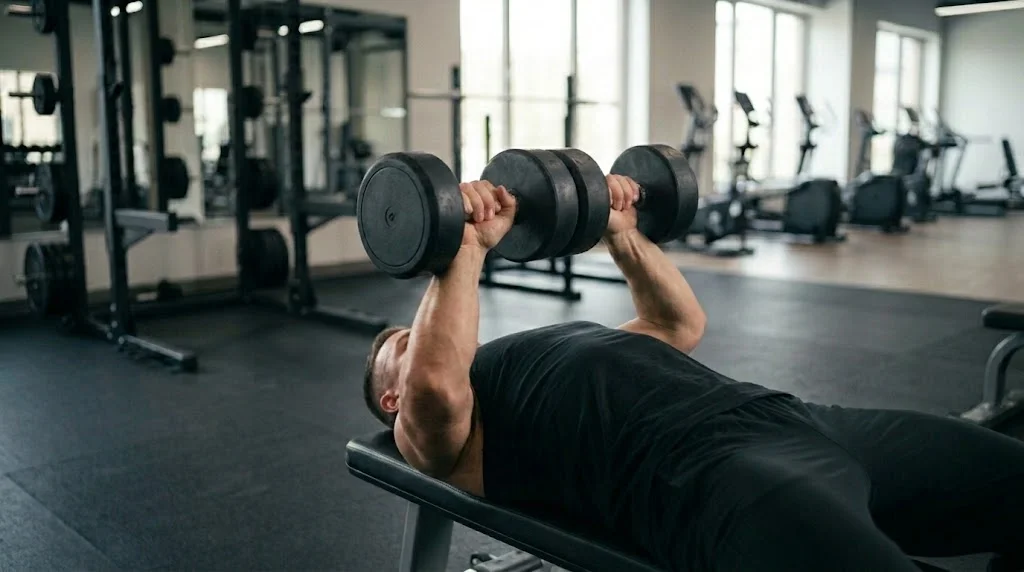
The incline French press is an isolation triceps extension performed seated on an incline bench with dumbbells lowered behind the head that trains the long head of thetriceps. The back rest holds your torso still and sets the arms behind the body, so the long head starts under a stretch that a flat skull crusher never reaches, while the incline keeps the shoulders out of the full overhead position that a standing French press demands. The stretch loads the bottom of every rep. Lifters use it as a second triceps movement on an arm or push day.
What Muscles Does the Incline French Press Work?
- Primary: Triceps brachii (long head)
- Secondary: Triceps brachii (lateral and medial heads), anconeus
- Tertiary: Posterior deltoid, latissimus dorsi, forearm flexors (grip), rectus abdominis
How Do You Set Up for the Incline French Press?
Set the bench to a 45 to 60 degree incline. Sit with a dumbbell in each hand resting on your thighs, then lie back and press both dumbbells up over your face with a neutral grip, palms facing each other. Plant your feet flat, set your head and upper back into the pad, and pull your shoulders down. Point your elbows at the ceiling, upper arms angled just behind your ears, and lock them there.
How Do You Perform the Incline French Press?
- Set your upper arms beside your ears, elbows pointing up and slightly back, dumbbells held together above your head.
- Bend only at the elbows and lower the dumbbells behind your head in a slow arc.
- Reach the bottom when your forearms pass parallel to the floor and you feel the stretch at the back of the arm; the elbows have not moved.
- Pause for one count in the stretched position without letting the dumbbells rest on your shoulders.
- Extend the elbows to drive the dumbbells back up along the same arc until the arms are straight.
- Stop just short of hard lockout, squeeze the triceps for a count and set the elbows for the next rep.
What Are the Key Form Cues?
- Elbows stay pointed at the ceiling: if they drift forward on the way up, the shoulder is doing the lift instead of the triceps.
- Reach long at the bottom: let the weight pull the elbows back a fraction to load the long head before the extension.
- Keep the dumbbells touching each other so the arms travel together.
- Feel the back of the arm stretch under the load, not the shoulder joint.
- Keep your head on the pad so the neck does not drive the movement.
What Are the Most Common Mistakes?
- Going too heavy: the elbows flare, the upper arms swing forward and the movement turns into a partial press; drop the load until the elbows stay fixed.
- Letting the elbows drift forward during the extension: the shoulder flexes and the lats and chest steal the work, so pin the upper arms beside the ears.
- Cutting the bottom short: the long head stretch is the reason for the incline, so lower until the forearms pass parallel to the floor.
- Bouncing out of the stretch: the triceps tendon at the elbow takes a snap load in its longest position; pause for one count at the bottom.
- Setting the bench too flat: the movement becomes a skull crusher and the upper arm loses its behind-the-body angle, so keep the incline at 45 degrees or more.
What Are the Best Incline French Press Variations?
- French press: the upright version with the arms fully overhead, more shoulder demand.
- Incline E-Z bar French press: the same bench with an E-Z bar for heavier loads and a fixed hand spacing.
- Flat bench dumbbell skull crusher: arms in front of the body and less stretch, an easier entry point.
- Single-arm incline French press: one dumbbell at a time, free hand on the working elbow to keep it still.
- Incline cable French press: a low pulley behind the bench keeps tension at the top of the rep.
How Do You Progress the Incline French Press?
- Add 5 pounds a hand once you complete every set at 15 reps with the elbows still pointing at the ceiling.
- Work 10 to 15 reps and add one rep per set each session until you reach 15.
- Start with 3 sets and add a fourth when the third set still pauses at the bottom on the last rep.
- Slow the lowering to a 3 count, or hold the stretch for 2 seconds, before adding weight.
How Should You Program the Incline French Press?
Program the incline French press late in a push or arm day, after your pressing and after any heavy triceps work such as a close-grip bench press. Once or twice a week is enough. Do 3 to 4 sets of 10 to 15 reps with 60 to 90 seconds of rest. Pair it with a cable pushdown so the lateral head also gets direct work in its shortened position.