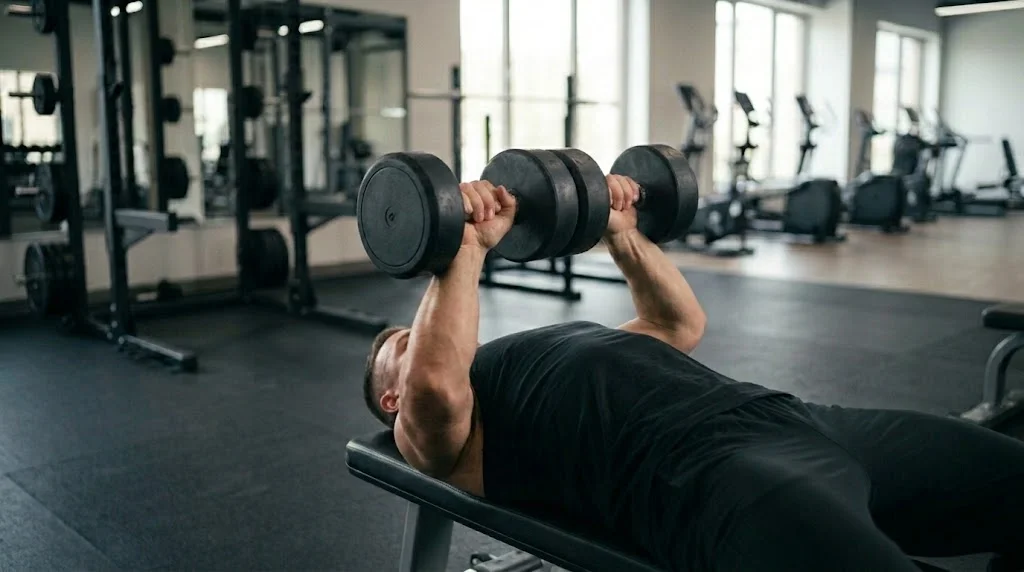
The dumbbell arc press is an incline chest press performed with two dumbbells on a 45-degree bench that trains the upperchestby pressing the weights up and inward along a curved path. Where a standard incline press drives the dumbbells straight up, the arc press starts them wide at shoulder level and sweeps them together over the face, so the pecs adduct the arms while they press. It sits between a fly and a press: more load than a fly, more inner-chest squeeze than a press. Lifters program it as a second chest movement after their heaviest press.
What Muscles Does the Dumbbell Arc Press Work?
- Primary: Pectoralis major, clavicular head (upper chest)
- Secondary: Anterior deltoid, triceps brachii, pectoralis major sternal head
- Tertiary: Serratus anterior, biceps brachii (long head), rotator cuff, forearm flexors
How Do You Set Up for the Dumbbell Arc Press?
Set the bench to about 45 degrees and sit with a dumbbell on each thigh. Plant your feet wider than your hips, then lie back so your glutes, upper back and head touch the pad. Kick the dumbbells to shoulder level with your palms facing forward, elbows bent to about 90 degrees and slightly below shoulder height. Pull your shoulder blades down and together. Tension starts with the dumbbells wide, level with your upper chest.
How Do You Perform the Dumbbell Arc Press?
- Set the elbows below the dumbbells with your forearms vertical and the weights wide at upper-chest level.
- Press up and inward so each dumbbell traces a quarter circle toward the midline above your face.
- Touch the dumbbells together at the top with your arms straight over your upper chest; the touch tells you the arc is complete.
- Squeeze the inner chest for one count while pushing the dumbbells against each other.
- Lower along the same curve, letting the dumbbells separate as the elbows bend and drift back to shoulder level.
- Stop at the wide bottom position with forearms vertical, then begin the next arc.
What Are the Key Form Cues?
- Hug a barrel on the way up: think of wrapping your arms around something round, so the press and the squeeze happen together.
- Keep the elbows under the weights: the dumbbells should stay stacked over the elbows through the curve, not swing ahead of them.
- Drive your upper back into the pad as you press so the shoulders stay behind the chest.
- Turn your pinkies slightly toward each other near the top to finish the pec contraction.
- Feel the stretch across the upper chest at the wide bottom before you reverse.
What Are the Most Common Mistakes?
- Using dumbbells sized for the incline press: the arc collapses into a straight press because the inward sweep is weaker, so drop the load until the weights meet every rep.
- Clanging the dumbbells together at the top: momentum does the last inch of adduction and the pecs lose the squeeze, so bring the weights together slowly and press them.
- Dropping the elbows far below the bench at the bottom: the front of the shoulder is stretched under load in extension and external rotation, so stop the elbows just below shoulder height.
- Lifting the hips off the pad on the way up: the incline flattens and the load shifts to the mid-chest, so keep three points of contact.
- Bending the wrists back under the load: the dumbbells drift behind the forearm line, so keep the knuckles pointed at the ceiling.
What Are the Best Dumbbell Arc Press Variations?
- Flat bench dumbbell arc press: a flat bench shifts the sweep onto the sternal head for lifters new to the arc.
- Dumbbell squeeze press: the dumbbells stay pressed together through the whole rep, harder on the inner chest.
- Steep incline dumbbell arc press: a 60-degree bench moves the arc toward the anterior deltoid.
- Single-arm dumbbell arc press: one dumbbell crosses the midline while the trunk resists the twist.
- Cable crossover press: a low cable pair gives the same curved path with constant tension.
How Do You Progress the Dumbbell Arc Press?
- Add 5 pounds per dumbbell once you touch the weights together on every rep of every set.
- Work between 8 and 12 reps; add a rep each session until you hit 12, then add load and return to 8.
- Begin with 3 sets and add a fourth once the last set still reaches the top cleanly.
- Add a 2-second squeeze at the top before adding weight again.
How Should You Program the Dumbbell Arc Press?
Run the dumbbell arc press as the second chest movement of a push or chest session, after a barbell or dumbbell bench press. One or two sessions a week is enough. Do 3 to 4 sets of 8 to 12 reps with 60 to 90 seconds of rest. Pair it with a row or a rear-delt raise between sets to keep the shoulders balanced while the chest recovers.