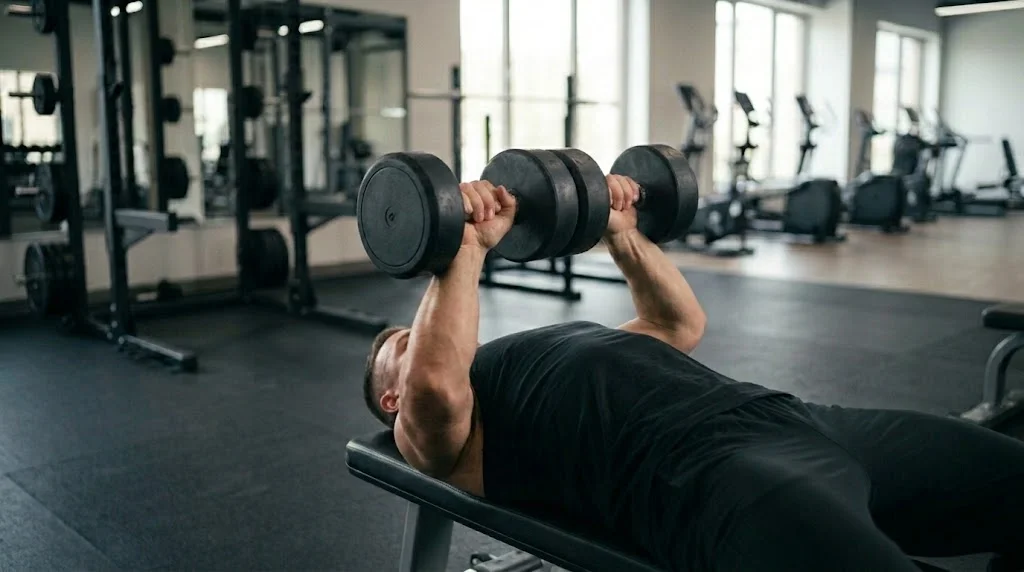
The dumbbell bench press with neutral grip is a flat-bench compound press performed with the palms facing each other and the elbows tucked, training the chest and triceps together. Turning the handles parallel to your torso puts the shoulder in mid-rotation, so the upper arms travel at about 45 degrees from the ribs instead of flaring wide, and the triceps share more of the press than in a standarddumbbell bench press. The wrist stays neutral and the handles can touch at the top. Program it as a main press for lifters whose shoulders dislike a pronated grip.
What Muscles Does the Dumbbell Bench Press with Neutral Grip Work?
- Primary: Pectoralis major (sternal head, mid chest)
- Secondary: Triceps brachii, anterior deltoid (front shoulder)
- Tertiary: Serratus anterior, rotator cuff, forearm flexors
How Do You Set Up for the Dumbbell Bench Press with Neutral Grip?
Set a bench flat and sit on the end with a dumbbell on each thigh. Lie back, kick the dumbbells up one at a time, then turn the handles parallel to your body so your palms face each other. Plant your feet flat, pull your shoulder blades into the pad, and set your elbows about 45 degrees from your ribs. Hold the dumbbells over your mid chest, arms straight, handles a few inches apart.
How Do You Perform the Dumbbell Bench Press with Neutral Grip?
- Set your elbows at roughly 45 degrees from your torso and keep the handles parallel to each other.
- Lower the dumbbells straight down toward the sides of your mid chest, forearms staying vertical over the elbows.
- Stop when the inner heads of the dumbbells reach chest level and your upper arms sit just below the bench.
- Pause for one count at the bottom with the shoulder blades still squeezed and the palms still facing in.
- Press up and slightly together until the handles nearly touch over your mid chest and the elbows straighten.
- Hold the top for a beat while the pecs squeeze the dumbbells inward, then lower again from the same start.
What Are the Key Form Cues?
- Crush the handles together: imagine squeezing the two dumbbells into one through the whole press so the inner chest keeps working.
- Forearms like pillars: keep each forearm vertical from the side view so the load stays over the elbow rather than the wrist.
- Pull the dumbbells down with your back instead of letting them drop, and feel the lats take up slack at the bottom.
- Drive through the pinky side of the hand to keep the handles parallel as you fatigue.
- Keep the upper arms at the same angle from the ribs on every rep.
What Are the Most Common Mistakes?
- Loading it like a standard press: heavy dumbbells pull the palms outward into a pronated grip and the tuck disappears; pick a weight that keeps the handles parallel to the last rep.
- Tucking the elbows all the way to the ribs: the press becomes a triceps exercise and the chest stretch vanishes; hold the 45-degree angle.
- Letting the dumbbells drift toward the shoulders: the path over the face shifts the load onto the front of the shoulder joint; keep them over the mid chest.
- Clanging the dumbbells at the top: the impact unloads the pecs at the peak; stop with the handles an inch apart and squeeze.
- Arching the lower back off the bench to shorten the range: it hides a weight you cannot press flat; keep the hips and upper back down.
What Are the Best Dumbbell Bench Press with Neutral Grip Variations?
- Neutral grip dumbbell floor press: the floor stops the elbows early, a regression that teaches the tuck.
- Incline neutral grip dumbbell press: a 30-degree bench shifts the press onto the upper chest.
- Close grip dumbbell bench press: dumbbells touching throughout, so the inner chest and triceps carry more load.
- Single-arm neutral grip dumbbell press: one dumbbell at a time, the free hand on your ribs to fight rolling.
- Swiss bar bench press: angled handles reproduce the neutral grip with a fixed bar and heavier loads.
How Do You Progress the Dumbbell Bench Press with Neutral Grip?
- Move up 5 pounds a hand once you finish every set at the top of the range with the handles still parallel.
- Build from 8 reps to 12 per set before each weight jump.
- Add a fourth set when three no longer leave the chest and triceps fatigued.
- Add a two-second pause at the bottom, or lower the dumbbells slightly below chest level for a longer stretch.
How Should You Program the Dumbbell Bench Press with Neutral Grip?
Use the dumbbell bench press with neutral grip as the first or second press of a chest or upper-body day, once or twice a week. Work 3 to 4 sets of 6 to 12 reps with 90 to 120 seconds of rest, keeping the load one where the handles stay parallel on every rep. It pairs with a cable fly afterwards to add the wide stretch the tucked elbows leave out.