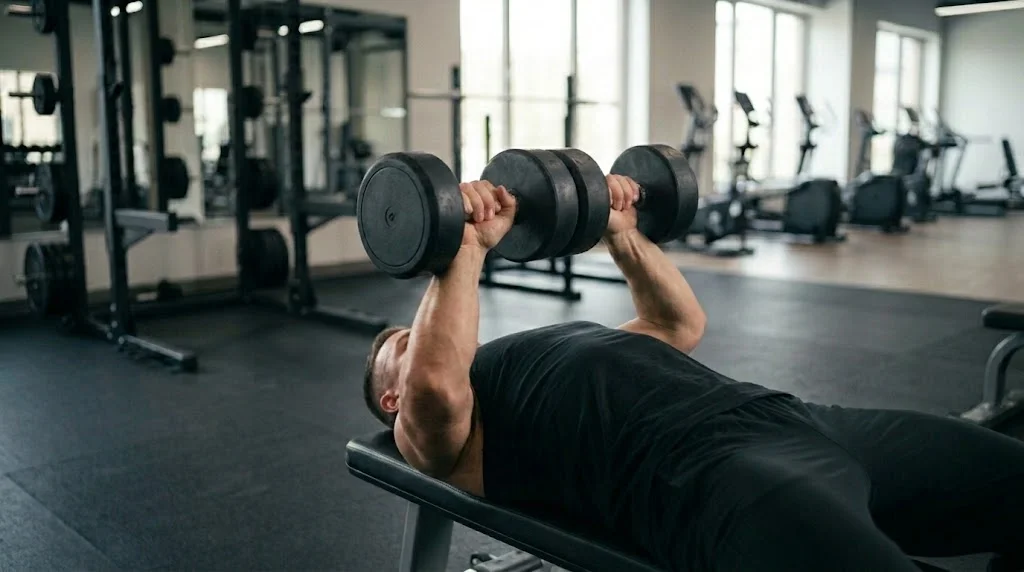
The shoulder fly is a standing dumbbell isolation exercise that raises both arms out to the sides in a wide arc to train the lateral deltoid from hip to shoulder height. It is the fly-style version of the lateral raise: the elbows stay almost straight and the dumbbells travel on a long radius, so the lever is longer and the load on the side delt peaks hard in the top third of the arc. Lifters program it as a light, high-repshoulderaccessory after overhead pressing.
What Muscles Does the Shoulder Fly Work?
- Primary: Lateral deltoid (side delt)
- Secondary: Anterior deltoid (front delt), supraspinatus (rotator cuff)
- Tertiary: Upper trapezius, serratus anterior, wrist extensors (forearm)
How Do You Set Up for the Shoulder Fly?
Pick a pair of light dumbbells, lighter than you would press with by a wide margin. Stand with your feet hip-width apart and your knees soft. Let the dumbbells hang at the front of your thighs with your palms facing your legs and a slight bend in each elbow. Pull your shoulder blades down, lift your chest and look straight ahead. Tension starts when the dumbbells float a few inches off your thighs.
How Do You Perform the Shoulder Fly?
- Set your elbows at a small, fixed bend and tilt your torso forward by a few degrees from the hips.
- Sweep both dumbbells out to the sides in one wide arc, keeping your arms long and your hands in line with your shoulders.
- Stop when your arms are parallel to the floor; your elbows sit level with your shoulders and your pinkies level with your thumbs.
- Hold the top for one count, feeling the side delt carry the full length of the arm.
- Lower the dumbbells on a slow arc back toward your thighs, resisting gravity the whole way.
- Stop just short of your thighs with the dumbbells still floating, then begin the next rep from the same forward tilt.
What Are the Key Form Cues?
- Reach the dumbbells away from you: make your arms as long as possible on the way up so the fly stays a wide arc, not a shrug.
- Pour the water out at the top: a slight thumbs-down tilt as the arms reach parallel keeps the side delt in charge.
- Keep the dumbbells slightly in front of your hips on the way up rather than dead to the side.
- Feel your shoulder blades stay low while your arms rise; the traps stay quiet below shoulder height.
- Let the descent take twice as long as the lift.
What Are the Most Common Mistakes?
- Going too heavy: the knees dip and the torso rocks to sling the dumbbells up, turning the fly into a momentum swing, so drop to a weight you can pause at parallel on every rep.
- Bending the elbows as the weight rises: the lever shortens and the rep becomes an upright row for the traps, so lock in the small elbow bend before the set.
- Raising the arms above shoulder height: the upper traps take over once the elbows pass parallel, so stop at level and squeeze.
- Leading with the thumbs: the palms turn up, the front delt takes over and the arc drifts forward, so keep the pinkies level with the thumbs.
- Dropping the dumbbells to a dead stop on the thighs: the delt unloads between reps, so stop a few inches short.
What Are the Best Shoulder Fly Variations?
- Seated shoulder fly: sitting on a bench removes the leg drive, a regression for learning the arc.
- Cable shoulder fly: a low pulley loads the bottom of the arc, for lifters who feel nothing until parallel.
- Dumbbell lateral raise: a more bent elbow and shorter lever, so you can use more load.
- Single-arm leaning shoulder fly: holding a rack and leaning away lengthens the bottom range for one side at a time.
- Incline prone shoulder fly: lying chest-down on a 45-degree bench shifts the arc toward the rear delt.
How Do You Progress the Shoulder Fly?
- Move up 2.5 pounds a hand once you can pause every rep at parallel for a full count without a torso rock.
- Work 12 to 20 reps; add 2 reps a session until you reach 20, then add load and drop back to 12.
- Start at 3 sets and add a fourth once the last set still reaches parallel on every rep.
- Slow the lowering phase to a 3-second count before touching the load again.
How Should You Program the Shoulder Fly?
Place the shoulder fly late in a shoulder or push session, after overhead presses and any heavier upright pulling. Two to three sessions a week works because the light load recovers quickly. Perform 3 to 4 sets of 12 to 20 reps with 45 to 60 seconds of rest. Pair it with a rear delt fly on the same day so the side and back of the shoulder are trained together.