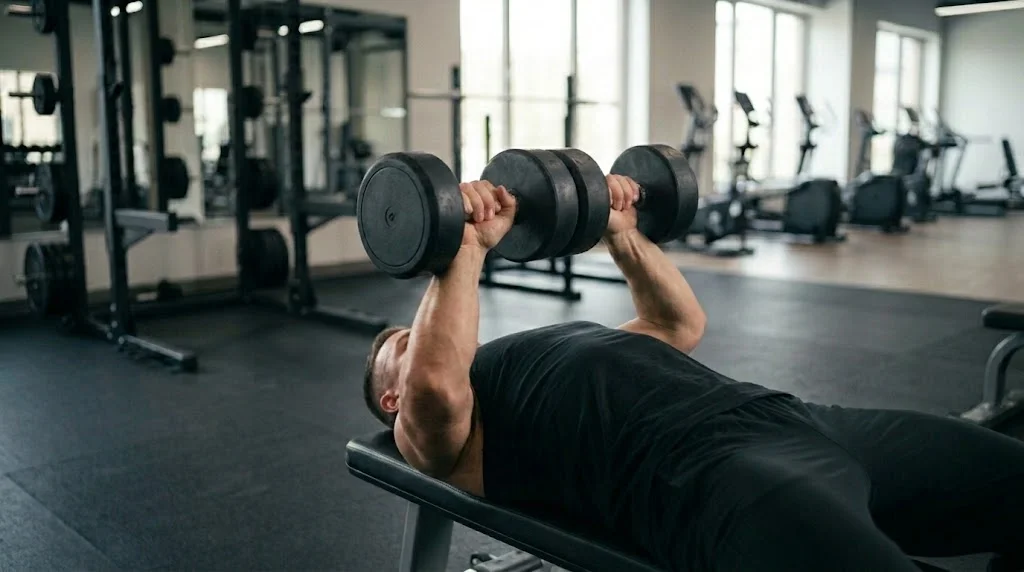
The elevated push-up is a bodyweight pressing exercise performed with the hands on a bench or box and the feet on the floor, training the chest and triceps at a reduced load. Raising the hands tilts the body toward upright, so a smaller share of your bodyweight sits on the arms and the press angles upward like an incline press. The higher the surface, the lighter the rep, which makes the height itself the loading dial. Lifters use it to build toward a floorpush-upor as a high-rep chest finisher.
What Muscles Does the Elevated Push-Up Work?
- Primary: Pectoralis major (chest), triceps brachii
- Secondary: Anterior deltoid (front delt), serratus anterior
- Tertiary: Rectus abdominis, gluteus maximus, quadriceps
How Do You Set Up for the Elevated Push-Up?
Choose a flat bench or box that will not slide. Place your hands on the edge slightly wider than shoulder width, fingers pointing forward, and walk the feet back until your arms are straight and your body forms one line from heels to head. Set the feet hip width apart on the balls of the toes, squeeze the glutes, tuck the ribs, and look at the bench just ahead of your hands.
How Do You Perform the Elevated Push-Up?
- Set the plank with the hands under the shoulders, arms straight, glutes and abs braced.
- Bend the elbows and lower the chest toward the bench, elbows travelling back at about 45 degrees from the torso.
- Stop when the chest is a fist width from the edge, the upper arms roughly level with the torso.
- Pause for one count at the bottom without letting the hips sag or the head drop.
- Press through the palms until the elbows lock, keeping the body line straight.
- Reset the shoulders by spreading the shoulder blades at the top, then begin the next rep.
What Are the Key Form Cues?
- Push the bench away: at lockout, spread the shoulder blades so the serratus finishes the rep rather than the elbows alone.
- One long plank: hold the glutes and abs on so the hips neither pike up nor sag from the top of the rep to the bottom.
- Screw the palms into the bench to keep the elbows from flaring.
- Lead the descent with the chest, not the chin.
- Lower for two counts and press in one.
What Are the Most Common Mistakes?
- Choosing a surface so high the rep costs nothing: the chest barely loads, so drop to a lower bench or box once 15 reps feel easy.
- Sagging the hips toward the floor: the lower back extends under the weight of the trunk and the abs quit, so squeeze the glutes before each rep.
- Flaring the elbows straight out: the front of the shoulder takes the load at the bottom, so keep the elbows around 45 degrees.
- Cutting the depth short: the chest never reaches the stretch that drives the press, so lower until the chest is a fist width from the bench.
- Poking the chin forward at the bottom: the neck arches and the chest stops short, so keep the gaze on the bench and lead with the sternum.
What Are the Best Elevated Push-Up Variations?
- Wall push-up: hands on a wall standing nearly upright, the lightest load for a first rep.
- Floor push-up: the same movement with the hands on the ground, the standard progression.
- Elevated close-grip push-up: hands a palm width apart on the bench, loading the triceps.
- Single-leg elevated push-up: one foot lifts off the floor, raising the trunk and hip demand.
- Elevated push-up on push-up bars: bars set on a box let the chest sink past the hands for a longer range.
How Do You Progress the Elevated Push-Up?
- Lower the surface by one step, from a bench to a low box to the floor, once you complete every set at 15 clean reps.
- Work from 8 reps per set up to 15 before dropping the height.
- Start at 3 sets and add a fourth when the last set still reaches full depth.
- Add a 2-second pause at the bottom, or a 3-second lowering, before changing the height.
How Should You Program the Elevated Push-Up?
Program the elevated push-up as the main press for a beginner or as a bodyweight finisher after dumbbell presses for a trained lifter, two to three times a week. Do 3 to 4 sets of 8 to 15 reps with 60 to 90 seconds of rest between sets. Pair it with an inverted row or a band row so the back gets pulled in the same session.